April 21: Second Trial on Insurrection Charges
Special Forces Commanders Testify Again, Maintain Consistent Statements on "Removing Lawmakers"
Referencing Yoon's Famous "Tough Prosecutor" Remark, Commanders Challenge Legitimacy of Orders
Kim Hyungki: "My subordinates did nothing, and thanks to that, we were able to protect democracy"
Yoon's Six-Minute Statement: "Martial law is like a sword... Using a sword does not always mean murder" - a fallacious argument
Military officers who appeared as witnesses at the second criminal trial of former President Yoon Sukyeol on insurrection charges engaged in heated exchanges with Yoon's legal team. Unlike the first trial, which was held on April 14, the second trial was largely filled with cross-examination by Yoon's defense. However, the military officers maintained consistency with their previous testimonies. In particular, Kim Hyungki, commander of the 1st Special Forces Battalion of the Army Special Warfare Command, drew attention when he stated, "I do not pledge loyalty to individuals. I have always been loyal to the organization, and that organization has tasked me with protecting the nation and its people." Unlike the first trial, where Yoon spoke for 93 minutes in a raised voice, he only spoke for six minutes during the second trial, which was the first to be open to the media.
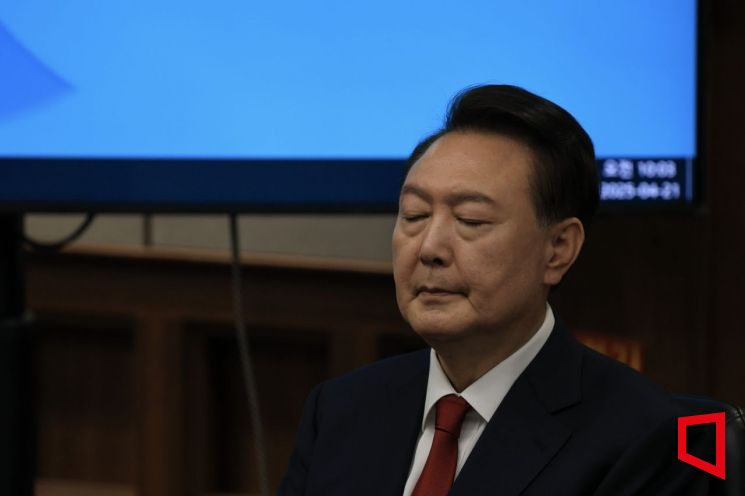 Former President Yoon Sukyeol is attending the second formal trial on charges of leading a rebellion at the Seoul Central District Court in Seocho-dong on the 21st. April 21, 2025 Photo by Joint Press Corps
On April 21, the 25th Criminal Division of the Seoul Central District Court (presiding judge Ji Guyoun) held the second trial for former President Yoon, who is charged with being the ringleader of an insurrection, in courtroom 417. The court conducted cross-examinations of Cho Sunghyun, commander of the 1st Security Battalion of the Capital Defense Command (Colonel), and Kim Hyungki, commander of the 1st Special Forces Battalion of the Army Special Warfare Command. These two officers were key field commanders who led military forces deployed to the National Assembly during the December 3 Martial Law, and they reiterated their previous testimonies given during direct examination by the prosecution.
Commander Kim testified that he understood the order to "remove the lawmakers" as coming from former President Yoon and said the instruction was so unusual that it could not be followed in the field. He stated, "I have served in the military for 23 years, and the one thing that has not changed, past or present, is the mission to protect the nation and its people," emphasizing that he does not pledge loyalty to individuals. By referencing Yoon's famous statement, "I do not pledge loyalty to individuals," which Yoon made during a National Assembly audit in October 2013 after facing difficulties investigating the National Intelligence Service's online comment scandal as a prosecutor, Kim clarified his own position. The incident cemented Yoon's reputation as a "tough prosecutor" and paved the way for his rise to the presidency. During the trial, Yoon, who had been sitting with his eyes closed and expressionless, looked directly at Commander Kim when he made this statement.
Commander Kim also asked to be punished for insubordination and called for vigilance to prevent the military from being used for political purposes again. He said, "Some have accused me of insubordination," and added, "How was I supposed to carry out the mission I received on December 4 last year? I would rather be punished for insubordination. My subordinates did nothing, and as a result, nothing happened. Thanks to that, we were able to protect democracy." He continued, "I hope those of you in the back (referring to the press) will continue to criticize, reprimand, and monitor so that the military is never again used for political purposes. Only then can we prevent this from happening again."
Earlier, Yoon's legal team also challenged the credibility of Commander Cho Sunghyun's testimony, but Cho stood firm once again. Yoon's attorney, Song Jin-ho, asked whether the order to "remove the lawmakers" was feasible as a military operation and suggested that Cho may have made an independent judgment in the field. Cho replied, "I don't know why such an impossible order was given." Despite repeated attacks from Yoon's team, Cho responded, "There is no such thing as an order to remove lawmakers in military operations, so why was it given? You know this well..." As similar questions were repeated, Cho protested, and the court noted, "The witness makes a valid point. The trial could be delayed."
Yoon: "Martial law is like a sword... Using a sword does not always mean murder"?a fallacious argument
During his second criminal trial, Yoon argued, "Martial law is value-neutral in itself and is merely a legal tool at the president's disposal." He repeated his claim from the first trial that the emergency martial law was a "messaging martial law" intended as a warning to the opposition. Yoon spoke for six minutes during this trial.
Given the opportunity to speak by the court, Yoon stated, "A sword can be used to cook food, gather firewood in the mountains, perform surgery on a sick patient, or commit crimes such as threats or assault. If you are going to judge this from the perspective of insurrection, you cannot simply equate the use of a sword with murder in a formulaic way." He continued, "Would it be acceptable to permanently or for a significant period disable only the National Assembly? All constitutional institutions must be simultaneously neutralized and seized, and only if this is proven to be a coup for long-term dictatorship and constitutional disorder should it be considered as such. Martial law is just one means to that end."
Yoon also argued, "No one was hurt or blood was shed, and from the beginning, we did not arm the troops and deployed only a small number of forces, taking this into consideration." He added, "When the country is in a state of emergency, the only way for the president to declare it is through emergency martial law." Yoon stated, "If you are going to claim that this was a disruption of the constitutional order, the trial must fundamentally address the political plan, the plan for seizing power, and how the military was intended to be used to achieve this. Only then can the truth of the insurrection charge be determined. I believe the order of issues to be addressed in this trial should proceed as the defense has argued."
In the latter part of the trial, Yoon expressed dissatisfaction, criticizing the trial process by saying that "many witnesses are testifying based on hearsay," and was admonished by the court. He said, "If the court is focusing on the insurrection charge and has established the legal theory and logic, there is no need to cross-examine witnesses on irrelevant matters. Written statements are a form of hearsay evidence, and if the defendant does not agree, they cannot be used as evidence and the witness must be brought to court. But is there any need to hear from expert witnesses in a court trial?" The court responded firmly, "The court has a clear understanding of the substantive legal principles of the insurrection charge. If the defendant and defense counsel have doubts about that, they are mistaken."
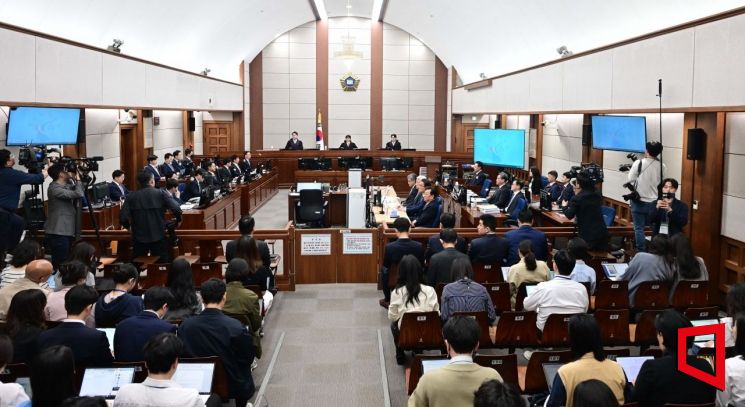 Former President Yoon Seokyoul, who was indicted on charges of leading an insurrection by declaring emergency martial law on December 3, is sitting in courtroom 417 at the Seoul Central District Court in Seocho-gu, Seoul, on the morning of April 21, 2025, waiting for the trial to begin. Photo by Joint Press Corps
Yoon's insurrection ringleader trial expected to continue at least until year-end... December dates also set
The trial of former President Yoon on charges of being the ringleader of an insurrection is expected to continue at least until the end of this year. On this day, the court scheduled dozens of trial dates through the end of the year, at a pace of three to four times per month. A total of 28 trial dates were confirmed during this hearing, including three in December?on the 4th, 15th, and 22nd. The court stated, "We need to hold about three sessions every two weeks," and announced that about 10 additional dates would be added to the schedule after considering both sides' opinions. The court's decision to schedule trial dates through year-end is seen as a sign of its determination to see the case through to the end. Since most of the witnesses in this case have already been confirmed, rather than being "expansive" witnesses who might increase the number of parties involved, it was possible to set the schedule through year-end.
The third hearing will be held on May 12. At the third hearing, Park Junghwan, chief of staff of the Special Warfare Command, and Oh Sangbae, adjutant to the commander of the Capital Defense Command, will be examined as witnesses. Meanwhile, Yoon's legal team has requested that Choi Jaehae, chairman of the Board of Audit and Inspection, Park Sungjae, Minister of Justice, Lee Changsoo, chief prosecutor of the Seoul Central District Prosecutors' Office, Lee Sangmin, former Minister of the Interior and Safety, and Baek Jongwook, former third deputy director of the National Intelligence Service, be called as witnesses to demonstrate the necessity of declaring emergency martial law. The defense also announced plans to request verification of the National Election Commission's system and to petition the Ministry of National Defense's Joint Chiefs of Staff to send official documents regarding martial law-related statutes.
© The Asia Business Daily(www.asiae.co.kr). All rights reserved.
![Clutching a Stolen Dior Bag, Saying "I Hate Being Poor but Real"... The Grotesque Con of a "Human Knockoff" [Slate]](https://cwcontent.asiae.co.kr/asiaresize/183/2026021902243444107_1771435474.jpg)
















