Invited Humanities Lecture by Choi Sanggu
Highlighting Forced Mobilization, Discrimination, and the Repatriation Movement
On April 19, Gwangju Koryoin Village held a humanities lecture under the theme "The History of Sakhalin Koreans' Migration and Return." The lecture was delivered by Choi Sanggu, head of the Global Overseas Koreans Solidarity (KIN), who addressed the lives of Sakhalin Koreans, from forced mobilization during the Japanese colonial period to the repatriation movement and ongoing institutional challenges.
Choi began the lecture by defining Sakhalin Koreans as "Koreans who migrated to or were born in Sakhalin before August 15, 1945, as well as their spouses and direct descendants." He explained that these individuals were forcibly mobilized as laborers to support the Japanese imperial war effort and worked under harsh conditions, such as in coal mines and in the construction of airfields.
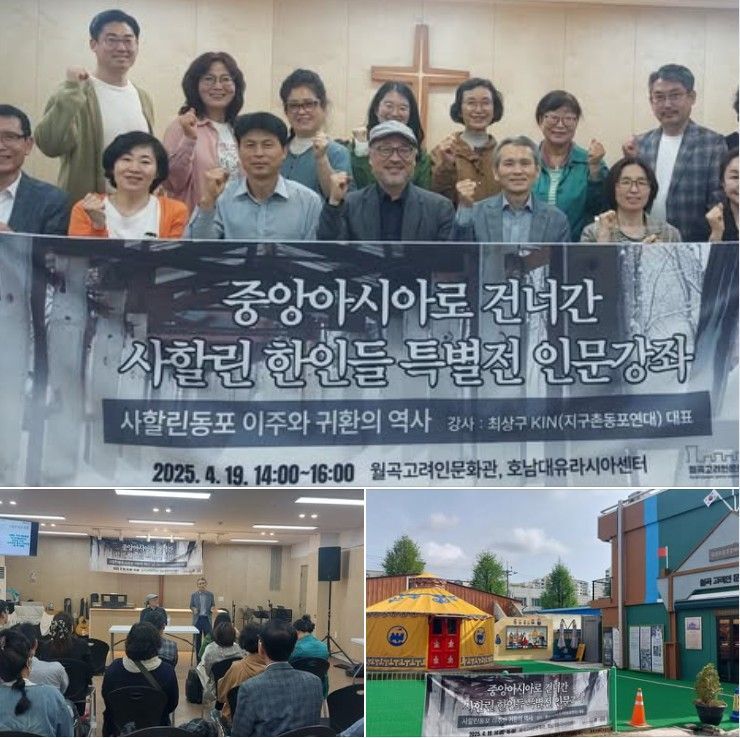 Gwangju Koryoin Village held a humanities lecture titled "The History of Sakhalin Koreans' Migration and Return" on the 19th at the Koryoin Village Community Center, organized by the Koryoin Cultural Center. Photo by Gwangju Koryoin Village
Even after liberation, their return was not easily achieved. The Soviet Union refused their repatriation in order to maintain its labor force, and Japan did not recognize them as its nationals. Amid ongoing disputes over nationality, many Koreans were unable to return home and continued their lives in a foreign land.
At the time, forced mobilization was carried out through both persuasion and pressure, with phrases such as "You only have to work for two years" and "At least one person from each household must go." After liberation, they were classified as "enemy nationals" within the Soviet Union and faced discrimination in migration, employment, promotion, and family maintenance.
Choi shared concrete examples of the repatriation movement among Sakhalin Koreans, including the case of about 1,000 Koreans who returned to Japan after marrying Japanese nationals in 1958; the activities of the "Hwathe Return First Korean Association" formed by Park Nohak, Lee Heepal, and Shim Gyesung; and the compilation of lists of those wishing to return through letter exchanges.
Since 2006, the Global Overseas Koreans Solidarity has accumulated records of the Sakhalin Korean community through local surveys, oral histories, cemetery investigations, and international symposiums. From 2007 to 2011, the organization identified 1,593 Korean graves at Yuzhno-Sakhalinsk No. 1 Cemetery. Since 2014, it has also worked to foster cultural connections by producing and distributing "The Only Calendar in the World."
These activities led to an institutional achievement in 2020 with the enactment of the "Special Act on Support for Sakhalin Koreans." However, Choi emphasized that "the current dual legal system, which separates Sakhalin Koreans from Koryoin in Central Asia, is causing institutional confusion," stressing the urgent need for integrated legal reforms and countermeasures.
© The Asia Business Daily(www.asiae.co.kr). All rights reserved.
![Clutching a Stolen Dior Bag, Saying "I Hate Being Poor but Real"... The Grotesque Con of a "Human Knockoff" [Slate]](https://cwcontent.asiae.co.kr/asiaresize/183/2026021902243444107_1771435474.jpg)















