"Let's Hold Out a Bit Longer":
Growing Possibility of Three Medical School Cohorts Attending Classes Together Next Year
Ongoing Disagreements Over the Composition of the Estimation Committee to Decide Post-2027 Quotas
Ministry of Health and Welfare Expresses Discomfort: "Regrettable to Change the Principle"
Although the number of medical school admissions for next year has been frozen at the pre-increase level, it is unlikely that residents who left hospitals and medical students who are refusing classes will return easily. There are also concerns that conflicts between the government and the medical community may reoccur due to disagreements over the composition method of the Health and Medical Workforce Supply and Demand Estimation Committee, which will decide the medical school quota after 2027.
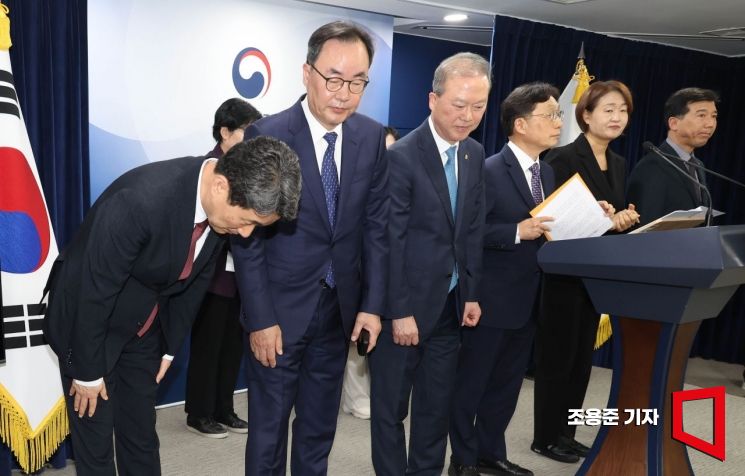 Lee Ju-ho, Deputy Prime Minister for Social Affairs and Minister of Education, is greeting after finishing a briefing on the adjustment direction of medical school admission quotas for the 2026 academic year at the Government Seoul Office in Jongno-gu, Seoul on the 17th. 2025.4.17 Photo by Jo Yong-jun
According to the medical community on the 18th, the government finalized the number of medical school admissions for the 2026 academic year at 3,058 the day before, and the medical community responded positively, but it is uncertain whether this will lead to the full return of medical students to their studies.
A first-year medical student A from the Chungcheong region said, "The minimum necessary condition for opening the negotiation table has been met, but it seems to be a somewhat insufficient measure to persuade students who are still refusing classes," adding, "First- and second-year medical students, who have an enormous academic workload, will not be able to keep up with the curriculum even if they return without measures such as implementing a flexible semester system."
Among some medical students, there is a movement to "hold out until the new government takes office." In this case, many students in several medical schools will inevitably fail due to insufficient attendance by the end of this month. The possibility of "tripling," where first-year medical students from the classes of 2024, 2025, and 2026 attend classes simultaneously, has also increased.
Residents who left training hospitals last year have still not returned. A resigned resident B said bluntly, "Freezing the medical school admissions is fortunate, but it is not a factor that will make residents return to training hospitals." Due to scheduling, there is realistically no way to return until the recruitment of interns and residents in the second half of this year. The Ministry of Health and Welfare stated, "Resident recruitment occurs twice a year, in the first and second halves, and currently, there are no plans for special training exceptions or additional recruitment."
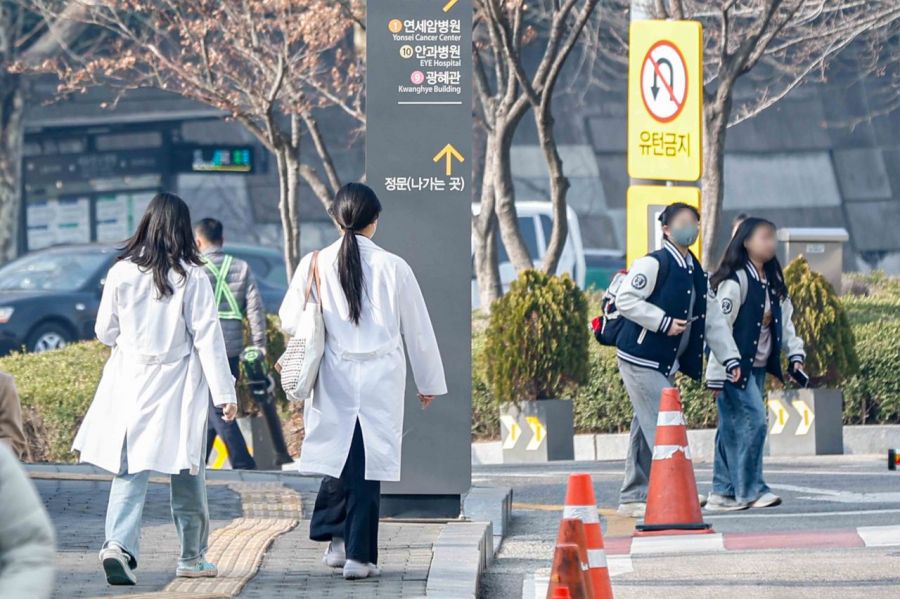 On the 21st, the deadline set by some medical schools including Yonsei University, Korea University, and Kyungpook National University for returning approached, and students were moving at Yonsei University College of Medicine in Seodaemun-gu, Seoul. 2025.3.21. Photo by Kang Jin-hyung
According to the partial amendment to the Basic Health and Medical Services Act passed by the National Assembly on the 3rd of this month, the medical school quota after the 2027 academic year will be decided through the Estimation Committee, but medical organizations still oppose the structure and composition of the committee. This is because the Estimation Committee itself is a subordinate organization of the Health and Medical Policy Deliberation Committee (HMPDC), chaired by the Minister of Health and Welfare, making it impossible to guarantee independence.
Kim Seong-geun, spokesperson for the Korean Medical Association, said, "The proposal to discuss quotas in the Estimation Committee was a suggestion from the medical community, but when looking at the actual law, it is very different from what was proposed," adding, "It is a structure where the government can decide as it pleases, and there is no safeguard to ensure that the government must follow the Estimation Committee's discussions."
The Ministry of Health and Welfare, which has been promoting the medical school quota increase policy for the past 14 months, expressed discomfort and said it was "regrettable" about the Ministry of Education's decision to reset the increase. This is because the Ministry of Education overturned its own principle even though the prerequisite of "full return of all medical students," which was the premise for zero increase, was not met.
A Ministry of Health and Welfare official said, "While the academic schedule of medical schools has not been fully normalized, I think this is a measure considering the educational environment, but I regret that the principle for deciding the 2026 medical school admissions announced in early March has been changed."
© The Asia Business Daily(www.asiae.co.kr). All rights reserved.
![Clutching a Stolen Dior Bag, Saying "I Hate Being Poor but Real"... The Grotesque Con of a "Human Knockoff" [Slate]](https://cwcontent.asiae.co.kr/asiaresize/183/2026021902243444107_1771435474.jpg)
















