Average Support for Single-Child Families Is 30,000 Won
Multi-Child Families Receive 910,000 Won
Educational Groups Call for Universal Welfare
Office of Education Says "Following Government Guidelines"
The educational welfare program 'Kkum Dreami', operated by the Gwangju Metropolitan Office of Education, is facing growing controversy over fairness as the benefits vary depending on the number of siblings in a family. Educational organizations have demanded a comprehensive overhaul of the system, stating that "single-child families are effectively being excluded."
On the afternoon of the 17th, the Gwangju Education Civic Solidarity held a press conference in front of the Gwangju Office of Education, asserting, "The representative educational welfare program 'Kkum Dreami' is undermining fairness and equity, contrary to its original intent," and insisted, "Support should be provided to students from all families, regardless of the number of children."
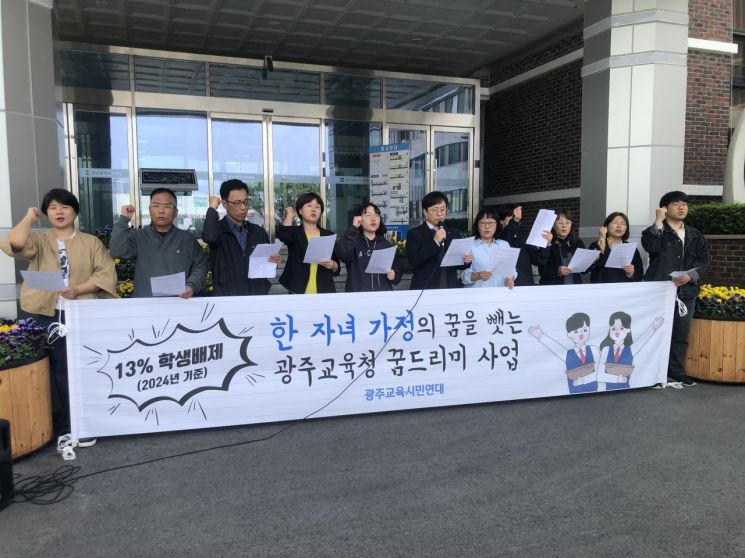 On the morning of the 17th, the Gwangju Education Citizens' Coalition held a press conference in front of the Gwangju Metropolitan Office of Education, pointing out the fairness issues of the "Kkumdreami" project and urging for system improvements. Provided by Gwangju Education Coalition
'Kkum Dreami' is a student education expense support program promoted by the Gwangju Office of Education, providing up to 1 million won per person to middle and high school students (grades 2-3) from multi-child families (two or more children), low-income households, and multicultural or North Korean defector families.
The Office of Education initially envisioned a universal welfare model for all middle and high school students, but explained that during discussions with the Ministry of Health and Welfare, the program was adjusted to a selective welfare model. As a result, students from single-child families are now only eligible for limited support for beneficiary-burdened items.
According to the Civic Solidarity, as of 2024, the average support for single-child families was only about 30,000 won, while 87% of all eligible students received an average of 910,000 won.
In addition to the simple difference in amount, multi-child families are eligible for support regardless of income, whereas single-child families must meet conditions such as having an income below 120% of the median to receive limited benefits.
The Civic Solidarity criticized, "It is hard to accept that eligibility for support is determined solely by the number of siblings," and added, "There is a welfare gap emerging among students attending the same classes in the same classrooms."
They also stated, "Parents who are excluded from support are expressing complaints and a sense of loss, and teachers are suffering from various paperwork burdens," claiming that "the program has even fostered a sense of alienation within public education."
On this day, the group demanded: ▲ a transition of the Kkum Dreami program to universal welfare ▲ an apology from Superintendent Lee Jungseon ▲ the establishment of concrete improvement measures, and submitted a petition to the Office of Education signed by 173 parents from single-child families.
In response, the Office of Education stated, "Despite repeated explanations of the program's process and purpose, the same claims continue to be raised," and added, "Kkum Dreami is a program with significant positive effects in reducing the burden of student education expenses, and we will continue to work with the Ministry of Health and Welfare to expand eligibility."
© The Asia Business Daily(www.asiae.co.kr). All rights reserved.
![Clutching a Stolen Dior Bag, Saying "I Hate Being Poor but Real"... The Grotesque Con of a "Human Knockoff" [Slate]](https://cwcontent.asiae.co.kr/asiaresize/183/2026021902243444107_1771435474.jpg)















