Air Force Establishes Safety Measures
to Prepare for Abnormal Situations
The South Korean and U.S. Air Forces will conduct 'Freedom Flag,' a large-scale joint air training exercise involving more than 90 air combat assets.
The Air Force announced on the 17th that the two countries' air forces will conduct the Freedom Flag exercise until May 2. The two air forces have integrated the combined squadron comprehensive training (KFT) and Vigilant Defense exercises, which were previously held twice a year, into the Freedom Flag exercise since last year, conducting it twice annually.
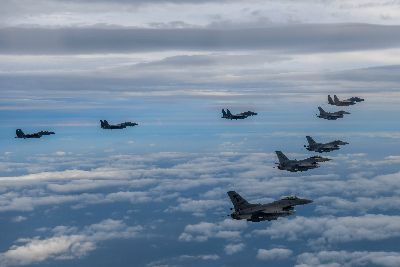
The name Freedom Flag combines 'Freedom,' symbolizing the core values of the Korea-U.S. alliance and liberal democracy, with 'Flag,' commonly used in air force joint exercises, conveying the meaning of 'protecting freedom and peace through the strong combined defense posture of the Korea-U.S. Air Forces.'
This exercise involves approximately 90 Korea-U.S. air combat assets, including South Korea's F-35A, F-15K, KF-16, FA-50, F-5, KA-1, KC-330, C-130, CN-235, E-737, and the U.S. Air Force's F-16, EA-18G, E-3G, KC-135, MQ-9, as well as the U.S. Marine Corps' F-35B, along with about 1,100 operational and support personnel.
Many of the participating forces from both countries will deploy to Gwangju Air Base on the day of the exercise to begin preparations. Additionally, during the exercise period, both air forces will operate a 24-hour Mission Planning Cell (MPC). Korea-U.S. mission personnel will exchange the latest tactics and know-how in the MPC and work to advance wartime operation and mission execution procedures.
The Korea-U.S. Air Forces plan to strengthen interoperability and cultivate capabilities for combined wartime mission execution through this exercise. They will also focus on reviewing and mastering the latest tactical electronic procedures reflecting changes in the modern operational environment. During the exercise, the two air forces will perform key air operation missions such as ▲Air Interdiction (AI), ▲Defensive Counter Air (DCA), ▲Airborne Intercept (X-INT), ▲Combat Search and Rescue (CSAR), and ▲Close Air Support (CAS), mastering wartime operational procedures and assessing sustained operational capabilities.
Notably, this exercise will mark the first time that fifth-generation fighters such as the Korea-U.S. Air Forces' F-35A/B will perform the role of Red Air (RA). These aircraft will conduct electronic attacks and maneuvers to evade friendly forces' (Blue Air) radar detection and simulate various threat scenarios to enhance pilots' realistic combat skills. Furthermore, the participation of U.S. Air Force unmanned aerial vehicles such as the MQ-1 and MQ-9 will be expanded to increase integrated training opportunities between manned and unmanned aerial assets and improve operational proficiency.
Meanwhile, the Air Force has prepared safety measures in anticipation of various abnormal situations such as adverse weather conditions, given the large scale of air power involved in the exercise. In the command and control domain, overall missions will be reviewed, flight preparation verification procedures will be strengthened, and training will be controlled more precisely. In the air traffic control domain, two dedicated control teams will operate simultaneously, working to prevent large-scale air traffic congestion through proactive information sharing and striving for stable flight operations.
Colonel Im Won-ho, Commander of the 192nd Integrated Weapons Flight Squadron, 29th Tactical Development and Training Wing of the Air Force, stated, "This exercise will serve as an opportunity to further solidify the combined defense posture and develop joint response capabilities against various threats on future battlefields," adding, "The Korea-U.S. Air Forces will continue to enhance combined operational capabilities through rigorous, realistic training."
© The Asia Business Daily(www.asiae.co.kr). All rights reserved.
![Clutching a Stolen Dior Bag, Saying "I Hate Being Poor but Real"... The Grotesque Con of a "Human Knockoff" [Slate]](https://cwcontent.asiae.co.kr/asiaresize/183/2026021902243444107_1771435474.jpg)















