MOLIT Announces Legislative Notice... Until May 28
"Efforts to Stabilize Fast-Track Maintenance Projects"
The Ministry of Land, Infrastructure and Transport (MOLIT) has initiated amendments to subordinate laws to lower the threshold for promoting redevelopment and reconstruction projects. The new regulations will include unauthorized buildings in the criteria for aged buildings and establish new reconstruction diagnosis standards that reflect residents' inconveniences.
On the 17th, MOLIT announced that it will publicly notify the draft amendments to the Enforcement Decree of the Urban and Residential Environment Improvement Act and the reconstruction diagnosis standards starting from the 18th. This amendment is a follow-up measure to the 2025 MOLIT work plan and the 'Regional Construction Economy Supplement Plan.' The draft amendments will be open for public comment for 40 days until May 28. The 'reconstruction diagnosis standards' and others will be separately announced for administrative notice for 20 days until May 8.
The current Enforcement Decree of the Urban Improvement Act stipulates that for the designation of redevelopment maintenance zones, aged or poor buildings over 30 years old must constitute at least 60% of the total. However, unauthorized buildings have been excluded from the aging calculation. The new amendment includes unauthorized buildings constructed before January 24, 1989, to eliminate blind spots in the system and facilitate project promotion.
For reconstruction projects, the existing 'safety diagnosis' will be renamed 'reconstruction diagnosis,' and the timing of the diagnosis will be adjusted to before project approval. This aims to reduce delays in project commencement caused by failing the diagnosis despite significant resident inconvenience.
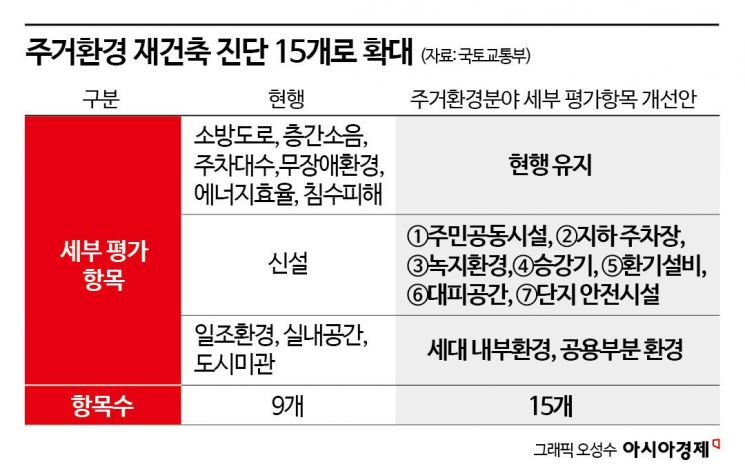
The diagnosis criteria will also change. Currently, scores are assigned based on four categories: structural safety, residential environment, equipment aging, and cost analysis. However, there have been criticisms that the residential environment category does not sufficiently reflect residents' inconveniences. The amendment subdivides the residential environment category by adding seven new items, including community facilities, underground parking, and green environment. Existing items such as sunlight, indoor space, and urban aesthetics are reorganized into 'internal household environment' and 'common area environment.' Evaluations will be graded from A to E according to standards presented by the Korea Agency for Infrastructure Technology Advancement.
The weighting of scores will also be adjusted. The weight of the residential environment category will increase from 30% to 40%, and cost analysis may be excluded from the evaluation. Residents can still opt to include cost analysis in the diagnosis if they wish. Previously, the weighting ratio for structural safety: residential environment: equipment aging: cost analysis was 3:3:3:1, but it will change to 3:4:3 going forward.
If a reconstruction diagnosis fails and a re-diagnosis is required, the diagnosis report prepared within three years can be reused. This measure aims to reduce the time and cost burden associated with diagnosis.
Kim Heon-jeong, Director of Housing Policy at MOLIT, stated, "We expect that redevelopment projects in aged areas will proceed more smoothly and that residents' inconveniences will be well reflected during the reconstruction diagnosis process. We will continue to incorporate field opinions to eliminate regulatory blind spots and stabilize the fast-track maintenance projects."
The full text of the draft amendments can be found on the MOLIT website under 'Policy Data - Legal Information - Legislative Notice & Administrative Notice.' Opinions can be submitted via mail, fax, or through the MOLIT website.
© The Asia Business Daily(www.asiae.co.kr). All rights reserved.
![Clutching a Stolen Dior Bag, Saying "I Hate Being Poor but Real"... The Grotesque Con of a "Human Knockoff" [Slate]](https://cwcontent.asiae.co.kr/asiaresize/183/2026021902243444107_1771435474.jpg)















