After Eight Days, Constitutional Court Grants Injunction on Han's Nominations
Effect of Nominations Suspended Until Constitutional Complaint Ruling
Court: "Risk of Irreparable Serious Harm... Urgent Need Recognized"
Four Possible Scenarios Remain After Injunction Pending Constitutional Court Decision
On the 16th, the Constitutional Court accepted a provisional injunction request to suspend the effect of Prime Minister and Acting President Han Deok-su's nomination of Lee Wan-gyu, Director of the Legislation Bureau, and Ham Sang-hoon, Chief Judge of the Seoul High Court, as successors to Justices Moon Hyung-bae and Lee Mi-seon, who will retire on the 18th. It has been eight days since Acting President Han nominated the two as candidates for Constitutional Court justices. With the provisional injunction accepted, Han's nominations are suspended until a conclusion is reached on the nine constitutional complaints filed alongside the injunction. Accordingly, the successors to Justices Moon Hyung-bae and Lee Mi-seon are likely to be decided by the next president elected on June 3. If the main constitutional complaint decision extends beyond the first week of May, regardless of whether the complaint is accepted, the next president can simply nominate new candidates. The Democratic Party of Korea is demanding that Acting President Han withdraw the nominations.
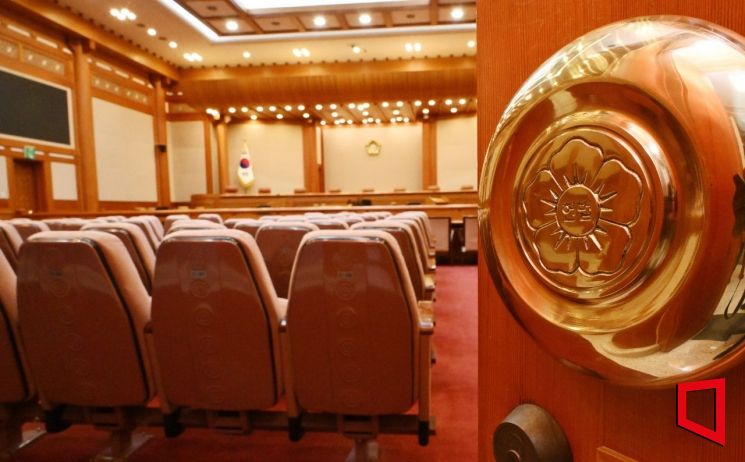 Tension is mounting on the 3rd at the Grand Chamber of the Constitutional Court in Jongno-gu, Seoul, one day before the Constitutional Court's ruling on the impeachment trial of President Yoon Seok-yeol. 2025.04.03 Photo by Joint Press Corps
On the same day, the Constitutional Court unanimously accepted the provisional injunction request filed by attorney Kim Jeong-hwan of the law firm Dodam, seeking to suspend the effect of Acting President Han’s nomination of Constitutional Court justice candidates. The Court stated, "The applicant faces the risk of suffering irreparable serious harm, and since the candidates can be appointed as justices regardless of whether the National Assembly conducts a confirmation hearing, there is an urgent need to prevent harm through the acceptance of the injunction."
Furthermore, the Court said, "At this point, it can be reasonably predicted that the candidates will be appointed as justices, and there is a possibility that the candidates will be appointed before the final decision on the constitutional complaint is issued. Therefore, it cannot be concluded that the main trial of this injunction request is clearly inappropriate or groundless." The Court added, "The disadvantage caused by dismissing the injunction and later accepting the complaint is greater than the disadvantage caused by accepting the injunction and later dismissing the complaint."
The Constitutional Court found that the requirements for accepting the injunction?standing, urgency, and comparative balancing?were met. Acceptance of a provisional injunction to suspend effect occurs when ① standing is recognized, indicating the case is worth contesting in the main trial, ② there is a need to prevent irreparable harm, or ③ there is an urgent necessity to suspend the effect, and ④ when comparing the disadvantages of dismissing the injunction followed by acceptance of the main claim versus accepting the injunction followed by dismissal of the main claim, the latter’s disadvantage is greater. This is the same standard applied when the Court accepted the injunction request to suspend the effect of the Constitutional Court Act filed by Broadcasting and Communications Commission Chair Lee Jin-sook last October.
Considering the gravity of the matter, the Court expedited the injunction proceedings. Constitutional complaints and injunction requests began to be filed from the day after Acting President Han’s nominations on the 9th, and the Court designated Justice Ma Eun-hyuk as the presiding justice just one day after the requests were received. On the 11th, the Court completed a preliminary hearing with a three-justice panel and referred the case to the full nine-justice bench. The full bench held deliberations daily starting from the 14th.
The upcoming variables are whether the Court will accept the constitutional complaints and the timing of the ruling. Constitutional complaints may involve oral arguments if necessary but are usually accepted by a majority of six or more justices through written review. According to the Public Official Confirmation Hearing Act, once the president nominates candidates, the National Assembly must complete the confirmation hearing within 20 days, extendable by 10 days. There are four main scenarios based on this timeline.
If the Constitutional Court rules the constitutional complaint unconstitutional, Acting President Han’s nominations of Lee Wan-gyu and Ham Sang-hoon will be nullified, and the nomination rights for the two seats will pass to the next president. If the next president is from the opposition party, they are expected to nominate new candidates and appoint two new justices after the National Assembly’s confirmation hearings. The same applies if the next president is from the ruling party.
If the constitutional complaint is dismissed or rejected, thereby recognizing the validity of Acting President Han’s nominations, the situation will vary depending on the timing of the ruling and the political affiliation of the new president. Although it took eight days from nomination to the injunction decision, the National Assembly still has up to 30 days to conduct confirmation hearings since the request for hearings has not yet been submitted or received. If the ruling is issued close to the June 3 presidential election, there are two possible scenarios: if the new president is from the ruling party, they may proceed with the appointments based on Han’s nominations; if the new president is from the opposition party, they are likely to withdraw Han’s nominations and nominate new candidates.
Moreover, if the dismissal or rejection ruling is issued between late April and the first week of May, Acting President Han can wait for the remaining deadline to submit the confirmation hearing report under the Public Official Confirmation Hearing Act and appoint the two candidates he nominated before the presidential election. This is because if the National Assembly does not adopt and submit the confirmation hearing report, the president can still make the appointments.
Professor Cha Jin-ah of Korea University Law School said, "(The constitutional complaint) concerns future violations of fundamental rights, and since it is clearly predictable at this point, the possibility of dismissal is low. Although there is a view that the acting president’s authority is broad during a presidential vacancy, so dismissal is not impossible, theoretically, acceptance is the correct outcome."
© The Asia Business Daily(www.asiae.co.kr). All rights reserved.
![Clutching a Stolen Dior Bag, Saying "I Hate Being Poor but Real"... The Grotesque Con of a "Human Knockoff" [Slate]](https://cwcontent.asiae.co.kr/asiaresize/183/2026021902243444107_1771435474.jpg)















