South Korea's Growth Rate Expected to Recover to 2.0% Next Year
Per Capita GDP Projected to Exceed $41,000 by 2028
U.S. Factors May Put Pressure on Fiscal Soundness
International credit rating agency Standard & Poor's (S&P) maintained South Korea's long-term sovereign credit rating and outlook at 'AA (Stable)' on the 15th, the same as before. Although trust in political stability was damaged following the emergency martial law situation in December last year, S&P viewed that the swift withdrawal of martial law, impeachment, and the confirmation of an early presidential election schedule prevented political uncertainty from seriously impacting the economy and financial system. The economic growth rate of South Korea this year was forecasted at 1.2%.

S&P Maintains South Korea's Credit Rating... "Policy Normalization After New President's Election"
On the day, S&P stated, "South Korea's economic competitiveness and solid external fiscal position are expected to support sovereign credit stability despite challenging global economic conditions," adding, "Although economic growth and exports may slow, these factors are expected to continue providing a strong economic and external foundation for the sovereign credit rating."
It continued, "Following the declaration and swift lifting of martial law in early December last year, South Korean institutions have promptly responded to potential instability arising from the martial law impact," and explained, "The policy environment is expected to generally normalize after the election of the new president."
However, S&P pointed out that if the recently expanded political division persists, it could reduce the policy momentum of the next government. It also noted that heightened tensions related to North Korea that severely damage the economy and fiscal conditions, or a decline to a significantly lower growth rate compared to other high-income countries, could be downward factors.
S&P has maintained South Korea's sovereign credit rating at 'AA' for nearly nine years since upgrading it from 'AA-' in August 2016.
Government: "This Rating Decision Positively Impacts South Korea's Creditworthiness"
S&P expects South Korea's economy to maintain an average growth rate higher than most high-income countries over the next 3 to 5 years, even if it slows somewhat. It also forecasted that the government's fiscal deficit will remain at an appropriate level over the next 3 to 4 years.
In particular, it projected South Korea's gross domestic product (GDP) growth rate to slow to 1.2% this year due to worsening international conditions but recover to 2.0% next year. This figure matches the 'S&P Asia-Pacific Growth Outlook' released last month. S&P also forecasted that from this year through 2028, South Korea's economic growth rate will trend around 2% annually, with per capita GDP exceeding $41,000 by 2028.
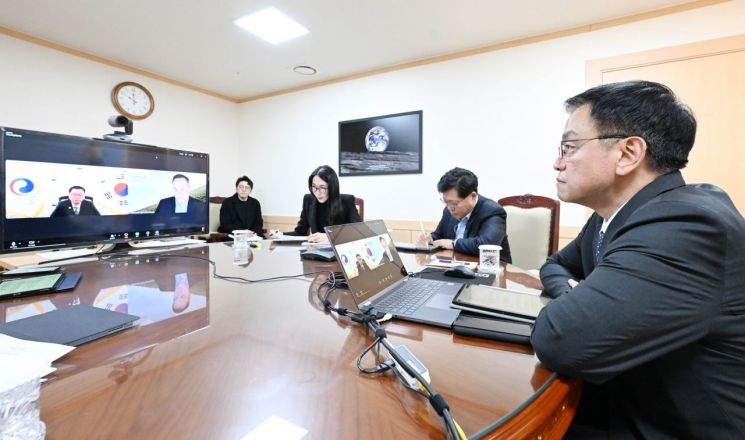 Deputy Prime Minister and Minister of Economy and Finance Choi Sang-mok holding a video conference with Roberto Saipon-Ar?valo, Global Head of Sovereign Ratings at international credit rating agency S&P, at the Government Seoul Office in Jongno-gu, Seoul, in December last year. Photo by Yonhap News
This year, the general government fiscal deficit as a percentage of GDP is expected to be -0.8%, an improvement from last year's -1.0%, due to favorable revenue conditions. However, it assessed that export impacts from U.S. tariffs and global economic slowdown this year and next could exert downward pressure on revenue, posing challenges to maintaining sound fiscal discipline.
S&P also explained that contingent liability risks of domestic financial institutions are limited. However, it mentioned that the increased debt of non-financial public enterprises over recent years poses constraints on fiscal management. It further identified the potential unification costs arising from a North Korean regime collapse as uncertain and very large contingent liabilities, representing the greatest vulnerability to South Korea's credit rating.
Strong net external assets and continued current account surpluses underpin South Korea's solid external soundness, according to S&P. It also projected that the current account surplus will approach 5% of GDP over the next three years. Along with the floating exchange rate system, the breadth and depth of South Korea's actively traded foreign exchange market provide a robust external buffer for the economy, the agency evaluated.
The Ministry of Economy and Finance explained, "Given the high domestic and external uncertainties such as the domestic political situation and changes in trade environment due to U.S. tariffs, this sovereign credit rating decision is expected to have a positive impact on South Korea's external creditworthiness."
It also noted, "Prior to this rating announcement, Deputy Prime Minister and Minister of Economy and Finance Choi Sang-mok met with the S&P annual consultation team last month, and through the inter-ministerial sovereign credit rating joint response council (chaired by the first vice minister of Economy and Finance), multiple ministries have systematically responded to the annual consultation, striving to manage external creditworthiness."
It added, "We will continue close communication with international credit rating agencies such as S&P, Moody's, and Fitch," and "we plan to do our best to maintain external creditworthiness by actively explaining our economic situation and policy directions."
© The Asia Business Daily(www.asiae.co.kr). All rights reserved.
![Clutching a Stolen Dior Bag, Saying "I Hate Being Poor but Real"... The Grotesque Con of a "Human Knockoff" [Slate]](https://cwcontent.asiae.co.kr/asiaresize/183/2026021902243444107_1771435474.jpg)
















