Up 0.52% from Previous Month
Widening Polarization in the Seoul Metropolitan Area
Apartment prices in Seoul increased their rate of growth in March, driving the nationwide rise in housing prices. Demand concentrated mainly in the Gangnam 3 districts and newly built or subway-accessible complexes, resulting in the largest increase in six months. Although some parts of the metropolitan area and provinces continued to decline, the strong performance in Seoul helped push the national housing prices into an upward trend for the first time in four months.
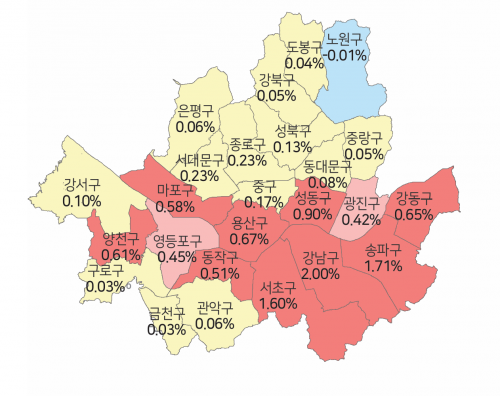
According to the "March Nationwide Housing Price Trend Survey" released by the Korea Real Estate Board on the 15th, the comprehensive housing sales price index (including apartments, multi-family houses, and detached houses) in Seoul rose by 0.52% compared to the previous month, an increase from 0.18% in the prior month. This figure significantly exceeds the national average increase of 0.01%.
Seoul housing prices had been slowing down since a 0.54% rise in September last year, dropping to 0.04% in January this year, but began to expand again in February to 0.18% after the large-scale lifting of land transaction permit zone regulations.
The rise in the Gangnam area was particularly notable. Gangnam-gu increased by 2.00%, Songpa-gu by 1.71%, and Seocho-gu by 1.60%, leading the overall upward trend in Seoul. The southeastern region of Seoul as a whole rose by 1.54%, the largest increase compared to other areas. The southeastern region saw an 8.13% increase year-on-year, the highest among Seoul districts over the past year. Transactions were mainly centered on subway-accessible and newly built complexes, with some popular complexes experiencing a shortage of listings. The area with the lowest housing price increase rate in Seoul was the northeastern region (0.17% month-on-month, 2.92% year-on-year).
Outside Seoul, the metropolitan area showed a clear temperature difference. Incheon fell by -0.16%, and Gyeonggi Province by -0.02%, both declining. However, the rate of decline narrowed compared to the previous month in both locations. Gwangmyeong-si in Gyeonggi fell by -0.46%, and Gimpo-si by -0.42%, showing a larger decline. Weakness persisted mainly in areas with a large volume of upcoming housing supply.
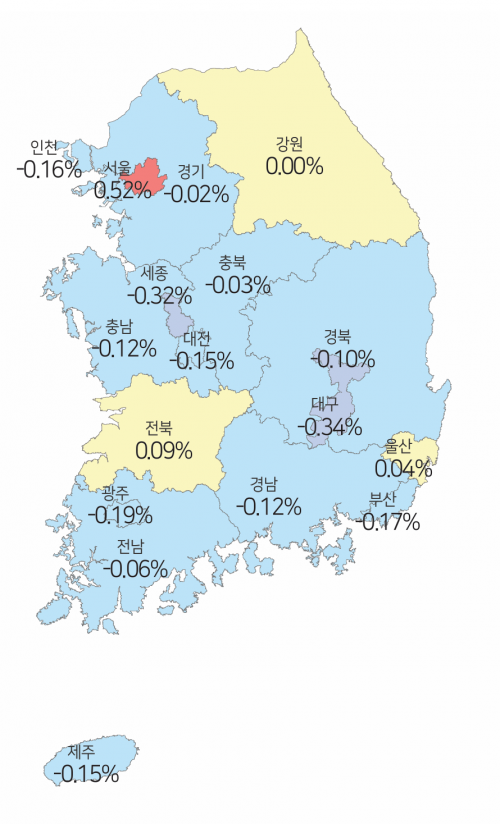
Among major provincial cities, Daegu (-0.34%), Busan (-0.17%), and Gwangju (-0.19%) also declined. In Daegu, Suseong-gu (-0.57%) and Buk-gu (-0.55%) experienced significant drops. This is analyzed to be influenced by accumulated supply and listing backlogs.
The Korea Real Estate Board explained, "In sales, demand is driven mainly by preferred complexes in Seoul and the metropolitan area, but in the provinces, there are mixed regions where delays in redevelopment projects and listing backlogs are observed."
The jeonse (long-term lease) market showed a similar trend. The comprehensive jeonse price index in Seoul rose by 0.17%, marking two consecutive months of increase, with the largest rises centered in the Gangnam area. Songpa-gu (0.67%), Gangdong-gu (0.40%), and Yongsan-gu (0.24%) were major rising areas. Conversely, Gwangmyeong-si in Gyeonggi Province saw a significant drop in jeonse prices (-1.26%) due to large-scale move-ins.
Meanwhile, the national average sales price index rose by 0.01%, remaining close to stable, while the jeonse price index increased by 0.03%, and monthly rent rose by 0.09%.
© The Asia Business Daily(www.asiae.co.kr). All rights reserved.
![Clutching a Stolen Dior Bag, Saying "I Hate Being Poor but Real"... The Grotesque Con of a "Human Knockoff" [Slate]](https://cwcontent.asiae.co.kr/asiaresize/183/2026021902243444107_1771435474.jpg)
















