Regional Issues Condensed into Presidential Pledges
Delivered to Each Candidate and Party, Yet Uncertainty Remains
Implementation After New Government Launch Still Unclear
No Leading Figure Like During Muan Airport Construction
"Need to Foster a 'Big Speaker' to Represent Regional Voices"
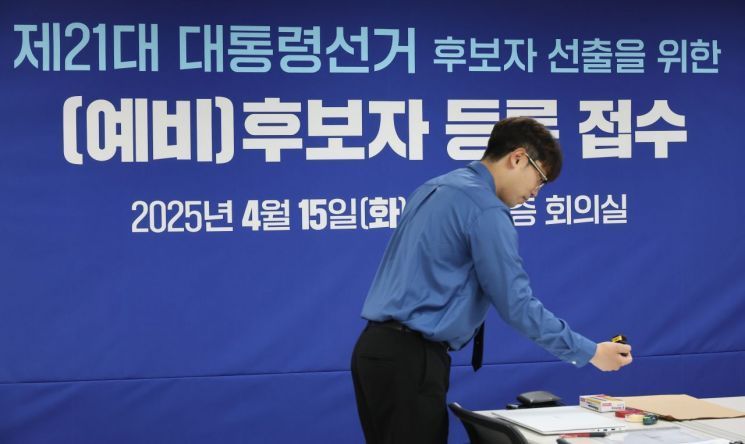 The Democratic Party will accept registration applications for primary candidates to select the 21st presidential election candidate from 9 a.m. to 6 p.m. on the 15th. Yonhap News
In line with the upcoming 21st presidential election to be held in June, Gwangju City and Jeonnam Province have proposed regional pledges to each political party and candidate, including the Democratic Party of Korea. However, concerns remain high.
There are numerous pressing issues necessary for regional development, but worries are already surfacing that there are not enough so-called influential figures to ensure these are ultimately reflected. The absence of a leader representing Honam continues to be a source of regret.
Recently, Gwangju City proposed 15 major tasks, 40 projects, and pledges worth 81 trillion won, including the construction of an AI Model City and a Future Mobility New Town. Jeonnam Province also finalized a total of 75 presidential pledges, such as the establishment of a national medical school, a mega project for the transformation of the petrochemical and steel industries, and the creation of a space launch vehicle industry convergence cluster. The total budget required for these projects is 191.9112 trillion won.
Despite the relatively tight schedule due to the sudden start of the presidential race, the prevailing opinion is that both local governments have carefully selected only those issues that will serve as the foundation for the region's present and future development, leaving little to be desired in terms of content.
The real issue is how many of these pledges will actually be realized. Unless there are major surprises, it appears that most of the regional pledges delivered to each party's candidate will be accepted. Given that this is an early presidential election held immediately after the impeachment of Yoon Suk-yeol, it is unlikely that any candidate or party will be bold enough to ignore the pledges proposed by Honam.
In fact, after the unconstitutional martial law imposed by former President Yoon Suk-yeol, Gwangju and Jeonnam were among the regions that voiced the strongest criticism. The pro- and anti-impeachment rallies held in Gwangju, featuring Korean history lecturers such as Hwang Hyunpil and Jeon Hangil representing progressive and conservative sides, respectively, reflected this atmosphere.
Honam always plays the role of a casting vote in national elections, so candidates have every reason to try to appeal to the region. However, it remains uncertain whether the region's demands will be reflected in the final presidential agenda and the next government's policy tasks, and whether they will actually be implemented. This is because, in the past, Honam's voice tended to diminish once the election atmosphere settled and stabilized.
This is even more true when considering the current national budget allocation system. Issues raised in the region are delivered to the relevant government ministries. Ministries such as the Ministry of Land, Infrastructure and Transport and the Ministry of Culture, Sports and Tourism then submit their budget requests to the Ministry of Economy and Finance by May 31 of that year, according to budget guidelines. The Ministry of Economy and Finance analyzes these requests, calculates the required amounts, and drafts the budget proposal.
The budget proposal is then adjusted through the Budget Deliberation Committee, Ministerial Council, and party-government consultations within the Ministry of Economy and Finance, and, after review by the Cabinet and approval by the President, is submitted to the National Assembly at least 90 days before the start of the fiscal year. The National Assembly (Special Committee on Budget and Accounts) reviews and finalizes the budget for the following year, which is then subject to the President's final approval.
On the surface, the government budget is finalized according to each procedure, but in reality, the process is as fierce as a battlefield. Even if something is a presidential pledge, the Ministry of Economy and Finance is not obligated to apply it unless there is a strong justification. In the end, the key is how effectively one can persuade them.
In order to get as many regional issues reflected as possible, not only regional ties but also school and blood relations are fully mobilized. According to the local political community, anyone who can help secure budget allocation is quickly introduced, regardless of their position. Naturally, local members of the National Assembly, central government officials, and former and current political figures involved in the presidential campaign can serve as the best connections.
Typically, a government transition committee is formed before and after the presidential election, where regional issues are initially reviewed. However, since this is an early election, the president-elect will immediately assume office without the formation of a transition committee.
This means that each government ministry will have to address various issues right away. Considering that it takes at least a month to appoint ministers and other cabinet members, it is likely that vice-ministerial officials will handle practical affairs. Vice-ministerial replacements tend to proceed relatively quickly. If there is an influential figure who can deliver the region's voice, it will be much easier to have regional issues reflected.
It is significant that Han Hwa-gap, a powerful lawmaker during the Kim Dae-jung administration, led the construction of Muan Airport, and that the push for Gwangju as a cultural hub city, which laid the foundation for the construction of the Asia Culture Center in Gwangju, resulted from a brief conversation in a car between former President Roh Moo-hyun and former Gwangju Mayor Kang Un-tae. This highlights the importance of having someone with roots in the region or who can at least reflect local public opinion.
However, the lack of a "big speaker" in the government after this 21st presidential election who can push regional issues is expected to be a burden going forward. Considering the region's extremely weak industrial and economic base, it will not be easy to find alternatives if these issues are not resolved politically.
There are already numerous unresolved issues, such as the relocation of the military airport and the establishment of a new medical school in Jeonnam. The success or failure of the AI industry, considered a future growth engine, also remains uncertain. While veteran politicians such as Park Jie-won are still active, it is difficult not to worry about the future. This is the background for concerns that the presidential pledges of Gwangju City and Jeonnam Province may ultimately not be reflected. The "Revival of Honam Politics" keyword, championed by several regional politicians including Jeonnam Governor Kim Young-rok, has resonated strongly in the region for the same reason.
A local political figure stated, "This presidential election feels different from previous ones," adding, "In this national emergency following impeachment, the presence of a clear candidate within the Democratic Party, Lee Jae-myung, brings both expectations and concerns about what kind of influence he will have on Gwangju and Jeonnam."
He continued, "If the regional presidential pledges are smoothly incorporated into the next government, there will be no problem, but we are not in a situation where we can afford to sit back and do nothing. There needs to be someone to represent the region, and in that sense, there are many things to consider."
© The Asia Business Daily(www.asiae.co.kr). All rights reserved.
![Clutching a Stolen Dior Bag, Saying "I Hate Being Poor but Real"... The Grotesque Con of a "Human Knockoff" [Slate]](https://cwcontent.asiae.co.kr/asiaresize/183/2026021902243444107_1771435474.jpg)















