Trade Surplus Reaches $1.4 Billion
as Both Exports and Imports Decline
In March, exports from the Gwangju and Jeonnam regions decreased by 12.6% compared to the same month last year. The main reason was the sluggish performance of key items such as semiconductors, home appliances, and petroleum products. Imports also fell by 21.3%, resulting in a trade surplus of $1.408 billion.
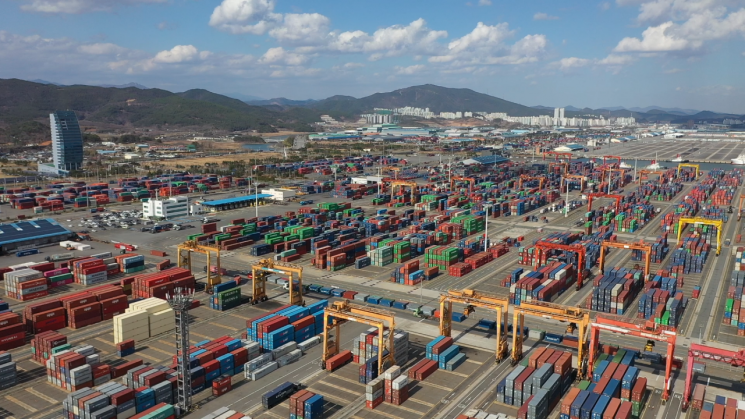
According to the "March Export-Import Trends" announced by the Gwangju Main Customs Office on the 15th, the total export value of the two regions in the same month was $4.547 billion, and the import value was $3.139 billion. For the cumulative period from January to March this year, exports amounted to $13.884 billion and imports to $10.824 billion, down 17.1% and 10.2% respectively. The cumulative trade surplus stands at $3.06 billion.
In the Gwangju area, imports increased more than exports. In March, exports were $1.338 billion, down 8.0%, while imports rose 16.0% to $716 million. The trade surplus was $622 million. Among export items, machinery (32.8%), tires (6.1%), and transportation equipment (1.7%) increased, but semiconductors (-25.3%) and home appliances (-35.4%) decreased. Imports of rubber (256.0%), machinery (68.7%), and semiconductors (18.1%) increased, while chemical products (-7.5%) decreased.
In the Jeonnam area, both exports and imports saw significant declines. In March, exports were $3.209 billion, down 14.4%, and imports were $2.423 billion, down 28.1%. The trade surplus was $786 million. Exports of transportation equipment surged by 448.3%, but petroleum products (-49.1%), chemical products (-28.0%), and steel products (-13.9%) decreased. Imports of chemical products increased slightly, while crude oil (-37.6%), coal (-26.3%), and iron ore (-19.0%) decreased.
Gwangju performed well in machinery and transportation equipment exports, while Jeonnam, with its high dependence on petroleum and resource exports, was greatly affected by the energy market. Both regions could not avoid the impact of slowing global demand and falling raw material prices.
© The Asia Business Daily(www.asiae.co.kr). All rights reserved.
![Clutching a Stolen Dior Bag, Saying "I Hate Being Poor but Real"... The Grotesque Con of a "Human Knockoff" [Slate]](https://cwcontent.asiae.co.kr/asiaresize/183/2026021902243444107_1771435474.jpg)















