"Youth Influx Driven by Jobs and Housing Powers Urban Growth"
"Hydrogen Economy to Fundamentally Transform the Energy System"
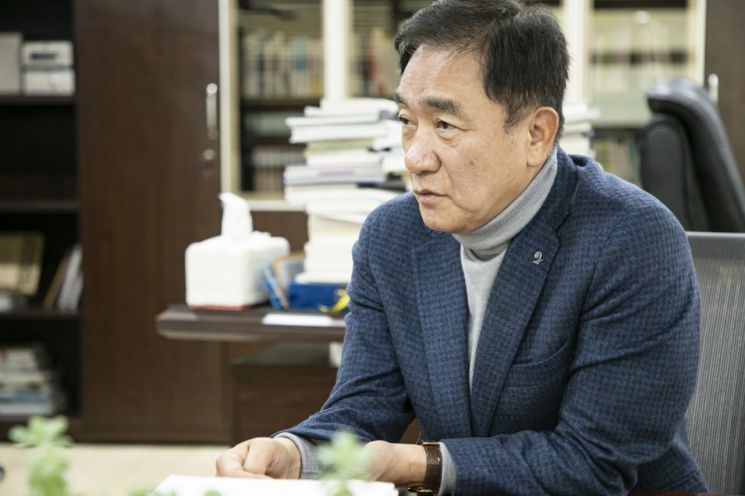 Jeong Jang-seon, mayor of Pyeongtaek, is determined to develop 'hydrogen' and 'future cars' as new growth engines alongside the city's core semiconductor industry for sustainable urban growth. Photo by Pyeongtaek City
"We will create new sources of growth for the city through hydrogen and future vehicles."
Celebrating 30 years since its elevation to city status this year, Pyeongtaek is a city showing remarkable growth even among the southern Gyeonggi region, where industry and population are concentrated. After surpassing a population of 500,000 in 2019 and entering the ranks of 'large cities,' it exceeded 600,000 last year, just five years later.
In an interview with Asia Economy, Mayor Jeong Jang-seon cited the increase in the youth population as the reason behind this growth. Mayor Jeong said, "Over the past five years, the youth population in Pyeongtaek has increased by 18.9%, the highest growth rate among cities nationwide with populations over 300,000," adding, "The reason young people are flocking to Pyeongtaek is because of jobs and housing."
The number of employed people in Pyeongtaek increased from 213,600 in the first half of 2013 to 336,500 in the first half of last year. Over the past five years, 74,837 new businesses have been registered in the city, ranking fourth highest among local governments nationwide.
Mayor Jeong also expressed his commitment to fostering new industries for the city’s sustainable growth. "While semiconductors remain a backbone, we must nurture diverse industries rather than focusing on just one. That is 'hydrogen' and 'future vehicles.'"
Pyeongtaek aims to become a future-oriented city encompassing hydrogen production, processing, distribution, and consumption, mainly in the western region. Mayor Jeong said, "Following the launch of the hydrogen transportation complex for hydrogen supply in November last year, Pyeongtaek Port is also being developed as a hydrogen port," adding, "The recently opened Korea Clean Hydrogen Promotion Institute will establish itself as a think tank for hydrogen industry research and workforce development."
Mayor Jeong expressed confidence in the future vehicle industry’s prospects, saying, "With Pyeongtaek Port as an export hub for automobiles, the three major automakers, and over 250 automobile-related companies in the region combining hydrogen and semiconductors, the outlook for Pyeongtaek’s future vehicle industry is bright," and emphasized growth alongside future vehicles.
Mayor Jeong is also focusing on 'carbon neutrality' as much as future industries. He said, "Our people perceive abnormal climate as dangerous as the North Korean nuclear threat," noting, "Especially the heavy snowfall last November caused massive damage in Pyeongtaek and the southern metropolitan area."
He added, "Through the hydrogen economy, we will bring fundamental changes to the fossil fuel-centered energy system," and "Once the hydrogen ecosystem envisioned by Pyeongtaek is completed, hydrogen produced locally will be used in housing, public facilities, commercial facilities, and transportation logistics."
Mayor Jeong plans to support companies in achieving 'RE100' based on clean hydrogen. "Currently, a power plant near Pyeongtaek Port is producing eco-friendly electricity using clean hydrogen and is establishing a system to supply this to companies," he explained.
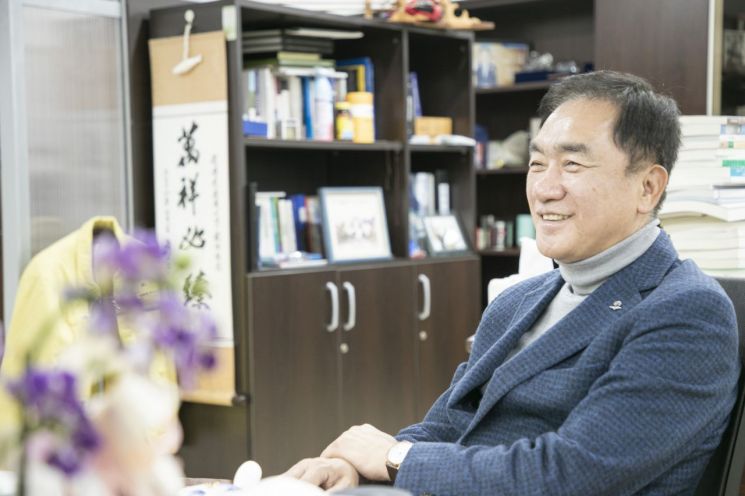 Jeong Jang-seon, mayor of Pyeongtaek, stated that he will resolve urban imbalance through efficient investment by selection and concentration. Photo by Pyeongtaek City
Pyeongtaek faces significant challenges due to its rapid urban growth. The comprehensive funeral facilities and resource recovery facilities currently being promoted by the city have met opposition from nearby residents.
Mayor Jeong said, "The construction of resource recovery facilities is essential to prevent a waste crisis," but added, "We will not proceed unilaterally." He intends to conduct thorough communication among citizens regarding the scale and nature of the incineration plant and the method of selecting contractors. Regarding the comprehensive funeral facilities, Mayor Jeong’s approach is to proceed through active communication not only with residents but also with neighboring local governments rather than rushing.
Regional imbalance is also a challenge. Mayor Jeong said, "The new town demands more development, while the old town calls for resolving regional imbalances," adding, "Of course, it would be ideal to carry out development that satisfies everyone, but the city’s budget is limited."
To promote development in the western region, Mayor Jeong is pushing forward the 'New Frontier Project.' This plan aims to expand port-related infrastructure and foster advanced industries such as hydrogen and future vehicles to achieve balanced development in the slower-developing western area.
Mayor Jeong stated, "The way to achieve regional balanced development with limited budgets is through selection and concentration," and "We will continue to pursue administrative innovation to ensure budgets are used efficiently where needed."
© The Asia Business Daily(www.asiae.co.kr). All rights reserved.
![Clutching a Stolen Dior Bag, Saying "I Hate Being Poor but Real"... The Grotesque Con of a "Human Knockoff" [Slate]](https://cwcontent.asiae.co.kr/asiaresize/183/2026021902243444107_1771435474.jpg)
















