Evaluated as Important Materials for Research
on the Structure of Eupseong Fortresses
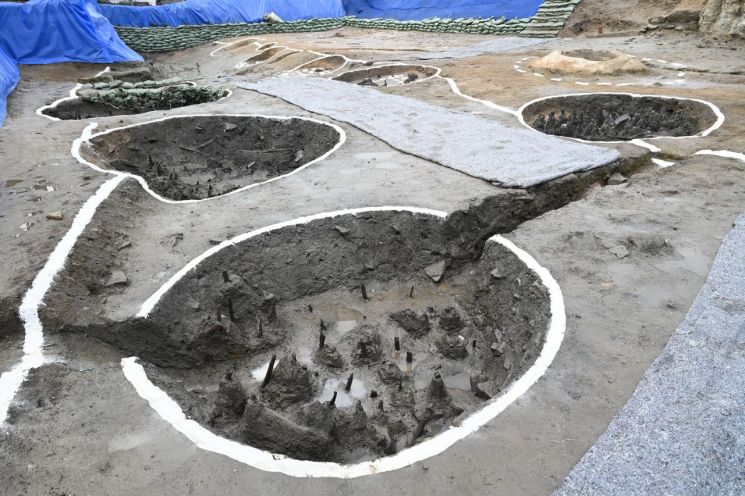 The appearance of a lethal trap and moat discovered during the excavation of Hongju Eupseong. / Provided by Hongseong County
During the excavation survey of the fortress walls at Hongjueupseong in Ogan-ri, Hongseong-eup, Hongseong-gun, Chungcheongnam-do, which is National Historic Site No. 231, numerous deadly defensive facilities such as traps and moats were discovered. These findings are being evaluated as important materials for research into the structure of eupseong fortresses.
Hongseong-gun, Chungcheongnam-do, announced on the 15th that during the excavation survey of the southeastern walls of Hongjueupseong, which has been underway since April last year for the restoration and sanctification of Hongjueupseong, they have successfully unearthed traps presumed to be from the Joseon Dynasty and moats from the Goryeo Dynasty.
This survey uncovered a large number of traps in excellent preservation, surpassing those previously found within Hongjueupseong, along with traces of stakes believed to be remnants of a chiseong, identified both physically and in the land formation patterns.
The traps are recorded as deadly defensive facilities consisting of pits dug into the ground with sharp wooden stakes installed, while moats are ditches dug around the exterior of the fortress to prevent enemy intrusion. A chiseong is a defensive structure created by protruding a rectangular section from the fortress walls.
Except for Jeollabyeongyeongseong in Gangjin, Jeollanam-do, which was the first case of large-scale traps as defensive facilities in a Joseon Dynasty fortress, there are almost no other confirmed cases nationwide. Thus, the traps discovered here are considered crucial materials for understanding and researching the structure of eupseong fortresses.
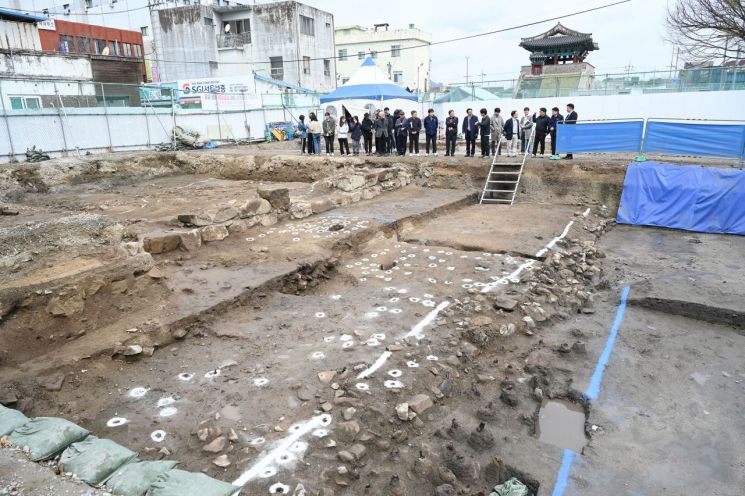
An official from the county said, "We will make multifaceted efforts, including consulting with relevant experts, so that the results of this year-long Hongjueupseong excavation and survey can be used as valuable materials for the future restoration and maintenance of Hongjueupseong."
Since 2022, excavation surveys for the restoration of the demolished fortress walls at Hongjueupseong have uncovered the stone arrangements at the base of the Goryeo Dynasty earthen fortress, the main wall structure and construction methods of the Joseon Dynasty stone fortress, and traps with wooden stakes that have been preserved intact.
Meanwhile, the county plans to complete within the year the creation of the Hongjueupseong waterfront space, which includes the construction of ponds and pavilions to secure scenic views of the soon-to-be-restored fortress and the Hongju Millennium Culture Experience Center, as well as the Joyang Park project to provide leisure and rest spaces around Joyangmun.
© The Asia Business Daily(www.asiae.co.kr). All rights reserved.
![Clutching a Stolen Dior Bag, Saying "I Hate Being Poor but Real"... The Grotesque Con of a "Human Knockoff" [Slate]](https://cwcontent.asiae.co.kr/asiaresize/183/2026021902243444107_1771435474.jpg)
















