'Korea-U.S. Industrial Cooperation Conference' Panel Discussion
Comprehensive Cooperation Needed in Supply Chains, Workforce, and Technology
Korea's Strengths in HBM and Manufacturing Talent Highlighted
Opportunities in AI Application Services and Data Center Investment
Utilizing U.S. Semiconductor Subsidies and GPU Regulation Exemptions
South Korea and the United States have been diagnosed with the need to strengthen cooperation in supply chains, workforce, and technology amid rapid changes in the artificial intelligence (AI) and semiconductor industries. As AI technology rapidly reshapes industries overall, it is argued that Korea can leverage its advantages in high-bandwidth memory (HBM) technology and research personnel to collaborate more closely with the U.S.
On the 15th, an expert discussion on cooperation strategies in AI and semiconductor fields was held at the 'Korea-U.S. Industrial Cooperation Conference' at the Korea Chamber of Commerce and Industry in Seoul.
At the discussion, Kim Chang-wook, Managing Director of Boston Consulting Group (BCG) and moderator of the session, said, "The AI revolution is still at a very early stage," adding, "Hyperscalers (cloud service providers) have been investing but are struggling to turn a profit." He emphasized, "Semiconductors are the most important driving force behind AI and must continue to be developed and evolved," and stated, "Korean companies need to think about how to share and utilize foundation models in cooperation with U.S. hyperscalers."
Kim explained that Korean companies with semiconductor technology have the potential to collaborate with U.S. cloud providers. He elaborated, "Hyperscalers want to build small-scale data centers in Korea," and added, "There could be a 'win-win' way for Korean and U.S. companies."
He also diagnosed that since the U.S. lacks research engineers while Korea lacks manufacturing specialists, there is a high possibility for mutual cooperation.
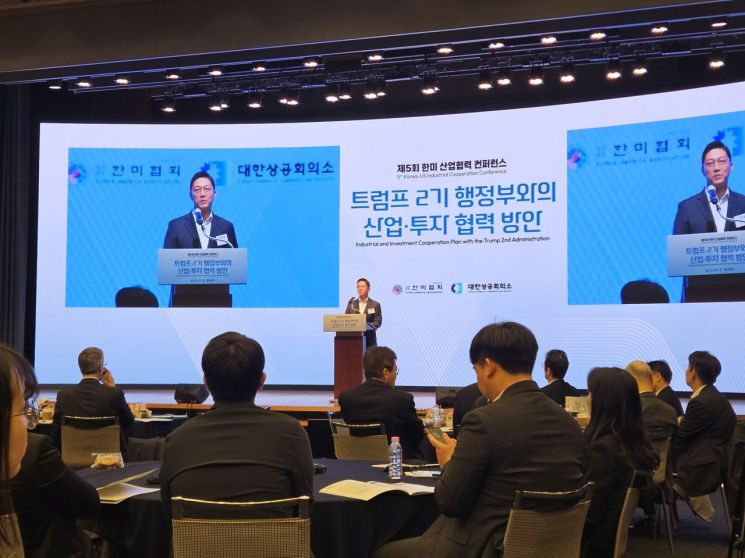 Kim Chang-wook, Managing Director of Boston Consulting Group (BCG), is delivering the keynote speech at the 'Korea-US Industrial Cooperation Conference' held on the 15th at the Korea Chamber of Commerce and Industry in Seoul. Photo by Park Joon-yi
Martin Chorzempa, Senior Fellow at the Peterson Institute for International Economics, emphasized the importance of Korea’s possession of high-bandwidth memory (HBM) production technology. However, he suggested that rather than developing proprietary AI models, Korea should collaborate with existing AI companies through application (app) development. Martin said, "HBM is a crucial driver of AI GPUs," and "It is essential for training global AI models such as ChatGPT, Grok, and DeepSeek." He continued, "To have proprietary AI models, one would need to build GPU clusters of 100,000 to 200,000 units, which is a highly competitive and costly field," and explained, "Instead, building apps on top of existing AI models is an area where an ecosystem has already been established in Korea."
He particularly mentioned that Korea is an exception in the AI semiconductor export controls imposed by the U.S. Trump administration. He emphasized, "Korea can access GPUs designed in the U.S. without regulation," and "Korea has the opportunity to build apps based on U.S.-based AI models." Furthermore, regarding the U.S. Chips Act, he predicted that subsidies could actually increase in terms of tax credits.
However, he pointed out that tariff policies could negatively impact the semiconductor sector. He said, "If tariffs are imposed, the cost of training AI in the U.S. could increase by about 25-30%, and the prices of all items used in those facilities could rise."
Mike Ye, Asia Head of Policy and Legal Affairs at Microsoft, also stated, "There are opportunities for Korea in the AI field," encouraging Korea to focus on developing its own large language models (LMM) and AI app development. He stressed the need to build automation solutions to address cybersecurity and population decline issues.
There was also a suggestion to strengthen cooperation between Korea and the U.S. Go Jong-wan, Head of Strategic Planning at the Korea Semiconductor Industry Association, said, "It is necessary to further strengthen cooperation between Korea and the U.S. in the semiconductor and AI fields." He explained, "The vulnerabilities of supply chains were revealed during the COVID-19 period, and ongoing geopolitical tensions and natural disaster issues are increasing instability in the global semiconductor supply chain," adding, "It is necessary to strengthen Korea-U.S. solidarity to stabilize the supply chain from design to manufacturing of AI semiconductors."
Go pointed out the shortage of personnel to support technological innovation as the era of AI semiconductors approaches and stressed the need to enhance semiconductor workforce competitiveness in both Korea and the U.S. He also mentioned the need for joint research between the two countries on next-generation semiconductor and process technologies. Additionally, he added that establishing Korean production plants and research and development (R&D) centers in the U.S. is necessary.
© The Asia Business Daily(www.asiae.co.kr). All rights reserved.
![Clutching a Stolen Dior Bag, Saying "I Hate Being Poor but Real"... The Grotesque Con of a "Human Knockoff" [Slate]](https://cwcontent.asiae.co.kr/asiaresize/183/2026021902243444107_1771435474.jpg)















