Record-High $901.47 Million in HFF Exports Last Year
ODM Companies Lower Export Barriers
Through International Certifications
ODM companies manufacturing health functional foods (HFF) are gaining attention as the hidden driving force behind South Korea's record-high HFF exports last year. These companies laid the groundwork for rapid entry into overseas markets with varying certification standards by obtaining international HFF standard certifications in advance.
According to export-import trade statistics from the Korea Customs Service on the 15th, the export value of HFF and other unclassified prepared foods reached a record high of $901.47 million (approximately 1.3259 trillion KRW) last year. HFF export values have continued to grow from $581.01 million (about 854.7 billion KRW) in 2020 to $722.7 million (about 1.0631 trillion KRW) in 2021, $730.43 million (about 1.0745 trillion KRW) in 2022, and $847.28 million (about 1.207 trillion KRW) in 2023.
Accordingly, the Korea Health Supplements Association forecasts that South Korea's HFF export value will reach 5 trillion KRW by 2035, and the share of domestic exports in the overseas HFF market will expand from the current 0.14% to 1.5%.
The rise in HFF exports is attributed to domestic HFF ODM companies. ODM refers to a production method where manufacturers with design and development capabilities supply products or goods to distributors who have secured sales networks. The HFF market is relatively challenging for exports due to differing standards by country, such as efficacy certification, quality management certification, and certification procedures by the Ministry of Food and Drug Safety. However, HFF ODM companies have lowered export barriers for distributors by preemptively obtaining international standard certifications such as the US CGMP (Current Good Manufacturing Practice for food) and HALAL.
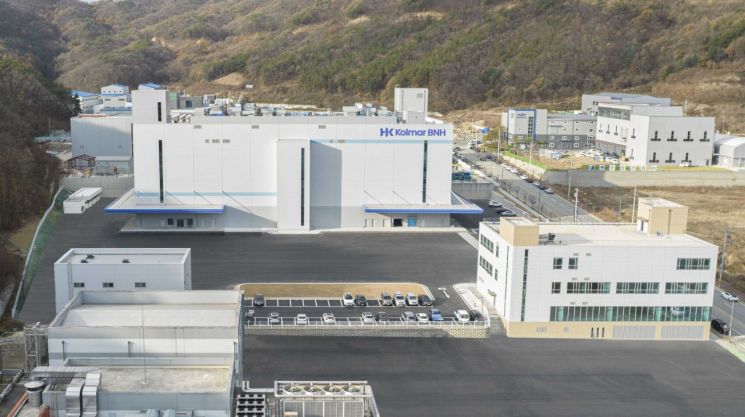
Kolmar BNH's Sejong Plant 3 was recognized as an accredited testing institution in the chemical testing-food field by KOLAS (Korea Laboratory Accreditation Scheme), enabling exports without separate retesting for six items, including functional ingredients such as vitamin C. Additionally, by acquiring GMP certification from Australia's TGA (Therapeutic Goods Administration), export procedures to Australia and Europe have been simplified. A Kolmar BNH official explained, "We are sequentially preparing the necessary certifications for entry into major markets such as China, the US, Australia, and Europe," adding, "Thanks to proactive measures, we have secured cost savings and time efficiency in exports."
Alphbio obtained the international food safety standard FSSC 22000 certification in January. FSSC 22000 is a global food safety management system recognized by the Global Food Safety Initiative (GFSI). It meets all requirements of ISO 22000 and Hazard Analysis and Critical Control Points (HACCP). A company representative said, "The FSSC 22000 certification is the international recognition of the global standard quality management and safety we have built," adding, "Through this certification, we can add global credibility to our health functional food management system and prepare for a greater leap in expanding overseas markets."
Exports by HFF ODM companies are also increasing. Kolmar BNH recorded a 20% increase in HFF export value last year, reaching 135 billion KRW, as products including 'HemoHIM' gained popularity in Russia, China, the US, and Indonesia. Exports to Malaysia and Indonesia grew by more than 20% in addition to the existing major market, China.
Novarex also saw a 22% increase in export value last year, reaching 91.2 billion KRW, by supplying HFF to China, Vietnam, Thailand, and Malaysia. Cosmax NBT's export share of total sales increased from 62% in 2022 to 65% in 2023, and is expected to rise to 70% in 2024, expanding its overseas presence.
© The Asia Business Daily(www.asiae.co.kr). All rights reserved.
![Clutching a Stolen Dior Bag, Saying "I Hate Being Poor but Real"... The Grotesque Con of a "Human Knockoff" [Slate]](https://cwcontent.asiae.co.kr/asiaresize/183/2026021902243444107_1771435474.jpg)















