KOSPI Gains Narrowed by Foreigners' Net Selling in Spot and Futures Markets
"Volatile Market Expected to Continue for the Time Being"
On the 14th, the domestic stock market closed higher, buoyed by expectations of easing tariff risks originating from the United States.
On that day, the KOSPI closed at 2,455.89, up 23.17 points (0.95%) from the previous session. Earlier, the index opened at 2,454.28, up 21.56 points (0.89%). Individual investors bought stocks worth 192.5 billion KRW, while foreigners and institutions sold stocks worth 257.3 billion KRW and 9.1 billion KRW, respectively.
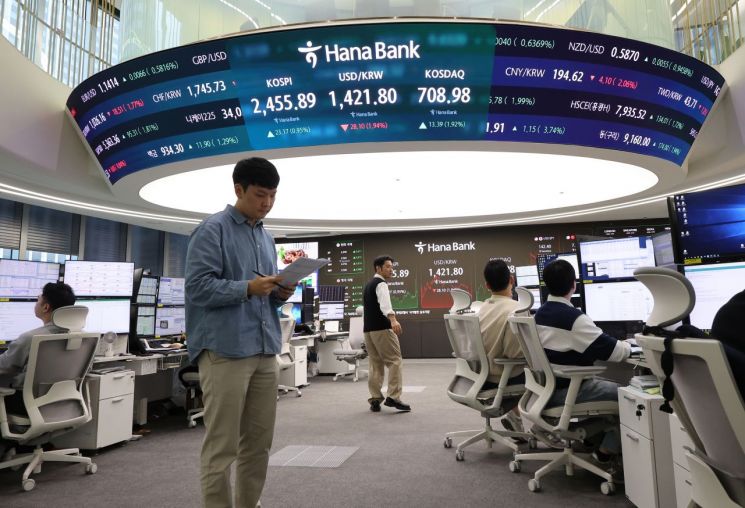 On the 14th, dealers are conversing in the dealing room of Hana Bank in Jung-gu, Seoul. Photo by Yonhap News.
Among the top market capitalization stocks, most closed higher, including Hanwha Ocean (3.22%), LG Energy Solution (2.24%), Samsung Electronics (1.81%), Hanwha Aerospace (1.67%), Celltrion (1.49%), HD Hyundai Heavy Industries (1.46%), Kia (1.22%), and KB Financial Group (1.20%). On the other hand, NAVER (-0.16%), SK Hynix (-0.33%), and Samsung Biologics (-0.67%) declined.
Notably, following Seoul Mayor Oh Se-hoon's announcement that he would not run in the presidential election, Jinyang Chemical hit the lower limit price, and related theme stocks such as Jinyang Industry (-29.19%) and Jinyang Poly (-23.06%) also plunged consecutively.
Ji-won Kim, a researcher at KB Securities, analyzed, "Investment sentiment recovered mainly in the electrical and electronics sector, including Samsung Electronics and LG Innotek, which are expected to benefit from mutual tariff exemptions on smartphones and other products." He added, "The continued upward momentum in the defense and shipbuilding sectors and the strength of pharmaceutical and bio stocks supported the index's rise." However, he summarized, "The KOSPI narrowed its gains and closed relatively weaker compared to the KOSDAQ due to simultaneous net selling by foreigners in both spot and futures markets and the decline of some large-cap stocks."
On the same day, the KOSDAQ closed at 708.98, up 13.39 points (1.92%). The index, which opened at 699.99, up 4.40 points (0.63%), saw increased buying mainly in bio stocks, expanding its gains. While individuals and institutions net bought 4.4 billion KRW and 22.4 billion KRW respectively, foreigners alone sold stocks worth 24.9 billion KRW.
Among the top market capitalization stocks, ABL Bio (10.68%), Alteogen (3.34%), Rigachem Bio (2.78%), Rainbow Robotics (2.53%), Peptron (2.19%), Kolon TissueGene (1.88%), and Hugel (1.61%) rose.
In particular, news that Lee Jae-myung, the Democratic Party's presidential candidate, would visit Puriosa AI, a domestic AI semiconductor fabless company, sparked a surge in AI chatbot stocks such as Saltlux (23.78%) and Wisnut (21.77%). Conversely, Classys (-0.16%) and Samchundang Pharm (-2.04%) closed lower.
In the Seoul foreign exchange market, the won-dollar exchange rate closed at 1,424.1 won, down 25.8 won from the previous trading day as of 3:30 p.m. Due to concerns about economic stagnation and a weak dollar, the rate continued its sharp decline for the third consecutive trading day, reaching its lowest level since December last year.
Researcher Kim stated, "Although relief that the U.S.-originated tariff anxiety has passed its peak drove the stock market, expectations for resolving uncertainties remain difficult," and forecasted that a volatile market phase would continue for the time being.
© The Asia Business Daily(www.asiae.co.kr). All rights reserved.
![Clutching a Stolen Dior Bag, Saying "I Hate Being Poor but Real"... The Grotesque Con of a "Human Knockoff" [Slate]](https://cwcontent.asiae.co.kr/asiaresize/183/2026021902243444107_1771435474.jpg)















