Recycling of Only 50 Types of Electrical and Electronic Products
Expanded to All Items Starting Next Year
"76,000 Tons of Minerals to Be Recovered, 200 Billion KRW in Benefits"
Starting next year, all electrical and electronic products used in daily life will be subject to recycling. Until now, only large products like washing machines and refrigerators have been recycled, but from now on, handheld fans and portable batteries must also be recycled. The government expects this measure to secure tens of thousands of tons of minerals and generate an annual benefit of 200 billion KRW.
On the 14th, the Ministry of Environment announced that the partial amendment to the Enforcement Decree of the Act on Resource Circulation of Electrical and Electronic Products and Automobiles, which includes these provisions, was approved at the Cabinet meeting held at the Government Complex in Jongno-gu, Seoul.
According to the amendment of the enforcement decree, from January 2026, all electrical and electronic products will be included in the Extended Producer Responsibility (EPR) system. EPR is a system that imposes recycling obligations on producers who manufacture products and charges recycling fees to producers who do not comply. Currently, only 50 types of medium and large home appliances such as washing machines and refrigerators are subject to this system. From next year, medium and small products such as portable fans, clothes dryers, electric kickboards, portable batteries, and Bluetooth earphones will also be subject to EPR regulations.
However, medical devices with infection risks and military supplies requiring confidentiality are excluded. Small manufacturers with sales under 1 billion KRW and importers under 300 million KRW are exempt from obligations as before. Additionally, separate from the increase in EPR items, the national recycling targets set annually will be maintained. This year’s national recycling target is 8.79 kg per person.
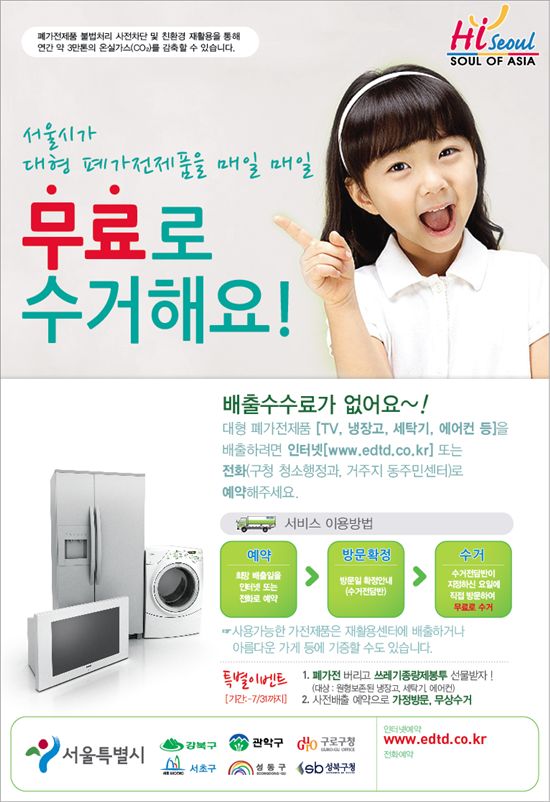 Large Home Appliance Free Collection Poster
With this system reform, the government expects environmental and economic benefits exceeding 200 billion KRW annually. This is because various mineral resources can be extracted during the recycling process of electrical and electronic products. According to the Ministry of Environment, approximately 22,000 tons of clothes dryers, 15,000 tons of clothing care devices, and 200 tons of portable fans are expected to be recycled annually. It is estimated that valuable resources such as iron and aluminum recovered in this process will reach 76,000 tons per year.
Manufacturers and importers can reduce their burden. This is because they will be exempt from the previously paid 'waste charge.' Instead, they only need to pay the deduction association fee required to fulfill recycling obligations. The waste charge amounts to 20.5 billion KRW annually, while the recycling charge is 15.4 billion KRW, making it about 5.1 billion KRW cheaper.
The Ministry of Environment explained that there will be no consumer damage such as price increases due to recycling regulations. Bae Cheol-han, Deputy Head of the Secondary Battery Support Group at the Ministry of Environment, said, "As product collection and free collection systems have been advanced, conditions have been created to recycle almost all electrical and electronic products at low cost," adding, "Since the burden on companies will rather decrease, there is no possibility of costs being passed on to consumers."
At the same Cabinet meeting, a partial amendment to the Enforcement Decree of the Water Supply Act was also approved. The amendment stipulates the authority to establish integrated water supply plans and the matters to be included in such plans. It also became possible to integrate water supply projects between local governments. The Ministry of Environment evaluated that linking water sources and water facilities enables management rationalization, alleviates disparities in water services between regions, and enhances the ability to respond to water crises such as droughts.
Additionally, the Enforcement Decree of the Special Act on the Improvement of Air Quality in Air Control Zones (Air Control Zones Act) was partially amended to regulate vehicles allowed to operate in low-emission zones. Emergency vehicles and vehicles designated by local government heads through ordinances are permitted to operate. If a vehicle not allowed in the low-emission zone is detected, a fine of 100,000 KRW per day will be imposed once daily.
© The Asia Business Daily(www.asiae.co.kr). All rights reserved.
![Clutching a Stolen Dior Bag, Saying "I Hate Being Poor but Real"... The Grotesque Con of a "Human Knockoff" [Slate]](https://cwcontent.asiae.co.kr/asiaresize/183/2026021902243444107_1771435474.jpg)















