Heo Junyoung of Sogang University Analyzes GDP Impact of Government Spending
Published in the Bank of Korea Economic Research Institute's Quarterly Journal "Economic Analysis"
A study has found that if the government spends 1 won more, the gross domestic product (GDP) increases by 1.45 won. This research draws attention as it can be referenced to gauge the economic stimulus effect of the supplementary budget currently being discussed in the political arena.
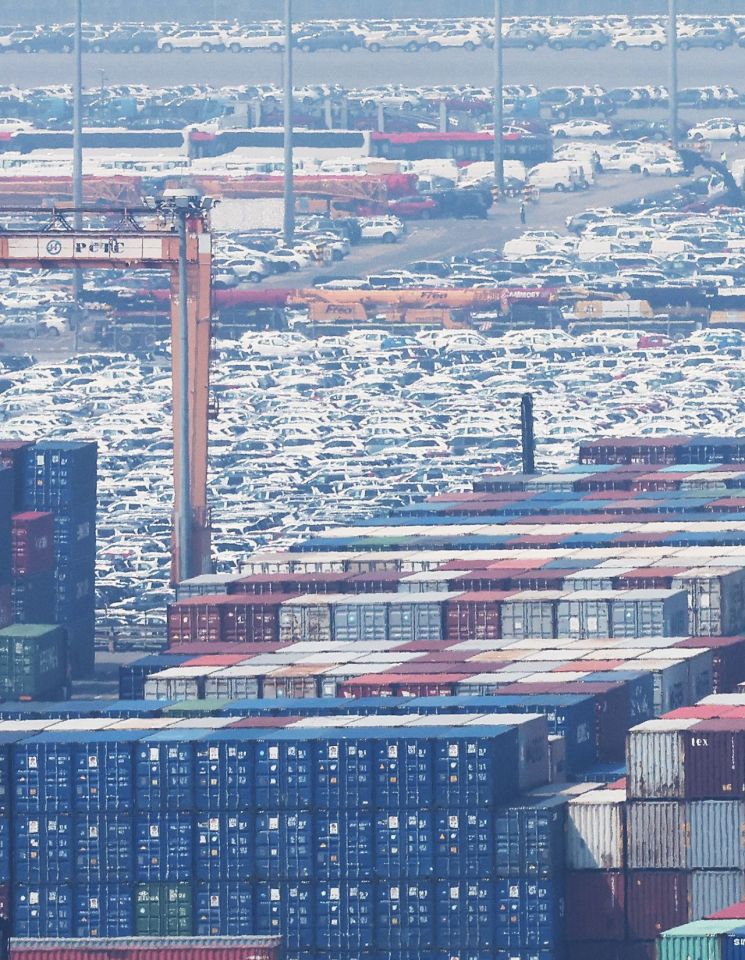 On the 3rd, when U.S. President Donald Trump announced a 25% reciprocal tariff on Korean imports, export cars were parked behind containers piled up at Pyeongtaek Port, Gyeonggi Province. Photo by Yonhap News
Professor Heo Jun-young of the Department of Economics at Sogang University and PhD candidate Kim Se-hoon recently published a paper titled "Analysis of the GDP Effect of Government Expenditure" in the quarterly academic journal "Economic Analysis" by the Bank of Korea Economic Research Institute. The research team estimated the impact of government spending on GDP (government expenditure multiplier) using time series data from the first quarter of 2002 to the fourth quarter of 2023. They introduced a multivariate model expanded to 25 variables, correcting the information deficiency problem of the existing small-scale model composed of 5 variables and enhancing the reliability of the multiplier.
As a result, the government expenditure multiplier in South Korea was calculated to be 1.45. Even when narrowing the analysis period to before COVID-19, up to the fourth quarter of 2019, it reached 1.23. The interpretation is that when the government injects money, household spending increases, labor market indicators improve such as a decrease in unemployment rate and an increase in employment rate, leading to a short-term rise in GDP. The research team stated, "An increase of 1 won in government expenditure was analyzed to increase current GDP by 1.45 won," adding, "Government spending is at least an effective countermeasure to economic fluctuations in the short term." However, they pointed out that in the medium to long term, an increase in government spending could raise government bond interest rates and potentially contract the economy.
Based on the research team's estimates, a simple calculation shows that if a supplementary budget of 10 trillion won is executed as proposed by the government, this year's GDP growth rate would increase by about 0.5 percentage points. This assumes growth according to the economic forecast presented by the Bank of Korea last February (1st quarter 0.2%, 2nd quarter 1.3%, 3rd quarter 2.0%, 4th quarter 2.3%).
However, several prior studies have evaluated the government expenditure multiplier as lower than 1 or pointed out that the GDP response to government spending shows a negative (-) relationship. The multiplier estimated by the Bank of Korea itself is also observed to be lower than 1.45. Bank of Korea Governor Lee Chang-yong previously mentioned, "If the supplementary budget is around 15 to 20 trillion won, it has the effect of raising the growth rate by 0.2 percentage points."
© The Asia Business Daily(www.asiae.co.kr). All rights reserved.
![Clutching a Stolen Dior Bag, Saying "I Hate Being Poor but Real"... The Grotesque Con of a "Human Knockoff" [Slate]](https://cwcontent.asiae.co.kr/asiaresize/183/2026021902243444107_1771435474.jpg)















