Main Policy Directions of China Amid U.S. Pressure
National Assembly Research Service Releases Report on the 11th
South Korea, Highly Dependent on Chinese Economy, Should Seek Cooperation from the Perspective of 'I-yong Hu-seong'
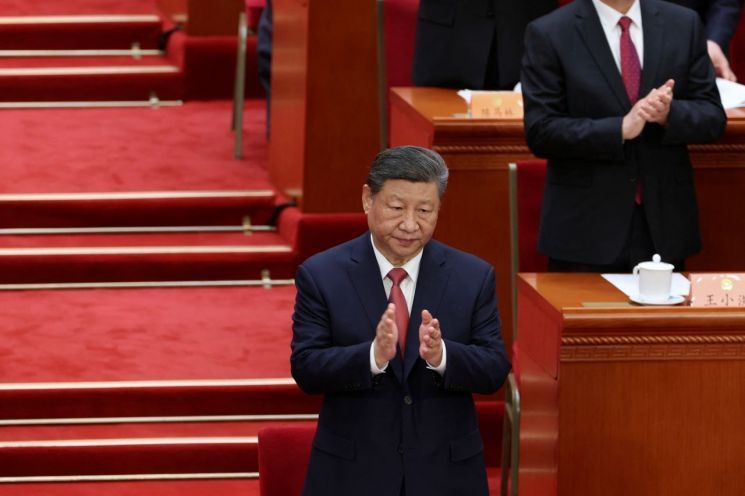 Chinese President Xi Jinping attending the closing ceremony of the CPPCC. Photo by Reuters and Yonhap News.
The National Assembly Research Service identified the core policy directions of the Chinese government this year as consumption, openness, and science and technology in its report. Based on this, South Korea is preparing for the second phase of the Korea-China Free Trade Agreement (FTA) while arguing that cooperation opportunities should be sought from the perspective of 'I-yong Hu-seong (利用厚生)' in various aspects such as technology and industry.
Main Policy Directions of China: 'Consumption, Openness, Science and Technology'
The National Assembly Research Service stated in the report titled 'Key Contents of the 2025 Two Sessions (Lianghui - National People's Congress) and Korea-China Cooperation Measures' released on the 11th, "This year's Two Sessions focused on ▲promoting consumption ▲expanding external openness ▲pursuing self-reliance and self-strengthening in science and technology, and related follow-up measures are being implemented."
The Two Sessions, China's largest annual political event, were held in Beijing for a week starting from the 4th of last month. The Two Sessions provide insight into China's economic and social development goals and foreign policy directions for the coming year. Notably, this event was the first since the inauguration of the second term of the U.S. Trump administration. Unusually, heads of major Chinese big tech companies such as DeepSea, Xiaomi, and Baidu attended in large numbers. This reaffirmed China's commitment to fostering advanced industries like artificial intelligence (AI) and supporting private enterprises.
The report noted, "The 2025 Two Sessions focused on promoting consumption, expanding openness, and pursuing self-reliance and self-strengthening in science and technology," adding, "The word 'consumption,' which was mentioned only 21 times last year, was mentioned 32 times this year, indicating that stimulating domestic demand through consumption promotion was presented as the most urgent task." This analysis suggests that the Chinese government, facing difficult domestic and international environments, expressed a strong determination to recover the economy.
It further stated, "At this forum, Chinese President Xi Jinping unusually conveyed the message to private enterprises and entrepreneurs to 'become rich first to promote common prosperity (先富促共富)'," interpreting this as a significant shift from the 'common prosperity (共同富裕)' stance that had been the main ideological basis for strengthening anti-monopoly measures against large corporations.
The report also analyzed that China emphasized an active openness despite the pressure from the second Trump administration. This analysis is based on the fact that the word 'openness' was used 21 times in the Two Sessions work report, up from 14 times last year.
Additionally, the report said, "China plans to actively foster future industries such as biomanufacturing, quantum technology, embodied intelligence, and 6G to achieve self-reliance and self-strengthening in science and technology," noting, "This year's government science and technology budget was set at 398.119 billion yuan (approximately 80 trillion KRW), a 10% increase from the previous year, and a 'National Venture Capital Guidance Fund' worth about 1 trillion yuan (approximately 200 trillion KRW) will be established to invest in advanced technologies such as AI."
Assessing China's Uncertainties and Opportunities to Seek Korea-China Cooperation
The report pointed out that South Korea should prepare for the second phase of the Korea-China FTA negotiations based on the analysis of this year's Two Sessions and seek cooperation opportunities with China. It emphasized the need to examine both investment risks and opportunities, given the mixed pessimism and optimism toward the Chinese economy.
The report stated, "First, China expressed its willingness to expand the opening of the service sector to attract foreign investment through the Two Sessions," explaining, "It is promoting orderly opening in fields such as internet and culture and plans to pilot expand openness in telecommunications, medical care, and education to increase reinvestment by foreign companies." It added, "South Korea should thoroughly monitor recent changes in China's service sector pilot projects by region and field and utilize this for preparing negotiations in the second phase of the Korea-China FTA service sectors such as culture, medical care, tourism, law, information, technology (IT), and research and development (R&D)."
It continued, "Second, although cooperation areas in advanced industries are limited due to constraints from the U.S.-China technological hegemony competition, it is possible to identify mutually complementary fields between Korea and China and designate them as 'blue zones' to seek technological cooperation between the two countries." For example, Seo Haeng-a, a research fellow at the Korea Institute of Science and Technology Evaluation and Planning (KISTEP), suggested cooperation fields that could be included in the blue zone such as environmental technology, renewable energy, smart cities, bio, and medical care.
Generally, blue zones refer geopolitically to reliable countries centered around the U.S. However, in terms of industrial technology cooperation, it can be expanded as a concept of a kind of 'safe zone' between countries where cooperation with China is allowed to some extent.
Furthermore, "Third, as the role of Chinese local governments increases in the development of advanced industries and attracting foreign investment, exchanges with Chinese local governments can be utilized as a platform for Korea-China cooperation in advanced industries, science and technology, and tourism service sectors," citing Hangzhou City in Zhejiang Province, Shenzhen City in Guangdong Province, and Shandong Province as examples.
Recently, Hangzhou City has emerged as a center of China's advanced industries, producing not only DeepSea but also robot companies such as Unitree and Deep Robotics, and brain-computer interface company BrainCo. This was attributed mainly to the proactive role of the local government. Shenzhen City announced plans to provide compensation of 5 million yuan (approximately 1 billion KRW) to foreign companies that make additional investments. The tourism industry potential of Shandong Province was also highly evaluated. According to the report, the number of domestic tourists visiting Shandong Province in 2024 surged to 900 million, and tourism revenue exceeded 1 trillion yuan (approximately 201.2 trillion KRW). Among them, the number of tourists visiting Qingdao reached 140 million. Yang Yanlong, director of the Asia Research Center at Shandong University, advised exploring mutual cooperation measures between Korea and Shandong Province in the tourism industry.
The report concluded, "In a chaotic situation where the free trade order is shaken by U.S. tariff pressures and other protectionist measures, the international community faces an era of self-help," emphasizing, "Considering South Korea's economic dependence on China and the potential of the future Chinese market, it is urgent to seek Korea-China cooperation measures from the perspective of I-yong Hu-seong. Above all, efforts to restore mutual trust between the two countries should precede attempts to build a new Korea-China relationship."
© The Asia Business Daily(www.asiae.co.kr). All rights reserved.