Back Briefing After Daegu Campaign on the 9th
"Passionate Response from Young Women at the Scene"
Lee Jun-seok, the presidential candidate of the Reform New Party, actively refuted the public opinion that his approval rating is low among young women by highlighting the 'Dongtan Moms' in his constituency.
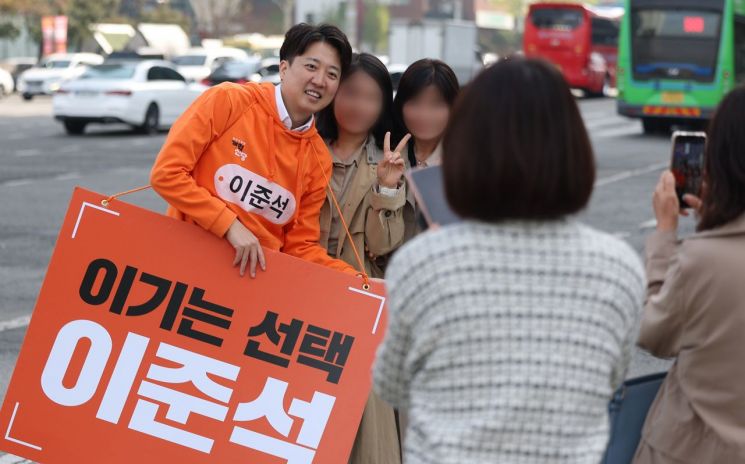 Reform New Party presidential pre-candidate Lee Jun-seok is taking photos with citizens at Beomeo Intersection, Suseong District, Daegu on the 9th. Photo by Yonhap News
On the 9th, after finishing a campaign in Daegu, Lee responded to a question at a back briefing asking, "Aren't you unpopular among young women?" by saying, "Since the approval rating among men in their 20s is high, some people see a big gap with women in their 20s." He claimed, "During my tenure as the leader of the People Power Party, it was the period when the party had the highest approval rating among women in their 20s and 30s over the past decade," adding, "The frame of 'Why can't you get the support of women in their 20s and 30s?' and 'divide and rule' was created during the process when 'Yun Hae-gwan' and others ousted me from the party leadership."
He said that the online reactions and the actual voting results are completely opposite. "Dongtan is a place where the meme 'Dongtan Moms' emerged, reflecting the strong voices of women. It is a place with many politically trained women," he recalled that he was elected in Dongtan, Hwaseong, Gyeonggi Province, a year ago. 'Dongtan Moms' refers to women in their 30s and 40s living in the Dongtan New Town who are raising infants and toddlers, as described in online communities. Lee emphasized, "The fact that I caused a sensation by being elected as a third-party candidate there means that I understand what female voters want and present tailored pledges."
He continued, "I confirmed that the response from young women was positive even during today's campaign," and added, "In the last general election, contrary to the opinion polls, women led the actual vote share."
In the 20th presidential election, Lee led the People Power Party and focused on targeting 'Lee Dae-nam' (men in their 20s) in addition to the existing middle-aged demographic. Last year, in the National Assembly plenary session, he was the sole dissenting vote against the so-called 'Deepfake Prevention Act' (Partial Amendment to the Special Act on the Punishment of Sexual Violence Crimes), which passed with 272 out of 273 members voting in favor.
After the last general election, at a Seoul Foreign Correspondents' Club (SFCC) meeting, despite being described by a major foreign media outlet as a "politician who turned the Korean presidential election into an anti-feminism election" and being asked if he wanted to refute or comment, he expressed, "I am concerned that labeling someone as an anti-feminist with such extreme language just because they do not 100% agree with the feminist agenda might be the current essential nature of the feminist movement."
© The Asia Business Daily(www.asiae.co.kr). All rights reserved.
![Clutching a Stolen Dior Bag, Saying "I Hate Being Poor but Real"... The Grotesque Con of a "Human Knockoff" [Slate]](https://cwcontent.asiae.co.kr/asiaresize/183/2026021902243444107_1771435474.jpg)















