USFK Commander: "Reduction of US Forces in South Korea Would Be Problematic"
As the Donald Trump administration reviews the global deployment of U.S. forces, commanders responsible for the Korean Peninsula and the Indo-Pacific region have expressed negative views on the withdrawal or reduction of U.S. troops stationed in South Korea.
On the 10th (local time), Samuel Paparo, Commander of the Indo-Pacific Command, stated at a Senate Armed Services Committee hearing held in Washington D.C. that "If U.S. forces in South Korea disappear, the likelihood of him (Kim Jong-un, Chairman of the State Affairs Commission of North Korea) invading increases."
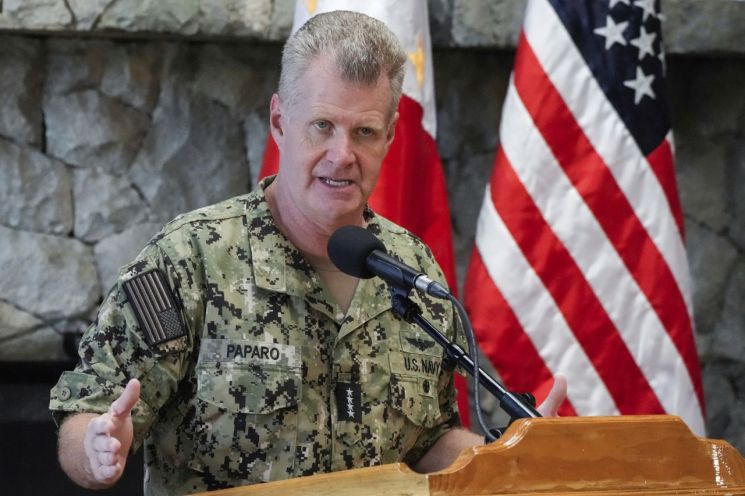
Commander Paparo used the word 'loss' to describe the situation regarding U.S. forces in South Korea, which can be interpreted not only as withdrawal but also as reduction.
When asked whether a significant reduction of U.S. forces in South Korea would be good or bad, Commander Paparo replied, "It diminishes our ability to overwhelm in conflict." He also said that U.S. forces in South Korea benefit not only South Korea but also other allied countries.
Additionally, Xavier Brunson, Commander of U.S. Forces Korea and Combined Forces Command, was asked about reports that the U.S. Department of Defense is considering reducing forces on the Korean Peninsula to focus on responding to the China threat and defending the U.S. mainland. He responded that "a reduction of U.S. forces in South Korea would be problematic." He emphasized, "What we provide there (on the Korean Peninsula) is the potential to impose costs on Russia in the East Sea, the potential to impose costs on China in the West Sea, and the deterrence against North Korea that is currently operational."
Recently, The Washington Post (WP) reported that the U.S. Department of Defense, in its 'Interim National Defense Strategy Guidance,' prioritizes preparing for a Chinese invasion of Taiwan and defending the U.S. mainland, while leaving responses to North Korea and others to allied countries.
The remarks on this day emphasized that U.S. forces in South Korea are important not only for deterring North Korean invasion but also for checking China and Russia. Furthermore, Commander Brunson stated in his opening remarks that "the return on the 'investment' of U.S. forces stationed in South Korea is not measured solely in money," but also involves "accessibility, forward bases, sustained partnerships, and deterrence."
When asked about the impact of reducing U.S. forces in South Korea on South Korea and regional partners, Commander Brunson mentioned that he recently received orders to move some Patriot missile batteries from U.S. Forces Korea to the Middle East, saying, "We need to leverage strategic clarity about what is being asked of our military power." This can be interpreted as a caution against reducing U.S. forces in South Korea, as such reductions could signal a weakening of deterrence against North Korea and checks on China and Russia.
Regarding whether he believes Kim Jong-un will invade South Korea, Commander Brunson said, "I do not believe he will invade," but added, "What I can say is that he will use weapons and systems to limit the great growth South Korea has achieved over the past 75 years."
The day before, President Trump, at a signing ceremony for an executive order, said, "We pay for troops in Europe but do not get much reimbursement. It is the same with South Korea," adding, "This has nothing to do with trade, but we will make it part of the negotiations." This revealed his intention to comprehensively negotiate the stationing of U.S. forces in South Korea and the cost burden, linking it with trade issues such as tariffs.
© The Asia Business Daily(www.asiae.co.kr). All rights reserved.
![Clutching a Stolen Dior Bag, Saying "I Hate Being Poor but Real"... The Grotesque Con of a "Human Knockoff" [Slate]](https://cwcontent.asiae.co.kr/asiaresize/183/2026021902243444107_1771435474.jpg)















