Vision for the 140th Anniversary Revealed in Asia Economy Interview
"Toward a Global Hub for Quantum Technology Cooperation and Research"
"Solving Society's Challenges Through AI Convergent Research"
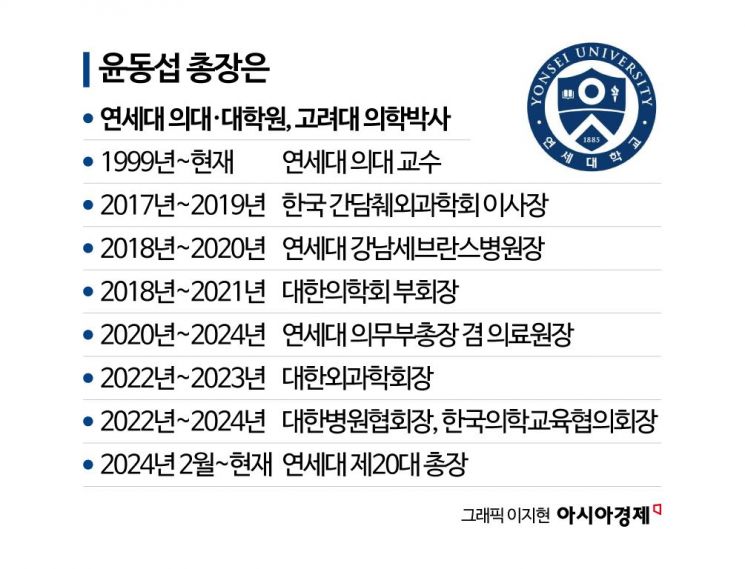
People often say "to wield the scalpel." The scalpel is a tool that helps save lives by cutting away diseased tissue to promote new growth. Sometimes, it is even called a "friend of reform." Yoon Dong-seop (63), President of Yonsei University, is a surgeon who skillfully wields that scalpel. As an authority in the deep areas of the human body, particularly in the liver, gallbladder, and pancreas fields, he temporarily put down the scalpel and transformed into the CEO leading Yonsei University in February last year, steering its direction. On March 27, Asia Economy met President Yoon at Underwood Hall, imbued with the 140-year spirit of Yonsei. His eyes sparkled behind his glasses when talking about the "Yonsei spirit" and "Yonsei's future." The following is a Q&A.
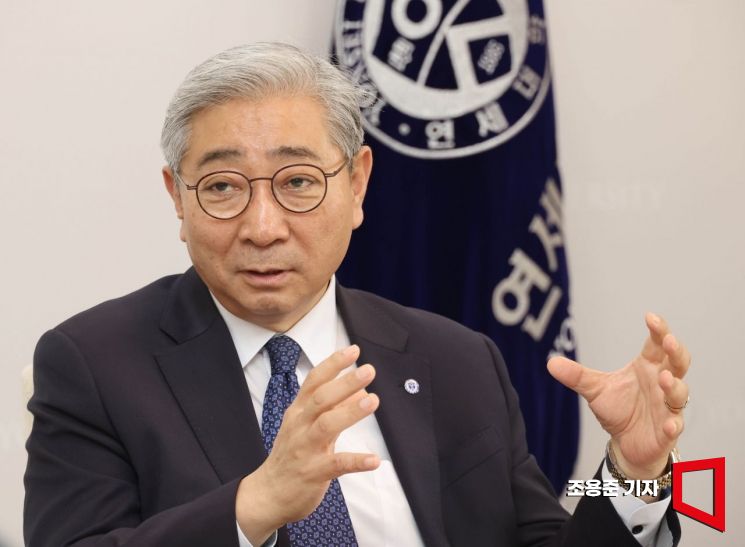 Yoon Dong-seop, President of Yonsei University, is being interviewed by Asia Economy at the Yonsei University Main Building in Sinchon, Seoul. Photo by Jo Yong-jun
"Leap to a Quantum Research Hub, Elevate South Korea's Status and Secure Future Growth Engines"
-I heard you will soon visit the University of Cambridge in the UK.
▲Yonsei University is a world-class university in terms of global capabilities. We have student exchanges and joint research with 740 universities in 77 countries. I will visit not only the UK but also several places such as Aalto University in Helsinki, Finland. At Cambridge, we will sign a joint research MOU on quantum computing, attend an AI conference, and discuss new drug development projects. (On the 3rd, Yonsei signed an MOU with Cambridge to strengthen academic exchange and research cooperation in the field of quantum science and technology.) Cambridge is the cradle of physics research in human history, from Newton's classical mechanics to Stephen Hawking's quantum mechanics. Through the MOU, we expect to build a global partnership with Cambridge and contribute to scientific advancement. Based on this, we also plan to establish a strategic cooperation platform with universities possessing leading quantum science technologies, such as the University of Waterloo in Canada and the Cleveland Clinic in the United States.
-Why 'quantum mechanics'?
▲Quantum science and technology is an innovative tool that can solve complex problems humanity faces, such as cryptography, optimization problems, new drug development, and artificial intelligence. It is a core technology driving sustainable development in future society, a force reshaping the global industrial landscape, and at the center of technological hegemony competition among nations. Yonsei University is strategically fostering quantum science and technology, building an ecosystem with two pillars: education and research. On the education side, we plan to operate a non-degree education program called 'Quantum Academy' that covers everyone from the general public to students and non-majors, aiming to improve quantum literacy across society. To cultivate top-tier talent, we are pushing to establish a Department of Quantum Informatics in graduate school starting this semester.
In research, we are intensifying efforts based on the IBM Quantum System One (Yonsei installed this quantum computer at the Songdo International Campus Quantum Computing Center in November last year, the first in Korea and the second worldwide among universities). We expect to achieve results in various fields such as new drug development, logistics, finance, and basic science. We have adopted the slogan 'Quantum LOVE' (Literacy, Outreach, Versatility, Engagement) and are promoting joint research with world-renowned research institutions. Our goal is to become a global hub for quantum technology cooperation and research.
-Please tell us more about the IBM quantum computer Yonsei introduced.
▲The 127-qubit IBM quantum computer we brought in has the most advanced technology and significantly improved error rates. We plan to use it to create a cutting-edge bioindustry complex in Incheon. It can shorten the time and increase the probability of success in new drug development, which traditionally required a long time, very low probability, and a lot of money. This will provide a major growth engine for our society and contribute to enhancing the nation's status. We have not only introduced the equipment but also recruited eight experts to build a talent pool.
"The Key to AI Innovation Protecting the Dignified Lives of Citizens is Multidisciplinary Convergent Research"
-What will the 'AI Innovation Institute' launching this year do?
▲All colleges of Yonsei University will participate in the institute. It is the largest single AI research institute in Korea, covering diverse fields such as humanities, social sciences, education, medicine, engineering, and business. Beyond technology-centered AI research, we aim to conduct 'multidisciplinary convergent research' exploring the impact of AI on human life and society. In the humanities and social sciences, we will conduct in-depth research on topics like 'AI and social change,' 'AI and human interaction,' and 'AI and security.' The education sector plans to develop AI-based education models. Kia donated over 10 billion KRW. This can be seen as a new industry-academia-research cooperation model laying the foundation for AI and future mobility fields. Another example of multidisciplinary convergent research is the 'Institute for Population and Talent,' jointly established by the medical and business schools. It conducts convergent research addressing social challenges such as low birth rates, aging, immigration, education, labor, mental health, and dignified living. The goal is to propose policy alternatives that ensure everyone, including vulnerable groups, can enjoy a dignified life amid rapidly changing population structures.
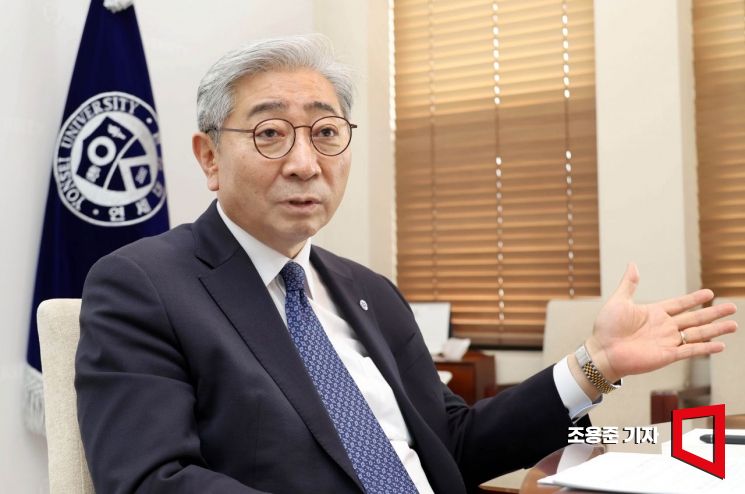 Yoon Dong-seop, President of Yonsei University, is being interviewed by Asia Economy at the Yonsei University Main Building in Sinchon, Seoul. Photo by Jo Yong-jun
"Yonsei's Global Capabilities to Compete with the World, Inheriting the Spirit of Founding Missionaries"
-What is Yonsei University's vision as a global academia? Is the 'Songdo Campus era' settling in well?
▲The Residential College system in Songdo is successfully settling in. Since it is a new attempt, the ultimate evaluation will come in 10 years, but it is one of the systems Yonsei can be proud of. Since my inauguration as president, I have been thinking about education unique to the international campus that other universities cannot attempt. Our students can receive education equivalent to that of the US Ivy League in Korea, under much more comfortable conditions. This is thanks to the dedication of our professors.
Yonsei is expanding strategic partnerships with leading overseas researchers and global research institutions through the Yonsei Frontier Lab. In 2024, we hosted the 'IAMC (Integrated Assessment Modeling Consortium) International Conference' for the first time in Korea, solidifying our position as a leading university in climate policy research. This year, we also hosted 'RECOMB-Microbiome 2025,' the world's top conference in computational biology, for the first time in Korea. We plan to translate outstanding faculty research into English and share it with scholars worldwide through the Yonsei News newsletter. We also operate various global education programs aimed at fostering a sense of global community and international leadership beyond borders. The Global Institute of Theology (GIT), operated by the Divinity School, has had 119 students from 32 countries since its establishment in 2015. It exemplifies Yonsei's global educational spirit, inheriting the pioneering spirit of missionary Underwood.
-Yonsei University was built through the sweat and blood of missionaries including Underwood. Social contribution activities are indispensable.
▲Based on the founding ideology of Christian spirit, contributing to society through education and research is our important mission. We are actively expanding research and education programs to implement the UN Sustainable Development Goals (SDGs). Among them, the Institute for Global Engagement and Empowerment (IGEE) collaborates with various international organizations including the UN to promote innovative projects for sustainable development. We also co-host the Global Sustainable Development Forum (GEEF) with the Ban Ki-moon Foundation, providing a platform for global discussions. Last year, together with Korea University, Seoul National University, and Pohang University of Science and Technology, we pledged to strengthen social responsibility through the 'Sustainable Campus Initiative' joint declaration and held a forum. Yonsei Medical Center builds medical education systems, provides medical volunteer services, and conducts research for developing countries, sharing advanced medical technology and infrastructure worldwide.
"140th Anniversary of Yonsei... Leap to a World-Class Research University through Student-Centered Educational Innovation"
-Yonsei will soon celebrate its 140th anniversary. What about the next 10 years?
▲Western missionaries with a great vision founded Yonsei University in Joseon, which had nothing, and nurtured South Korea's competitiveness. Just as they lifted us up, Yonsei must contribute through education so that lands like Joseon back then, now third-world countries, can prosper 10 or 100 years from now. Looking at the next 10 years briefly, we plan to select doctors from remote areas in Africa, train them at Severance Hospital, and prepare projects so they can return to their countries and serve their people. Also, it is necessary to solve humanity's challenges and contribute to social development through convergent research. From this perspective, our university's proud humanities, engineering, and world-class hospital provide optimal research conditions.
-You emphasized the 'Yonsei spirit' at your inauguration and promoted 'Empowering Yonsei.'
▲Over the past year, we have worked to translate the Yonsei spirit into concrete achievements, and I believe that identity has become clearer. We have laid the foundation for Yonsei to establish itself as a center of knowledge creation by building interdisciplinary convergence and future technology-leading research infrastructure such as the AI Innovation Institute, Yonsei Quantum Complex, and Biomedical Engineering Convergence Research Center. Yonsei's education is transforming into a true empowering space through systematizing AI and software basic education, AI convergence advanced majors, student-designed majors, and strengthening global social responsibility education. Above all, the depth, dignity, and cultural-humanistic foundation of Yonsei people, demonstrated by alumnus Han Kang winning the Nobel Prize in Literature, reaffirm that our university is not merely a technology or performance-centered institution but a value-centered university for people and society.
-Please tell us about your future goals and attempts at change.
▲To change, we must accurately diagnose problems. I will consider this carefully. Now, just over a year into my term, I can say for sure that the education system will move toward research-centered and graduate school-centered. In that process, students must be able to design their own majors autonomously. As part of this, about 260 students will enter next year through student-designed majors. The university must lead well. By the end of my term, I will build a foundation for Yonsei to leap into a world-class research university. I will focus on expanding infrastructure for research and innovation and achieve student-centered educational innovation. I will communicate with faculty, students, staff, and alumni to explore development directions to create an open university where all members feel pride and trust. Lastly, I will take the lead in realizing publicness and social value aligned with Yonsei University's founding spirit, including support for vulnerable groups.
Interview by Lee Myung-jin, Head of Social Affairs Department
Compiled by Choi Young-chan, Reporter
© The Asia Business Daily(www.asiae.co.kr). All rights reserved.
![Clutching a Stolen Dior Bag, Saying "I Hate Being Poor but Real"... The Grotesque Con of a "Human Knockoff" [Slate]](https://cwcontent.asiae.co.kr/asiaresize/183/2026021902243444107_1771435474.jpg)

















