Improving Jobs, Education, Welfare, Tourism, and Housing Environment
Uljin County in North Gyeongsang Province, designated as a "population decline area" by the Ministry of the Interior and Safety with a population of 45,985 (as of the end of February 2025), is implementing population policies aimed at sustainable growth by improving settlement conditions amid the risk of local extinction.
The resident population refers to people who live in the area and are registered as residents.
The key to increasing this population is improving jobs, education, welfare, and the residential environment. According to the 2023 Uljin County Social Survey, the top priorities for improving settlement conditions cited by Uljin residents were 'jobs and income (20.1%)', 'social security and welfare (18.6%)', and 'childcare and education (17.7%)'.
▲Creation of New Jobs
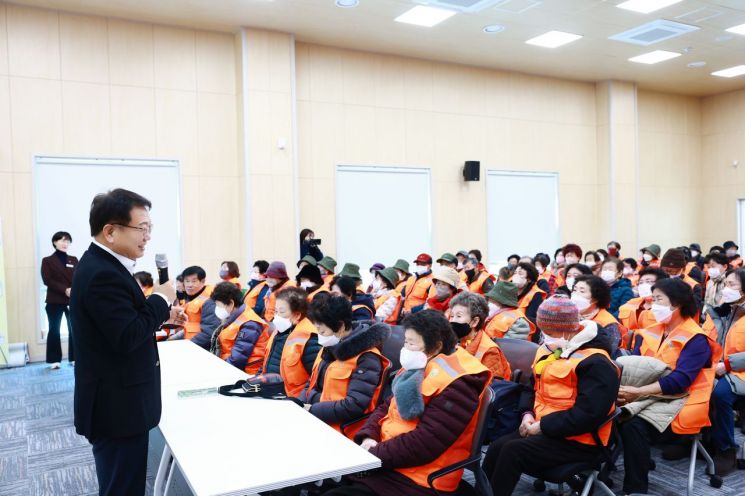 The launch ceremony of the senior citizen job program in Bukmyeon, Uljin County. Provided by Uljin County
Uljin County has reached a major turning point in its local economy with the construction of Shin Hanul Units 3 and 4. To maximize the employment and economic ripple effects from the 10-year construction plan, Uljin County has signed a local cooperation agreement with Korea Hydro & Nuclear Power and construction companies to expand the participation of local companies in construction projects and to provide quality jobs for local residents through skilled labor training and employment support.
Since being selected as a candidate site for the National Nuclear Hydrogen Industrial Complex in 2023, Uljin County has established the visions of "K-Energy Leader Uljin" and "Nuclear Clean Hydrogen Production City Uljin," and is steadily preparing for the "final approval of the national industrial complex" and the "hydrogen city development plan." As Uljin evolves into an industrial city for hydrogen economy self-reliance, the county aims to attract related companies centered on anchor enterprises within the industrial complex to create large-scale new jobs, with the goal of transforming from a city of 46,000 to a "resident population of 100,000."
▲Strengthening Welfare for Residents
With 33% of its population being elderly, Uljin County is a super-aged city and is strengthening its unique welfare system for seniors to ensure a comfortable and stable later life.
In particular, support for bathing and hairdressing expenses for seniors, reinforcement of senior center functions, expansion of communal meal programs, and operation of free laundries are "life-friendly services" that meticulously address even small inconveniences in daily life, leading to high satisfaction among seniors. This year, 2,686 seniors are participating in the "senior job program," an increase of 867 from the previous year, helping to stabilize their lives and promote self-realization and health through work.
The "Uljin Southern Complex Welfare Center," which aims to provide balanced welfare services for different regions and meet diverse welfare needs such as for the elderly, disabled, and volunteers, will begin full-scale implementation this year with the goal of starting construction next year.
To ease the household economic burden in this era of high prices, support for residential electricity bills has been increased from 17,690 won to 27,300 won per month, and support for household water bills has been raised from 5,000 won to 7,000 won per month starting this year. The "free rural bus service," which began in earnest on March 17, is also greatly helping residents' finances.
From this year, all Uljin residents can enjoy a safer daily life with the "Resident Safety Insurance," which has expanded its coverage from 19 to 36 items, providing up to 100 million won for accidents and disasters. The establishment of the "Uljin Emergency Welfare System" to minimize welfare blind spots is another new welfare benefit available to Uljin residents starting this year.
▲Improving Childcare and Educational Environment
Creating an environment where it is easy to have and raise children by strengthening childcare facilities and care services is essential for sustainable growth.
Uljin County operates nine public daycare centers and designates qualified private daycare centers as "Uljin-style public daycare centers," supporting them with functional enhancements and operations to provide quality childcare services. In addition, "Raising Children with Social-Emotional Competence" education is being provided to childcare teachers and parents to establish desirable parenting values and enhance capabilities.
As a result of continuous investment in infrastructure improvement, the "Together Care Centers," which serve elementary school children after school and currently operate in Uljin-eup and Hupo-myeon, will add a third branch in Jukbyeon-myeon this year to provide seamless care services to more dual-income families. The Namuljin Child and Youth Center and Uljin County Family Center, both scheduled for completion in April this year, are expected to support healthy child and youth activities and contribute to the revitalization of family culture.
The most important factor for a sustainable Uljin is nurturing talent to lead the county, namely "education." Uljin County has been designated as a leading area for the 2024 Educational Development Special Zone and is pursuing plans to innovate local public education and foster talent. The core is to improve the local educational environment and settlement conditions through cooperation between Uljin County and the Office of Education, as well as partnerships with universities and industries.
By 2025, Uljin County will focus on nurturing local talent, employment linkage, and digital-based educational innovation. From 2026 onward, the county plans to accelerate support for school education aimed at integrated education/care utilizing local resources and fostering global talent.
▲Strengthening Housing Support
To address housing supply issues and youth housing measures arising from population inflow due to the construction of Shin Hanul Units 3 and 4 and the National Nuclear Hydrogen Industrial Complex, Uljin County launched the Uljin Wolbyeon District Urban Development Project last year. The project includes the construction of around 400 public sale and rental housing units and a youth startup complex cultural space within the site. In addition, the county is easing the housing cost burden for newlyweds by supporting interest on rental deposit loans and monthly rent for young newlyweds.
▲Encouraging Return to Farming and Fishing Villages
To help returnees to farming and fishing villages settle stably, Uljin County provides loans for home purchases, support for home repairs and residential environment improvements, as well as funding for purchasing agricultural machinery and installing greenhouses. The start-up loan program for returnees to farming and fishing is also expected to attract interest from newcomers.
On-site training and mentoring with leading local farms for prospective returnees and new farmers are offered as one-on-one customized education, which is popular among novice farmers.
▲The Era of 10 Million Tourists
For Uljin County, expanding the "living population"?those who visit and engage in consumption and activities regardless of residency?is essential to boosting local vitality, in addition to increasing the resident population. Uljin County is developing and implementing strategies for the "era of 10 million tourists."
With the opening of the Donghae Line (Yeongdeok-Uljin-Samcheok section), Uljin County has entered its first-ever era as a railway city. To maximize the effects of improved transportation accessibility on tourism and economic revitalization, the county will begin developing tourism content tailored to local characteristics and railway-linked tourism projects in earnest this year. In partnership with KORAIL, Uljin County is planning regional theme tourism products and developing railway travel packages, pursuing aggressive marketing to attract railway tourists.
To improve convenience for tourists, the county has operated tourist taxis since March and plans to add city tour buses connecting major tourist attractions and railway stations. The "free rural bus service" is a significant benefit not only for residents but also for tourists.
To improve tourism infrastructure, Uljin County is attracting investment in year-round ocean resorts, creating "try-living-in-the-forest" villages, fishing village experience resorts, and complex spaces for experiencing life in seaside villages, as well as developing themed premium walking trails utilizing local resources such as forests and coastlines to expand unique stay-type tourism facilities.
County Mayor Son Byeongbok said, "Amid the crises of low birthrate, aging population, and the risk of local extinction, the role and administrative capacity of Uljin County as a local government are more important than ever. We will do our utmost to create a vibrant and sustainable 'Hopeful Uljin' where residents can take pride in being 'Uljin residents' by comprehensively promoting strategies to improve settlement conditions and attract the living population."
© The Asia Business Daily(www.asiae.co.kr). All rights reserved.
![Clutching a Stolen Dior Bag, Saying "I Hate Being Poor but Real"... The Grotesque Con of a "Human Knockoff" [Slate]](https://cwcontent.asiae.co.kr/asiaresize/183/2026021902243444107_1771435474.jpg)















