US-China Standoff and Yuan Risk Weigh on Won
"Tariff Negotiation Prospects with Korea and Authorities' Intervention Expected to Limit Further Rise"
On the 9th, the won-dollar exchange rate surpassed 1,480 won, marking the highest level since the financial crisis. This is due to the combined effects of the intense tariff war between the United States and China and the weakening of the yuan.
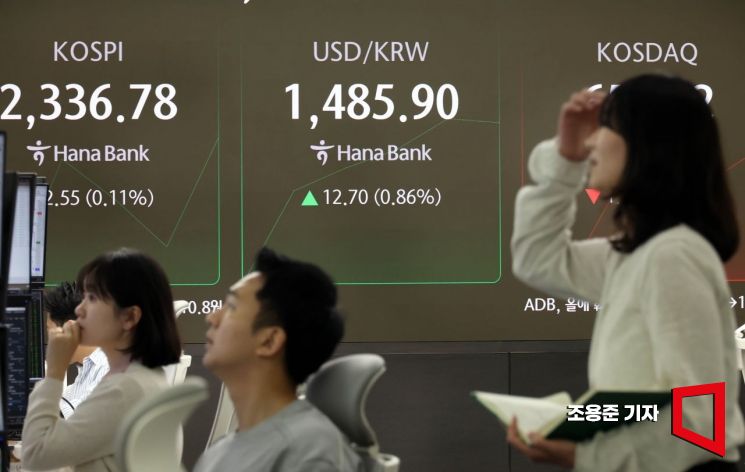 On the 9th, as the won/dollar exchange rate surged sharply, reaching its highest level since the financial crisis during trading hours, the status board in the dealing room at the Hana Bank headquarters in Jung-gu, Seoul displayed the KOSPI and won/dollar exchange rate. On that day, the KOSPI opened at 2,329.99, down 4.24 points (0.18%) from the previous session, while the won/dollar exchange rate started at 1,484.0 won, up 10.8 won. 2025.4.9 Photo by Jo Yongjun
At 9:15 a.m. that day, the won-dollar exchange rate in the Seoul foreign exchange market stood at 1,486.3 won, up 13.0 won from the previous day’s weekly closing price (as of 3:30 p.m.). This is the highest intraday level since March 16, 2009 (1,488.5 won) during the financial crisis.
Overnight, U.S. President Donald Trump announced an additional 50% tariff in response to China’s retaliatory tariffs. As a result, the won broke through 1,480 won in the overnight market, moving in tandem with the offshore yuan and Australian dollar. Continuing this trend, the won-dollar exchange rate opened at 1,484.0 won, up 10.8 won from the previous day’s weekly close, and surged to the high 1,480 won range during the session.
Experts analyzed that risk aversion and the weakening yuan increased upward pressure on the won-dollar exchange rate that day. The upper limit of the exchange rate was expected to reach the 1,490 won level. Min Kyung-won, a researcher at Woori Bank, said, "As the risk of the U.S.-China tariff war intensifies, risk aversion has strengthened, and the won is recording its highest level since the financial crisis due to linkage with the weakening yuan. The White House’s firm stance on imposing a 104% tariff on China caused the offshore yuan exchange rate to soar overnight, and the Nasdaq also turned downward again, creating the worst situation for the won." NH Futures economist Wi Jae-hyun also noted, "If, as on the previous day, Chinese authorities significantly devalue the yuan and hint at a currency war, additional intraday gains in the won will be inevitable." He added, "The won, a risk currency, is highly linked to the yuan, which is under additional depreciation pressure, creating a situation where negative factors overlap."
However, there is also a possibility of a slight retracement of the temporary surge. This is because President Trump mentioned Korea and Japan the previous day, suggesting the possibility of tariff negotiations. Expectations of tariff relief for Korea are positive factors for the won. It is also analyzed that authorities’ fine-tuning and actual intervention will play a role. Researcher Min said, "As the exchange rate breaks the highest point since the financial crisis, the levels that can be called previous highs are 1,514 won and 1,570 won." He added, "While the surge in the exchange rate causes overheating of financial market anxiety and foreign capital outflows, rising import prices may impose constraints on monetary policy, so the foreign exchange authorities are highly likely to actively adjust the pace."
© The Asia Business Daily(www.asiae.co.kr). All rights reserved.
![Clutching a Stolen Dior Bag, Saying "I Hate Being Poor but Real"... The Grotesque Con of a "Human Knockoff" [Slate]](https://cwcontent.asiae.co.kr/asiaresize/183/2026021902243444107_1771435474.jpg)















