Government: "Preparations for Test Trading and Other Issues"
Effect of Global Liquidity Inflow Also Delayed
Martial Law and Impeachment Fallout Suspected, Government Says "Not the Cause"
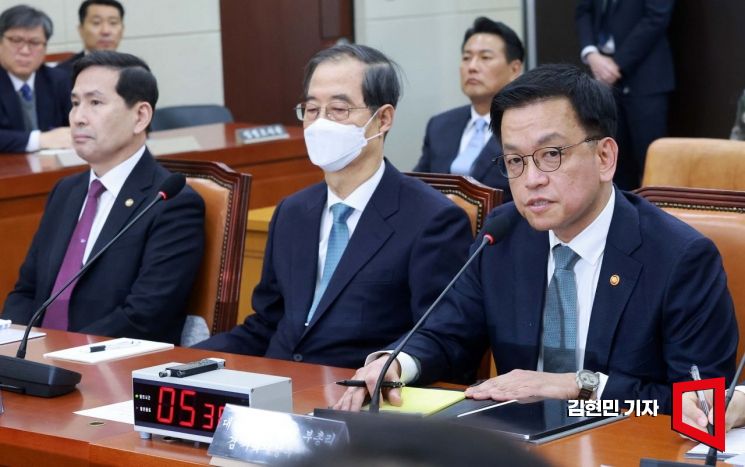 Choe Sang-mok, Acting President and Deputy Prime Minister as well as Minister of Economy and Finance, is speaking at the 3rd hearing of the "Special Committee on the National Investigation into the Charges of Insurrection through the Declaration of Martial Law by the Yoon Seok-yeol Government" held at the National Assembly on February 6, 2025. Photo by Kim Hyun-min
South Korea's government bonds were not included in the World Government Bond Index (WGBI) within this year as initially planned. Analysts suggest this reflects foreign investors' concerns over the tariff shocks originating from the U.S. and the ongoing political turmoil following the presidential impeachment. As foreign capital outflows intensify and the Korean won sharply depreciates against the dollar, the delay in WGBI inclusion timing is expected to act as a new negative factor for the financial and foreign exchange markets.
According to the Ministry of Economy and Finance on the 9th, FTSE Russell of the UK confirmed South Korea's inclusion in the WGBI early that morning. However, the timing of South Korean government bonds' index inclusion was postponed from the originally announced November of this year to April next year. With the delay in the start date, the method of increasing the inclusion weight was also changed from the initially planned 'quarterly phased increase' to a 'monthly phased increase.' This means the inclusion weight will be raised monthly rather than quarterly to complete the inclusion by the planned time.
The WGBI is considered one of the three major global bond indices alongside Bloomberg-Barclays Global Aggregate Index and JP Morgan Emerging Market Bond Index. It is a bond index composed of government bonds from 25 countries including major developed countries such as the U.S., the UK, and Japan, as well as emerging markets. South Korean government bonds were listed as a watchlist country before WGBI inclusion in September 2022 and successfully included in the regular market classification report in the second half of last year. South Korea's expected index inclusion weight is 2.05% (as of March), ranking ninth after the U.S. (41.9%), China (10.0%), Japan (9.7%), France (6.4%), Italy (5.9%), Germany (5.0%), the UK (4.7%), and Spain (3.9%).
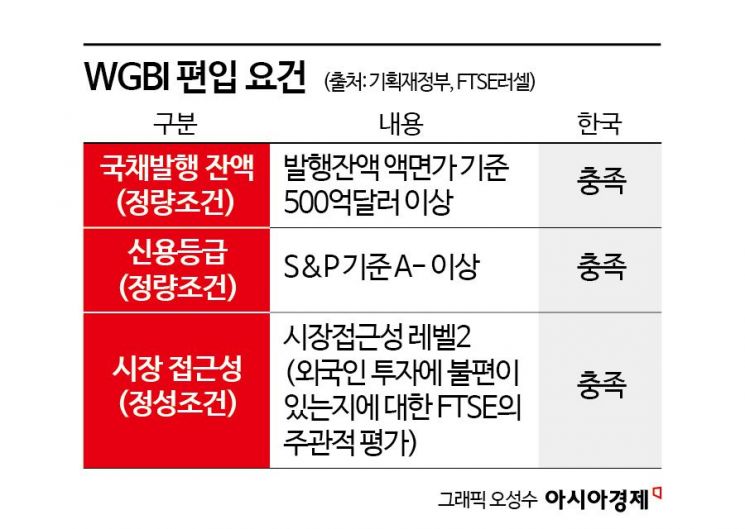
The Ministry of Economy and Finance, the responsible department, explained that the delay in index inclusion reflects demands from major bond market investors in Japan for improved investment conditions. The ministry stated, "This is to allow investors to complete internal procedures for investment execution and to prepare for test trading," adding, "In other countries as well, the timing of inclusion is flexibly decided considering investors' readiness."
However, the delay in inclusion timing has also postponed the inflow effect of global liquidity. Domestic and international financial institutions analyze that it will be difficult to immediately enjoy the stabilization of the foreign exchange market due to the won-dollar exchange rate decline and the interest cost reduction effect from bond price increases. Global funds that make investment decisions based on the WGBI amount to $2.5 trillion. Considering South Korea's weight (2.22%), the government initially predicted that at least $55.5 billion (approximately 82 trillion won) would flow into the domestic market starting this year due to the formal inclusion. This amount is similar to the government's net issuance of treasury bonds for one year.
In the financial investment industry, the delay in FTSE Russell's inclusion timing is seen as an unexpected outcome. This is because it is rare for the inclusion timing to be delayed after passing both the first and second gates for final inclusion. In fact, China is the only case where the timing was adjusted during the index inclusion process.
Some point out that this delay decision is not unrelated to the expanding internal and external negative factors facing South Korea. A financial investment industry official explained, "While the tariff bomb from the Donald Trump U.S. administration is a common issue faced by all trading countries, the political vulnerability revealed through the four-month political turmoil involving emergency martial law and presidential impeachment, along with the resulting foreign exchange market volatility and economic impact, have heightened investors' concerns."
He added, "The delay in inclusion timing could worsen investment sentiment and increase instability in the won's value," expressing concern that "this could be perceived as a new negative factor amid the already weakened net foreign bond buying."
In response, the Ministry of Economy and Finance said, "If the issue had been political uncertainty or problems within the government bond market itself, the inclusion would have failed altogether," emphasizing, "Since the completion date of inclusion remains the same while only the start date was postponed, the possibility that political uncertainty influenced the delay is zero."
© The Asia Business Daily(www.asiae.co.kr). All rights reserved.
![Clutching a Stolen Dior Bag, Saying "I Hate Being Poor but Real"... The Grotesque Con of a "Human Knockoff" [Slate]](https://cwcontent.asiae.co.kr/asiaresize/183/2026021902243444107_1771435474.jpg)
















