Bank of Korea Holds Briefing on Provisional February Balance of Payments
"Current Account Surplus Remains Strong Until March"
"Impact of U.S. Tariffs Expected to Gradually Emerge After April"
"Semiconductor Exports Show Steady Trend Despite Temporary Decline"
"Dividend Income May Be Affected by Tariff Policies, but Overall Impact Limited"
The Bank of Korea stated that the current account outlook for South Korea is "favorable until March," but it expects that from April onwards, the tariff policies of the Donald Trump administration in the United States will gradually have an impact.
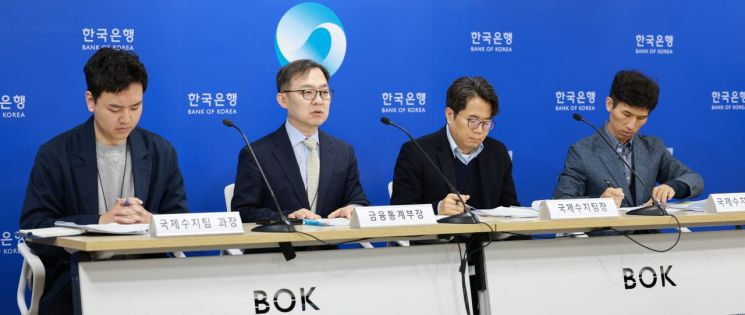 On the morning of the 8th, the 'February 2025 Balance of Payments (Preliminary) Press Briefing' was held at the Bank of Korea in Jung-gu, Seoul. (From left) Kim Tae-ho, Manager of the Balance of Payments Team; Song Jae-chang, Head of the Financial Statistics Department; Kim Sung-jun, Head of the Balance of Payments Team; Kwon Su-han, Manager of the Balance of Payments Team. Provided by the Bank of Korea.
On the 8th, Song Jae-chang, head of the Financial Statistics Department of the Economic Statistics Division 1 at the Bank of Korea, said at the briefing on the 'February Balance of Payments (provisional)' that "It is an unavoidable situation that uncertainty will increase and concerns about economic slowdown will rise in the long term after April." The current account surplus in February was $7.18 billion, continuing a surplus streak for 22 consecutive months. As of February, this is the third highest surplus level in history following 2016 and 2017. The surplus streak is also the third longest since the 2000s.
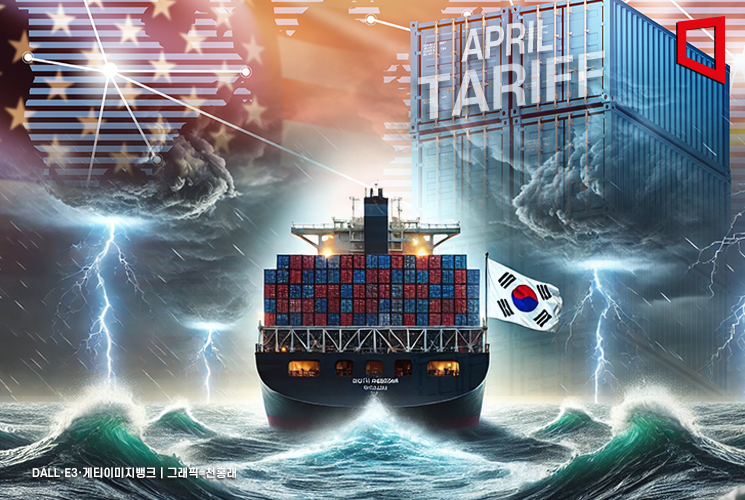
Regarding the significant expansion of the current account surplus in February compared to the previous month ($2.94 billion), Song explained, "This is due to the resolution of seasonal factors in January," adding, "Although semiconductor exports temporarily decreased, the increase in IT items continued, and some non-IT items also showed growth centered on certain products."
Regarding the impact of companies pushing forward export volumes ahead of the U.S. tariff policies, he said, "It is not statistically confirmed," but added, "Since the tariff announcements were forecasted from the end of last year, I think it cannot be completely ruled out."
He expected this favorable trend to continue in March as well. He said, "The goods balance (exports + imports) is favorable in March. It will be manageable to some extent until March, so it should be fine."
From April, it is expected that the impact of U.S. tariffs will be felt in earnest. Song said, "The market evaluates the level of U.S. tariff imposition as strong, so items with a high export ratio to the U.S., such as automobiles, automobile parts, and steel, will inevitably be affected," adding, "Indirect exports or Southeast Asia may also be impacted. If global trade slows down, it could also act as a factor reducing exports to China."
He added, "However, rather than deteriorating rapidly, the impact will gradually take place over time," and explained, "For major export items, contracts are made 2 to 3 months in advance, so there is a time lag before it is reflected in exports. The government is aware of the issue and is making efforts to support exports, and the Trump administration is also leaving room for negotiation, so we need to monitor the situation carefully while observing these impacts."
He also anticipated that the U.S. tariff imposition could affect dividends of domestic companies. Song said, "Dividend income and interest income from primary income are basically showing steady growth and are expected to continue," but added, "Due to the tariff policy, dividend income from local companies in Canada, Mexico, and Southeast Asia could be affected by reduced exports, which in turn impacts sales at local factories, potentially acting as a factor reducing primary income."
He further stated, "However, at present, we judge that the tariff policy will not affect the steady flow of primary income to a significant extent."
Although semiconductor exports in February decreased by 2.5% compared to the previous month, he expected a steady trend to continue through the first half of this year. Song said, "High value-added semiconductor exports continued to show a steady trend in March and are expected to continue," adding, "Low value-added semiconductor exports decreased due to price factors but have started to increase again in March, so exports are somewhat supporting the overall situation."
© The Asia Business Daily(www.asiae.co.kr). All rights reserved.
![Clutching a Stolen Dior Bag, Saying "I Hate Being Poor but Real"... The Grotesque Con of a "Human Knockoff" [Slate]](https://cwcontent.asiae.co.kr/asiaresize/183/2026021902243444107_1771435474.jpg)
















