The Ministry of Education reaffirmed its previous position that the number of medical school admissions for the 2026 academic year will be determined based on the 'medical school class participation rate.'
Although the impeachment of former President Yoon Seok-yeol has caused major national projects to lose momentum, it is said that the number of medical school admissions next year will proceed regardless of the impeachment.
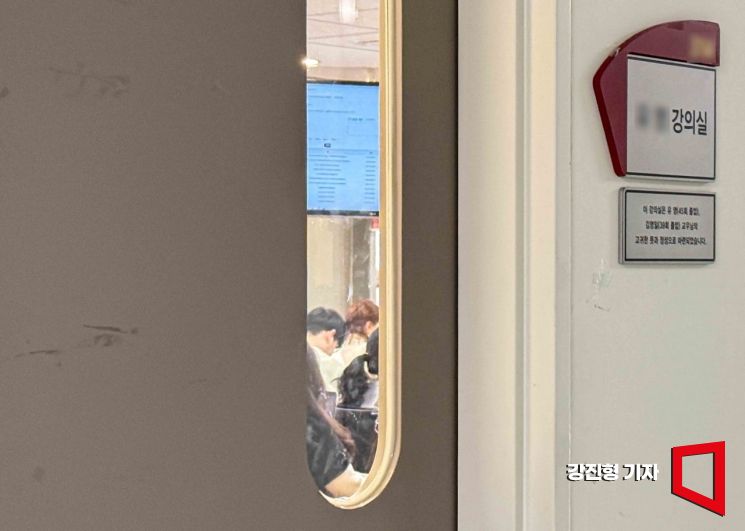 As Korea University announced that it will send expulsion notices to medical students who have not returned, students are attending classes at the Korea University College of Medicine in Seongbuk-gu, Seoul on the 28th. March 28, 2025. Photo by Kang Jin-hyung
According to education authorities on the 8th, all students at 40 medical schools nationwide have completed registration. However, some have stated they will continue their protest by taking leaves of absence or not attending classes after returning, so it is expected to take some time before classes return to normal. The Ministry of Education considers the normal conduct of classes this year at medical schools as a full 'return.' When the Ministry announced on the 7th of last month that it would freeze next year's medical school admissions, it set the conditions of 'all medical students returning by the end of March' and 'normalization of medical education' through this.
A Ministry of Education official said at a regular briefing on the 7th, "The number of admissions will be decided as promised (frozen upon medical students' return)," adding, "It will depend on the level of class participation regardless of the impeachment."
The Ministry understands that class participation rates are increasing mainly among third- and fourth-year medical students. Third- and fourth-year students mainly attend hospital clinical rotations, and to take the national medical licensing exam, they must complete 36 hours per week and a total of 52 weeks of clinical practice, so it is analyzed that it would have been burdensome to continue refusing classes. A Ministry official said, "When senior students return, (pre-med students) tend to follow along," expressing hope that the increase in class participation will spread to other grades. At Seoul National University College of Medicine, it is reported that most students from first to fourth year (except five) have all returned to classes. Yonsei University College of Medicine sent notices of expected failure on the 7th to fourth-year students who have not returned to classes.
The Ministry of Education plans to finalize next year's medical school admissions after monitoring the nationwide medical school class return situation this month. This is because each university must submit their admission numbers to the Korea Council for University Education by the 30th. If the class participation rate is judged to be at a 'level where normal classes are possible,' next year's medical school admissions will be frozen at the pre-increase level of 3,058 students.
© The Asia Business Daily(www.asiae.co.kr). All rights reserved.
![Clutching a Stolen Dior Bag, Saying "I Hate Being Poor but Real"... The Grotesque Con of a "Human Knockoff" [Slate]](https://cwcontent.asiae.co.kr/asiaresize/183/2026021902243444107_1771435474.jpg)















