Macroeconomic and Financial Issues Meeting Held
"Overseas Factors Driving Volatility"
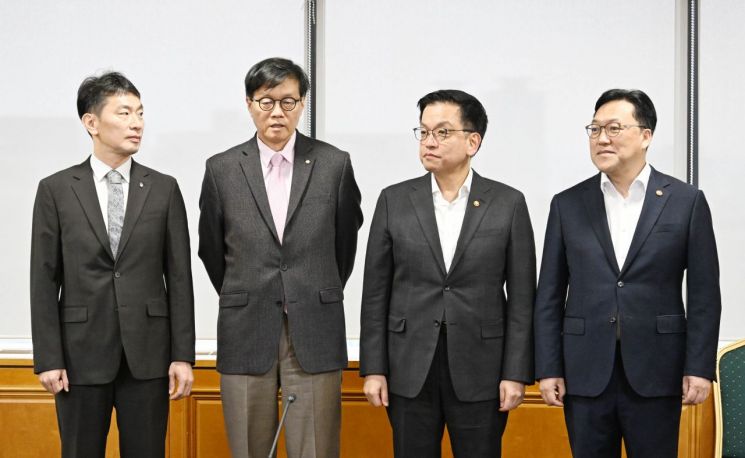 Choi Sang-mok, Deputy Prime Minister for Economic Affairs and Minister of Economy and Finance, is conversing with attendees before the Macroeconomic and Financial Issues Meeting held on the 8th at the Korea Federation of Banks in Jung-gu, Seoul. (Source: Ministry of Economy and Finance)
Choi Sang-mok, Deputy Prime Minister for Economic Affairs and Minister of Economy and Finance, on the 8th urged all institutions to continuously review and prepare contingency plans to swiftly implement market stabilization measures if necessary, in response to the increased volatility in financial and foreign exchange markets caused by the US tariff onslaught.
On the same day, Deputy Prime Minister Choi presided over the Macroeconomic and Financial Issues Meeting (F4 Meeting) at the Government Seoul Office, checking the trends in domestic and international financial and foreign exchange markets since the weekend and discussing future response directions. The meeting was attended by Lee Chang-yong, Governor of the Bank of Korea, Kim Byung-hwan, Chairman of the Financial Services Commission, and Lee Bok-hyun, Governor of the Financial Supervisory Service.
Deputy Prime Minister Choi also emphasized, "Please conduct a thorough analysis of the impact of changes in the trade environment on major countries' growth, inflation, and monetary policies, the policy responses of each country, and the ripple effects on the domestic economy."
Since the US government's announcement of reciprocal tariff measures on the 3rd, global financial markets have seen heightened risk aversion, with stock markets in the US, Europe, and Asia all plunging simultaneously, and the currencies of various countries fluctuating sharply against the US dollar, significantly increasing volatility.
The previous day, the won-dollar exchange rate surged by 33.7 won, approaching the 1,470 won mark. The domestic stock market plummeted over 5% due to the US reciprocal tariff shock. The KOSPI closed at 2,328.20, down 5.57% from the previous session, as foreign investors engaged in massive selling, while the KOSDAQ ended at 651.30, down 5.25% from the previous session, marking its lowest level this year.
Participants assessed that "recently, overseas factors are leading the volatility in financial markets more than domestic factors," and stated, "Since the volatility in domestic financial and foreign exchange markets is likely to continue for some time, we will closely monitor market conditions with heightened vigilance centered on the F4 meetings."
© The Asia Business Daily(www.asiae.co.kr). All rights reserved.
![Clutching a Stolen Dior Bag, Saying "I Hate Being Poor but Real"... The Grotesque Con of a "Human Knockoff" [Slate]](https://cwcontent.asiae.co.kr/asiaresize/183/2026021902243444107_1771435474.jpg)















