10% Basic Tariffs Take Effect on the 5th... Additional Tariffs on the 9th
Trump Maintains Determination on Tariffs Despite Stock Market Shock
Criticism from Wall Street... Ackman: "Heading Toward an Economic Nuclear Winter"
The three major indices of the U.S. New York stock market have been plunging for three consecutive days as of the 7th (local time) due to President Donald Trump's mutual tariff bombardment. Although the tariffs are causing megaton-level shocks to the U.S. and global stock markets, panic selling continues as President Trump maintains his determination to push forward with the tariff policy.
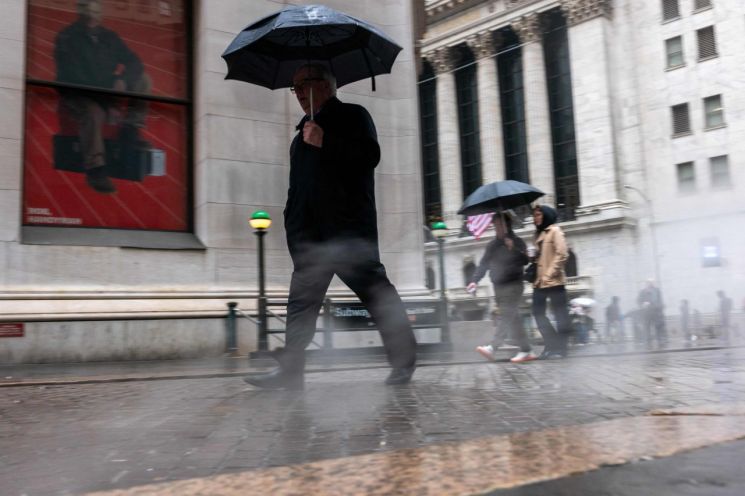
At 10:03 a.m. in the New York stock market on that day, the Dow Jones Industrial Average (Dow), centered on blue-chip stocks, was trading at 37,252.58, down 1,062.28 points (2.77%) from the previous trading day. The S&P 500, focused on large-cap stocks, fell 121.26 points (2.39%) to 4,952.82, and the Nasdaq, centered on tech stocks, dropped 344.39 points (2.21%) to 15,243.39.
By individual stocks, U.S. electric vehicle maker Tesla was down 4.09%. Heavy equipment manufacturer Caterpillar was down 2.8%. Apple was down 1.84%.
The U.S. mutual tariff bomb is shocking the stock market. The basic 10% tariff among the mutual tariffs announced by President Trump against major global trading partners took effect on the 5th. From the 9th, punitive additional tariffs imposed on the "worst offenders" will take effect. Investors had hoped for news that the Trump administration was close to reaching tariff reduction negotiations with some countries or would delay the punitive additional tariffs effective on the 9th, but President Trump has instead shown a strong determination regarding the tariff policy. On the 6th, regarding the U.S. stock market plunge, President Trump said, "Sometimes you have to take medicine to fix something." He stated, "We have a $1 trillion trade deficit with China and suffer losses of hundreds of billions of dollars annually," adding, "We will not trade unless this problem is resolved."
With the U.S. showing no intention of backing down and trading partners like China announcing retaliatory measures, concerns about a global trade war and economic recession are spreading. China announced it would impose retaliatory tariffs at the same level of 34% as the U.S. Canada and the European Union (EU) are also preparing retaliatory measures.
Wall Street is pouring out criticism. Bill Ackman, billionaire investor and chairman of Pershing Square Capital who supported President Trump in last year’s presidential election, said, "We are heading toward a self-inflicted 'economic nuclear winter,'" adding, "The president is losing trust among global corporate leaders. This is not what we voted for."
Chichard Safferstein, Chief Investment Officer (CIO) of Treasury Partners, said, "The sharp and sudden stock decline is a price revaluation reflecting the impending recession due to tariff burdens," and predicted, "The market will not rebound until tariffs are reduced through negotiations, valuations fall to very attractive levels, and fundamentals improve."
Bond yields are rising mainly in long-term bonds. The 10-year U.S. Treasury yield, a global bond yield benchmark, rose 7 basis points (1bp=0.01 percentage point) from the previous trading day to 4.06%, while the 2-year U.S. Treasury yield, sensitive to monetary policy, fell 1 basis point to 3.65% compared to the previous day.
The Chicago Board Options Exchange (CBOE) Volatility Index (VIX), known as the "fear index" of Wall Street, surged 18.9% from the previous day to 53.89.
© The Asia Business Daily(www.asiae.co.kr). All rights reserved.
![Clutching a Stolen Dior Bag, Saying "I Hate Being Poor but Real"... The Grotesque Con of a "Human Knockoff" [Slate]](https://cwcontent.asiae.co.kr/asiaresize/183/2026021902243444107_1771435474.jpg)















