From the 5th:
"Millennium Forest, Camellia Blooms" Theme
Every spring, the Camellia Forest at Okgyeongsa Temple, which stirs hearts with its crimson flower buds bursting among the sparkling green leaves, once again welcomes citizens and tourists with festivals and art exhibitions.
The Okgyeongsa Temple Camellia Forest is said to have been created by Doseon, who emphasized the concept of bibopungsu (a geomantic principle to supplement deficiencies), in order to suppress the fiery energy around the temple and invigorate the land's spirit while renovating Okgyeongsa Temple.
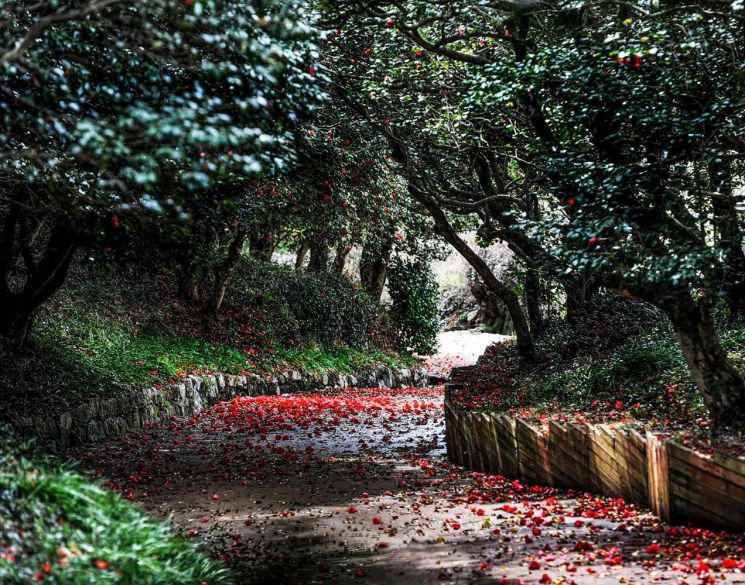
Although Okgyeongsa Temple was destroyed by fire in 1878 and now only a few foundation stones remain, the camellia trees with their thick growth rings continue to bloom dark red flowers every spring, carrying on a thousand-year history.
As the largest of its kind in the country, preserving the original landscape of southern temple forests and creating beautiful scenery, the Okgyeongsa Temple Camellia Forest hosts the 'Gwangyang Millennium Camellia Festival' every spring.
This year, under the theme 'Millennium Forest, Camellia Blooms,' a variety of programs such as a children's drawing contest, writing contest, nostalgic treasure hunt, and Doseon Guksa village experience will be held over two days starting from the 5th.
At the Jeonnam Provincial Museum of Art, built on the site of the old Gwangyang Station, visitors can view 'Camellia' by artist Kang Jongyeol, a work born from powerful inspiration drawn from the Okgyeongsa Temple Camellia Forest.
'Camellia (2015),' which fills an entire wall of the exhibition hall, is a monumental work composed of five canvases, each measuring 193.9 cm in height and 259.1 cm in width, and was inspired by the 'Okgyeongsa Temple Camellia Forest.'
Artist Kang Jongyeol explored the essence of existence by mediating the strong vitality of camellias, delving into the relationship between nature and human life. He visited camellia colonies across the country, from Jeju Island to Ulleungdo, and, captivated by the Okgyeongsa Temple Camellia Forest, visited the site multiple times and dedicated several years to completing his work.
Kang focused on the deep and profound historicity of the Okgyeongsa Temple Camellia Forest. He abstracted the fleeting emotions created by the scattering of light, birdsong, and the sound of wind that awaken the darkness of the forest densely filled with camellia trees twisted and gnarled by time, resulting in a masterpiece.
Kang Jongyeol said, "I cannot express how happy I was to see the surroundings transform as the light penetrated and scattered through the Okgyeongsa Temple Camellia Forest. I visited Okgyeongsa Temple many times. The forest holds the colors and mysteries bestowed by the passage of time. Art must endure, and the profound historicity of the Okgyeongsa Temple Camellia Forest, which has lasted a thousand years, resonated with the values I pursue, giving me powerful inspiration."
The Kang Jongyeol Invitational Exhibition 'Camellia, The Face of Time' at the Jeonnam Provincial Museum of Art will continue until the 25th of next month.
Kim Miran, head of the Gwangyang City Tourism Division, said, "The Okgyeongsa Temple Camellia Forest is a space for contemplation that embodies the aesthetics of emptiness and fullness, with over 10,000 camellia trees densely planted on the empty site of the former temple. I hope visitors will come to the Okgyeongsa Temple Camellia Forest, where the 8th Gwangyang Millennium Camellia Festival is being held this weekend, to enjoy a variety of festival content amidst the energy of a thousand years, and visit the provincial museum to experience how the camellia forest has been sublimated into art."
© The Asia Business Daily(www.asiae.co.kr). All rights reserved.
![Clutching a Stolen Dior Bag, Saying "I Hate Being Poor but Real"... The Grotesque Con of a "Human Knockoff" [Slate]](https://cwcontent.asiae.co.kr/asiaresize/183/2026021902243444107_1771435474.jpg)















