6270 Homes Repaired and 1317 Vacant Houses Demolished
216 Sites Equipped with City Gas, Sewage, and Communal Facilities
KCC, Commax, Kyungdong Navien, and KCC Shinhan Wallpaper Join the Effort
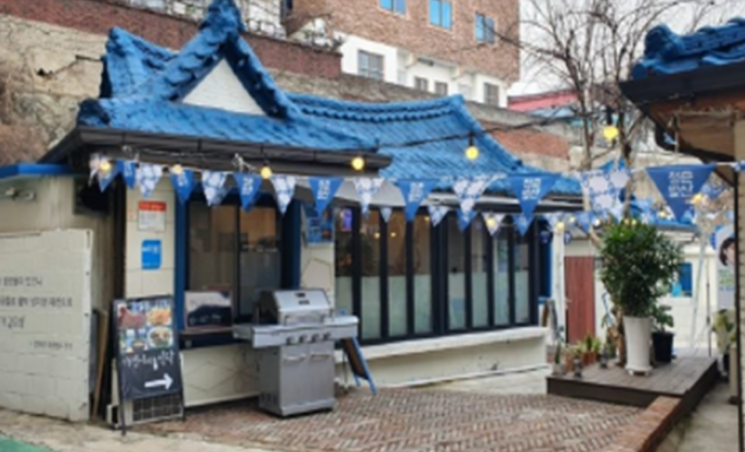 An old house in Balsan Creative Cultural Village, Seo-gu, Gwangju, has been reborn as 'Cheongchun Village' through the Saeteul Village Project. The aging house was renovated and transformed into a community space for the village. Provided by the Ministry of Land, Infrastructure and Transport
Just 10 years ago, residents of the lighthouse village in Gangneung-si, Gangwon Province, shared communal restrooms. In Haedoji Village, Yeongdo-gu, Busan, the steep terrain made it difficult to install sewage systems, causing wastewater to accumulate and odors to spread, leading to sanitation problems. Now, not only water and sewage facilities but also city gas have been installed, along with security cameras (CCTV). The Saetteul Village Project, which transformed daily life in urban vulnerable areas, has reached its 10th anniversary.
On the 3rd, the Ministry of Land, Infrastructure and Transport marked the 10th anniversary of the introduction of the "Urban Saetteul Village Project" (Urban Vulnerable Area Living Condition Improvement Project) by announcing its achievements and signing a business agreement to promote the "Public-Private Partnership Type Old House Improvement Project" in 2025, which repairs aging houses in cooperation with the private sector.
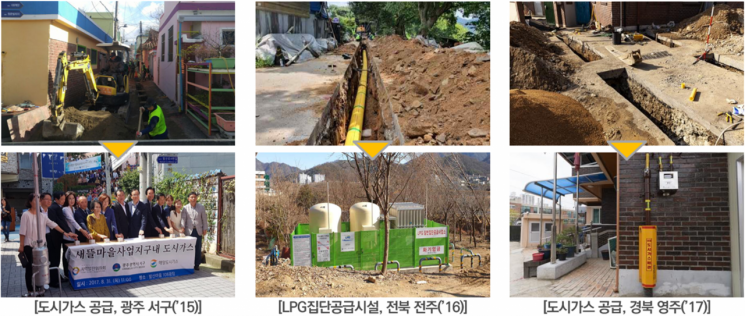 Urban gas and LPG supply are projects with very high resident satisfaction. The photo shows the urban gas supply construction in progress at a Saetteulmaeul project site in Seo-gu, Gwangju. Until now, urban gas had not been available, so residents had to rely on briquettes or LPG cylinders for their daily needs. The second photo shows an LPG collective supply facility installed in a village in Jeonju, Jeonbuk. In areas where it is difficult to introduce urban gas, separate LPG facilities were installed to improve energy accessibility. The third photo shows the newly connected urban gas at a Saetteulmaeul project site in Yeongju, Gyeongbuk. Gas meters and piping were installed on the exterior walls of residents' homes. Provided by the Ministry of Land, Infrastructure and Transport.
The Saetteul Village Project is jointly managed with the Presidential Commission on Local Autonomy and mainly targets urban vulnerable areas formed long ago, such as hillside villages, shantytowns, and refugee settlements. These areas lacked basic infrastructure, had dilapidated houses, and most residents were elderly or low-income. The project laid down basic infrastructure such as roads, sewage systems, and city gas, and eliminated or renovated communal restrooms. Its goal was to repair old houses to enable residents to live with dignity. Since its introduction in 2015, 182 villages nationwide have been selected as project sites, with 98 already completed. Excluding 5 canceled projects, construction is currently underway in 79 locations.
The total budget invested so far amounts to 542.5 billion KRW, of which about 379.8 billion KRW is national funding. In the areas where the project was implemented, not only were water supply and sewage pipelines installed and city gas connected, but also living infrastructure such as parking lots, communal laundry rooms, and village community spaces were established, along with repairs of old houses and demolition of vacant homes.
Above all, residents felt a significant impact. In a satisfaction survey conducted by the Ministry of Land, Infrastructure and Transport, 87.2% of all respondents answered that they were "satisfied." "Very satisfied" accounted for 24.5%, "satisfied" 62.7%, "neutral" 11.0%, and only 1.8% were "dissatisfied." Satisfaction was particularly high regarding the expansion of convenience facilities, installation of disaster prevention infrastructure, and housing improvements.
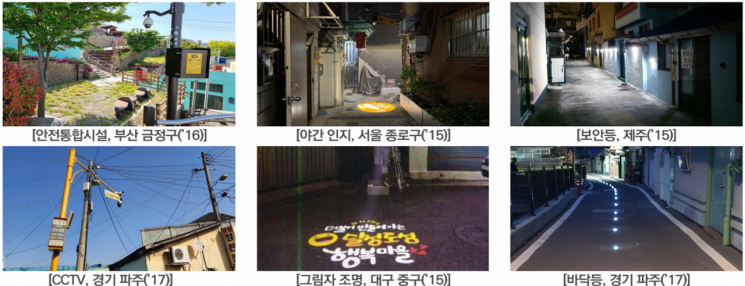 Safety integrated facilities, CCTV, security lights, and shadow lighting installed in Saetteul Village project sites. The ground lights installed along the alleys in Paju-si, Gyeonggi-do, provide continuous lighting at regular intervals along narrow paths to ensure pedestrian safety. Provided by the Ministry of Land, Infrastructure and Transport
The project was also linked with support from other ministries. Through the Ministry of Justice’s Crime Prevention Environmental Improvement Project, security CCTV and emergency bells were installed. It also created synergy effects by connecting with the Ministry of Environment’s slate roof removal project and the Ministry of Health and Welfare’s elderly care services.
Since 2018, to complement the limitation of being mainly financially supported, the "Public-Private Partnership Type Old House Improvement Project" has been conducted concurrently. This method repairs houses by utilizing private funds and expertise. So far, 1,104 households in 32 villages have been renovated. In this process, companies such as KCC, Commax, Kyungdong Navien, and KCC Shinhan Wallpaper supported windows, boilers, and wallpapers, while the Housing and Urban Guarantee Corporation provided sponsorship funds, and the international housing welfare nonprofit Korea Habitat took charge of construction.
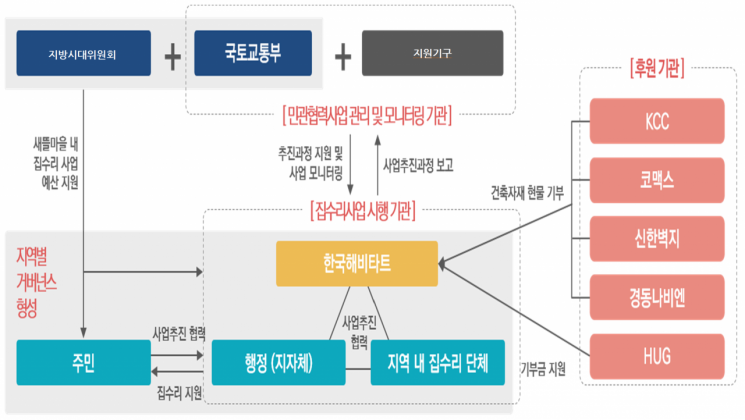 Newtteul Village Project Implementation System. The project is carried out by a professional nonprofit organization (Korea Habitat) in collaboration with home repair groups, utilizing government budgets, in-kind contributions from private companies, and donations from public institutions (HUG). Provided by the Ministry of Land, Infrastructure and Transport
This year, the Ministry of Land, Infrastructure and Transport plans to promote the public-private partnership type house repair project targeting about 250 households in five villages nationwide. The selected areas are Yeongju, Bonghwa, and Yeongcheon in Gyeongbuk Province; Gwangyang in Jeonnam Province; and Samcheok in Gangwon Province.
Lee Sang-joo, Director of the Land and Urban Office at the Ministry of Land, Infrastructure and Transport, said, "We will continue to expand the Saetteul Village Project to ensure a minimum quality of life anywhere in the country," adding, "Since house repairs are the area where residents feel the most tangible impact, the public and private sectors will work together to support this effort."
© The Asia Business Daily(www.asiae.co.kr). All rights reserved.
![Clutching a Stolen Dior Bag, Saying "I Hate Being Poor but Real"... The Grotesque Con of a "Human Knockoff" [Slate]](https://cwcontent.asiae.co.kr/asiaresize/183/2026021902243444107_1771435474.jpg)

















