"Korea is my birthplace and my root. Based on the experience I gained in France, I want to serve as a bridge between Korea and France." (Attorney Linard Kim)
"Korean companies have great potential to become partners in Europe in manufacturing industries such as defense, semiconductors, and secondary batteries, as well as in consumer goods." (Attorney Hong Seung-pyo)
Attorney Linard Kim was adopted to France as a child and raised by a Swedish mother. He studied in Germany and France and became the head of the French law firm GGV Avocats. Kim, who mainly advises German investment funds on real estate investments in France, has been active at GGV since 2001 and gained attention during the 2008 global financial crisis for advising on the renegotiation of real estate loans.
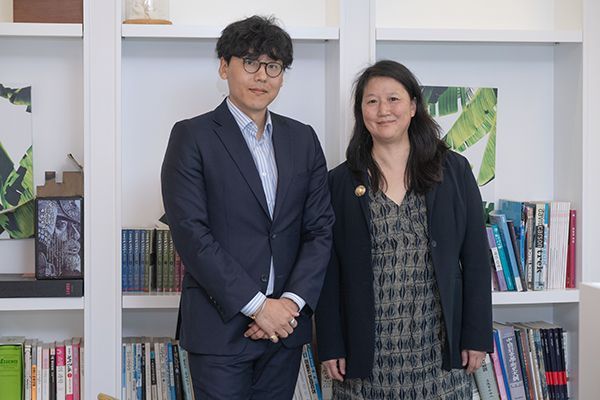
Attorney Hong Seung-pyo obtained his lawyer qualification in Luxembourg. He works throughout Europe, including Luxembourg, Belgium, France, and Germany. He mainly advises on European regulations and industries and is also actively engaged in lobbying activities with the European Union (EU) and the French government.
We met the two attorneys who visited Korea on March 27. Below is a Q&A with them.
- After being adopted from Korea to France, you completed your studies in Germany and France and now lead a French law firm. How has your personal background influenced your career as a lawyer?
Linard Kim (Kim): My experience studying law in Germany greatly helped me develop an international perspective as a lawyer. While working in France, I naturally became a bridge between France and Germany by mainly advising German-speaking clients, especially German investment funds. Now, I hope to play a similar role between Korea and France. Since Korea is my birthplace and root, I have a strong desire to connect my experience in France with Korea.
- I am curious about why you chose Germany.
Kim: Learning German as my first foreign language was the starting point. When I was considering my career path in high school, a teacher suggested, "Try studying law in Germany." My Swedish mother also encouraged me. In Sweden, there is a 'gap year' culture where students spend about a year abroad studying or working after high school graduation. In a similar way, I started studying law in Germany. Later, I returned to Paris and studied French law concurrently. As a result, I became a lawyer familiar with both French and German legal systems.
- The European real estate market has recently been shrinking. What risks do European investors worry about the most?
Kim: Since the COVID-19 pandemic, the work-from-home culture has become established, leading companies to reduce office space. Consequently, demand for commercial real estate has decreased, and prices have fallen. Additionally, the European Central Bank (ECB) raised interest rates, increasing borrowing costs and tightening overall liquidity. Investment funds across Europe prefer refinancing, which has increased advisory demand. Recently, there has also been a growing trend to convert commercial real estate into residential use. Such projects are actively discussed, especially in areas like La D?fense in Paris.
- I heard you provided similar advice during the 2008 financial crisis.
Kim: At that time, banks were the main clients. German banks had made large-scale investments in French real estate, and after the financial crisis, it became necessary to restructure real estate-backed loans. Some funds liquidated their entire holdings, while others used real estate assets as collateral to leverage and protect other portfolios. Recently, there is high demand to fully renovate older buildings that do not meet ESG standards and convert them into leasable assets. Given the current high vacancy rates, this is a prime example of turning a crisis into an opportunity.
- Could you share any experiences collaborating with Korean companies or institutions?
Kim: I once introduced the French startup and industrial ecosystem at a seminar on entering France hosted by Seoul City Hall. I also advised on boutique store lease contracts representing Korean luxury brands in Paris. Recently, I represented a Korean fund investing in real estate in southern France in a licensing-related dispute.
- Attorney Hong Seung-pyo, you are active mainly in Luxembourg, France, and Germany. What are the main trends in the European legal market recently?
Hong Seung-pyo (Hong): Traditionally, Korean companies often established production bases in France, Germany, and Eastern Europe. Recently, Luxembourg and the Netherlands have also gained attention. Luxembourg is the second-largest investment fund domicile globally after the United States. The Netherlands is frequently chosen for establishing holding companies within Europe. Recently, financial centers such as Paris, Frankfurt, and Luxembourg have shared London's role as a financial hub, especially after Brexit, with Paris taking on part of the international financial center role.
- I understand you also work as a lobbyist in Europe. What are your main areas of activity and current issues?
Hong: Brussels, Belgium, is the heart of EU policy where the European Commission is located. When EU-level regulatory directions are set here, they influence regulations in member states. Currently, lobbying around regulations on private equity and hedge funds is active. Unlike North America, there is almost no exchange related to private equity between Asia, especially Korea, and Europe. I aim to bridge this gap and help Korean institutional investors have a stronger voice in EU regulatory discussions.
- Are there any industries or regulatory issues you are focusing on recently?
Hong: At the European level, strategic industries such as defense, semiconductors, and secondary batteries are being reexamined. Since the Ukraine-Russia war, strengthening defense industry capabilities has become a core EU agenda. France, a traditional defense powerhouse, is eager to cooperate with Korea. The legal environment in Europe is also rapidly changing in sectors like space industry and fintech. In this process, understanding both EU-level regulations and member state regulations simultaneously is important. Korean companies still have relatively low understanding of EU law. In the mid to long term, it is necessary to strengthen responsiveness in neutral jurisdictions like Brussels.
- From the perspective of Korean companies, how should they strategically view the US and European markets?
Hong: The US remains the largest single market globally, but uncertainty is high due to the potential return of President Trump and protectionism. The EU can be a relatively stable alternative market. While conditions for entering the US market are becoming stricter, Europe has great potential for cooperation in areas where Korean companies have strengths, such as defense and consumer goods. Europe is a market strong in manufacturing and traditional industries rather than technology, so Korean companies have many opportunities to be chosen as partners in these sectors. When setting corporate strategies, it is necessary to reconsider the European market to diversify risks.
Lee Jin-young, Legal Times Reporter
※This article is based on content supplied by Law Times.
© The Asia Business Daily(www.asiae.co.kr). All rights reserved.
![Clutching a Stolen Dior Bag, Saying "I Hate Being Poor but Real"... The Grotesque Con of a "Human Knockoff" [Slate]](https://cwcontent.asiae.co.kr/asiaresize/183/2026021902243444107_1771435474.jpg)















