Consumer Price Inflation Rate at 2.1% Last Month
Inflation Remains in the 2% Range for Three Months
"Close to Target for January-March"
Wildfire Damage Not Yet Reflected...
Processed Food Prices Continue to Rise
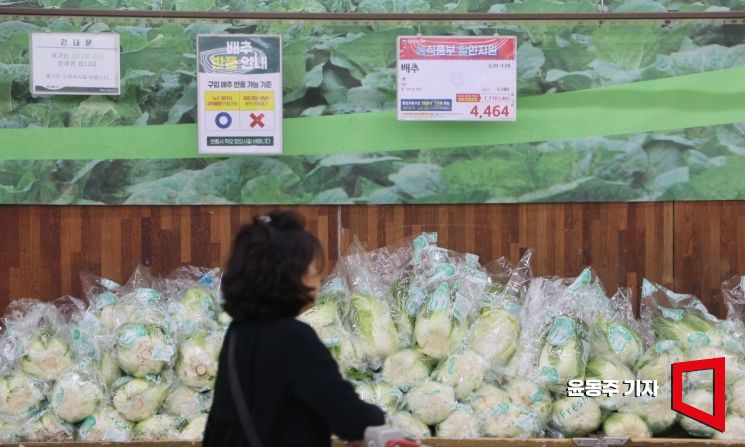 On the 24th of last month, napa cabbages were displayed at the Yangjae Hanaro Mart in Seoul. 2025.03.24 Photo by Yoon Dong-joo
The consumer price inflation rate has been hovering around 2% for three consecutive months. While the government has assessed the overall trend as stable, the inflation rates for personal services and processed foods are steep. There are also forecasts that prices of agricultural products, mainly produced in the Yeongnam region, could rise due to last month's wildfire damage.
Inflation around 2% for three months... "Close to target for January-March"
According to the 'March Consumer Price Trends' released by Statistics Korea on the 2nd, the consumer price index last month rose by 2.1% compared to a year earlier. This shows a slight increase from February's 2.0%. The consumer price inflation rate has been on an upward trend since hitting a low of 1.3% in October last year, rising to 1.5% in November, 1.9% in December, and then climbing back into the 2% range at the start of the new year, maintaining a rate in the low 2% range for three consecutive months.
Among the items, personal services contributed 1.05 percentage points to the overall inflation rate, leading the rise. Last month, the inflation rate for personal services was 3.1%, up 0.1 percentage points from the previous month. Within personal services, the dining-out sector remained steady at 3.0%, but the non-dining-out sector rose by 0.3 percentage points from 2.9% to 3.2%. In February, travel product prices were low, but with the arrival of spring last month, increased travel demand pushed prices back up.
Processed foods also recorded a high inflation rate, rising 3.6% compared to the same month last year. The increase in processed food prices has been gradually expanding, following 2.7% in January and 2.9% in February. Last month, prices of coffee (8.3%), bread (6.3%), kimchi (15.3%), and ham and bacon (6.0%) rose rapidly. This is interpreted as a result of multiple factors, including rising raw material prices due to climate change, high exchange rates since the end of last year, and labor cost burdens.
Nevertheless, the government assessed the inflation as stable. Lim Hye-young, head of the Price Policy Division at the Ministry of Economy and Finance, said, "The Bank of Korea's consumer price inflation target is 2.0%," adding, "The period from January to March this year is moving close to the target." Core inflation, which shows medium- to long-term trends, is also at a stable level. The core inflation index, excluding volatile food and energy items, rose 1.9%, and the index excluding agricultural products and petroleum products increased by 2.1%.
Wildfire damage not yet reflected... Processed food prices continue to rise
 On the 27th of last month, a farmer was repairing a damaged livestock barn in Imha-myeon, Andong, Gyeongbuk. Photo by Yonhap News
However, there are also factors that could drive inflation higher in the future. The impact of last month's wildfire damage in the Yeongnam region has not yet been reflected in the statistics. If supply and demand for spring cabbage, garlic, dried chili peppers, apples, and plums?mainly produced in Gyeongbuk and Gyeongnam?are disrupted, agricultural product prices could rise. Currently, the government is estimating the damage visually in areas where the fire has been completely extinguished, and plans to release inflation data reflecting the exact damage situation next month.
The rising trend in processed food prices is also a burden. Lee Doo-won, Economic Trend Statistics Officer at Statistics Korea, forecasted, "(Processed food prices) are expected to rise over several months." Processed food prices have been suppressed over the past two years but now seem unable to withstand recent upward pressure. In 2023, the government formed a dedicated team to stabilize prices and managed overall processed food prices. At that time, Deputy Prime Minister and Minister of Economy and Finance Choo Kyung-ho personally recommended lowering ramen prices.
Meanwhile, the living cost index, which is composed mainly of frequently purchased items and closely reflects perceived inflation, rose 2.4% compared to a year ago, showing a slight slowdown from the previous month's 2.6%. Among these, food prices increased by 2.8% compared to a year earlier, with the rate of increase growing, while non-food items rose 2.3%, lower than the previous month. The living cost index including rent and monthly lease payments also rose by 2.2%.
The fresh food index, which includes fish, vegetables, and fruits, fell 1.3% compared to the same month last year. This marks the second consecutive month of decline following last month. Fresh fruits dropped sharply by 6.1%, while fresh vegetables and fresh fish rose by 1.8% and 3.6%, respectively. Agricultural product prices fell 1.1% compared to the same month last year, with vegetable prices rising only 1.8%. Livestock and seafood prices increased by 3.1% and 4.9%, respectively, compared to the same month last year. The rise in seafood prices was the largest in one year and seven months since August 2023 (6.0%). Among agricultural products, radish prices rose 86.4%, marking the largest increase following the previous month.
© The Asia Business Daily(www.asiae.co.kr). All rights reserved.
![Clutching a Stolen Dior Bag, Saying "I Hate Being Poor but Real"... The Grotesque Con of a "Human Knockoff" [Slate]](https://cwcontent.asiae.co.kr/asiaresize/183/2026021902243444107_1771435474.jpg)
















