Joint Government Release of the "2024 Abnormal Climate Report"
Extreme Heat, Heavy Rain, and Heavy Snow Cause Widespread Damage Across Sectors
Record-High Summer Temperatures and Tropical Nights in 2024
Sharp Increase in Heat-Related Illnesses and Agricultural Losses
Unprecedented Sea Surface Temperatures Lead to Massive Aquaculture Losses
Heavy Rainfall and Unusual November Snowfall Set New Records
Government Pledges Stronger Climate Response and Carbon Neutrality by 2050
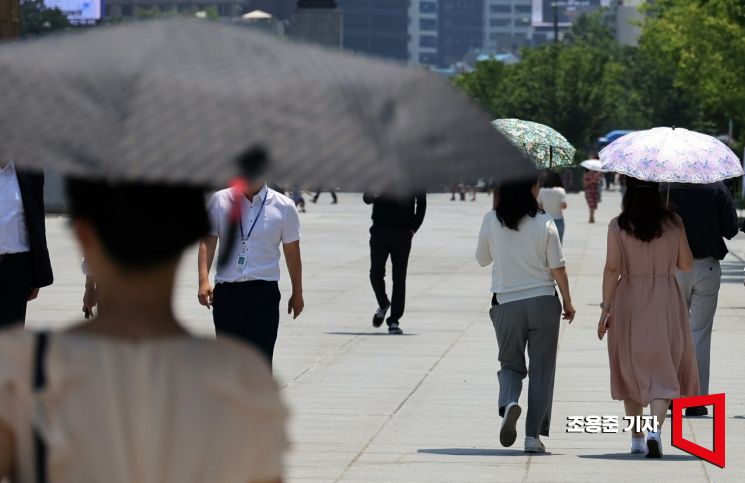 On the 19th, when a heatwave advisory was issued for the central regions including Seoul and Gyeonggi, the daytime temperature in Seoul rose to 35 degrees Celsius, and citizens visiting Gwanghwamun Square in Seoul shielded themselves from the sunlight with parasols. (2024.6.19) Photo by Jo Yongjun jun21@
Last year, the average summer temperature in South Korea was the highest since 1973. The number of tropical nights was also more than three times the average.
The 2050 Carbon Neutral Green Growth Committee (Prime Minister Han Duck-soo, Acting President, and Co-Chair Han Hwa-jin) jointly published the "2024 Abnormal Climate Report" on the 1st, together with related ministries and agencies (co-hosted by the Korea Meteorological Administration, Ministry of the Interior and Safety, Ministry of Agriculture, Food and Rural Affairs, Ministry of Trade, Industry and Energy, Ministry of Environment, Ministry of Land, Infrastructure and Transport, Ministry of Oceans and Fisheries, and 25 other organizations).
This report covers abnormal climate events such as extreme heat, heavy rain, and heavy snow that occurred in 2024, the damage status by sector, and future countermeasures.
According to the report, the average summer temperature in South Korea in 2024 was 25.6℃, 1.9℃ higher than the average, marking the highest since 1973. The number of tropical nights reached 20.2 days, 3.1 times the average, also ranking first historically. Additionally, the summer heat extended into September, with the average temperature in September reaching a record high of 24.7℃. There were an unusually high number of heatwave days at 6.0 days (average 0.2 days) and tropical nights at 4.3 days (average 0.1 days).
The abnormal climate caused significant damage in the agricultural sector as well. Due to heatwaves and high temperatures from July to September, 3,477 hectares of crops including ginseng were damaged, and continuous high temperatures during the rice planthopper growth period caused damage over 17,732 hectares. The rice planthopper damage by region was highest in Jeonnam (9,261.2 ha), followed by Jeonbuk (3,097.7 ha) and Chungnam (2,979.2 ha).
Sea surface temperatures were also high. The observed sea surface temperature around South Korea was 17.8℃, ranking first in the past 10 years (2015?2024), and the number of days with abnormal high sea temperatures (182.1 days) significantly increased compared to the 10-year average. Except for Incheon, Gyeonggi, and Jeonbuk, most coastal areas experienced mass mortality of aquaculture species worth 143 billion KRW due to summer high sea temperatures.
The number of heat-related illness patients also increased. During the summer heat-related illness emergency room surveillance period (May 20 to September 30), a total of 3,704 heat-related illness cases were reported, a 31.4% increase compared to 2,818 cases the previous year.

Last year’s monsoon season (June 19 to July 27) nationwide rainfall was 474.8 mm, ranking 11th highest historically and exceeding the average of 356.7 mm. Notably, 78.8% of summer rainfall fell during the monsoon season, showing the most concentrated rainfall during the monsoon since 1973. The monsoon rainfall was characterized by heavy rain in narrow areas, with nine locations recording hourly maximum rainfall exceeding 100 mm.
Heavy rains in July caused significant damage, including 9,447 hectares of crop damage, 891 hectares of farmland loss and burial, 1.022 million livestock losses, and 95% (167 hectares) of all landslide damage.
In late November, an unusual heavy snowfall occurred mainly in the central region due to the large temperature difference between high sea surface temperatures and low air temperatures. Seoul, Incheon, and Suwon recorded their highest single-day snowfall amounts in November.
The report indicates that from 1973 to 2024, the number of days with abnormal high temperatures mostly increased, while the number of days with abnormal low temperatures mostly decreased. In September 2024, the number of days with abnormal high temperatures was the highest, with 16.9 days for maximum temperatures and 19.7 days for minimum temperatures, more than any other month.
Jang Dong-eon, Administrator of the Korea Meteorological Administration, explained, "In 2024, South Korea experienced the highest average annual temperature on record, record-breaking tropical nights, concentrated heavy rains during the monsoon, and heavy snowfall in November. The global average temperature also rose to a record high of 1.55℃ above pre-industrial levels, making it a year that truly felt the climate crisis."
Kim Jong-ryul, Secretary-General of the Carbon Neutral Green Growth Committee, emphasized, "We will deepen our awareness of the seriousness of the climate crisis and actively discover new tasks for climate response through cooperation between government ministries and the private sector for future generations. At the same time, we will strengthen scientific analysis and policy execution to minimize damage caused by abnormal climate and achieve carbon neutrality by 2050."
Detailed information on the causes of abnormal climate events and sector-specific responses can be found in the "Abnormal Climate Report" section of the Korea Meteorological Administration’s Climate Information Portal Open Forum - Publications menu.
© The Asia Business Daily(www.asiae.co.kr). All rights reserved.
![Clutching a Stolen Dior Bag, Saying "I Hate Being Poor but Real"... The Grotesque Con of a "Human Knockoff" [Slate]](https://cwcontent.asiae.co.kr/asiaresize/183/2026021902243444107_1771435474.jpg)
















