It will take about a month to estimate wildfire damage and prepare a recovery plan
Emphasis on the need for "the fastest possible response"
Ministry of Economy and Finance has not disclosed detailed budget allocation
400 billion won allocated for recovery from 2022 Uljin and Samcheok wildfires
The government has announced a 'small supplementary budget' worth 10 trillion won, officially designating it as an 'essential supplementary budget.' This decision was made based on the judgment that it is difficult to wait for the National Assembly's time to respond quickly to the largest wildfire in history. Additionally, since trade response is also urgent, the supplementary budget size was calculated focusing on areas where there is little disagreement between the ruling and opposition parties. The government believes that for a swift response, the scale should not be expanded beyond 10 trillion won at this time, as prolonged negotiations in the National Assembly should be avoided. The focus is on rapid deployment rather than economic stimulus this year.
On the 30th, the Ministry of Economy and Finance announced plans to prepare a supplementary budget of 10 trillion won. The government, which had previously said it would wait for bipartisan agreement, reversed its position and decided to prepare a small-scale supplementary budget plan of 10 trillion won first. The proposed supplementary budget size by the government is significantly smaller than the 15 to 20 trillion won suggested by Lee Chang-yong, Governor of the Bank of Korea, and the 35 trillion won proposed by the Democratic Party of Korea.
Within the government, it was previously believed that a considerable amount of budget should be invested to stimulate the economy through the supplementary budget. A Ministry of Economy and Finance official explained the background for setting the supplementary budget at 10 trillion won, saying, "The wildfire damage is the largest ever, but it takes about a month to estimate the damage and come up with a recovery plan," adding, "We need to have the funds ready by then to use immediately." The official further explained, "This reflects the situation where only urgent and highly effective projects must be selected and implemented quickly," and "We cannot afford to delay by trying to include all projects, and trade response is also urgent."
The government maintains that the scale should not be significantly expanded beyond 10 trillion won due to the need for rapid response. A Ministry of Economy and Finance official stated, "Now the National Assembly must discuss it, but if the ruling and opposition parties try to add projects they each want and increase the scale, it will take a long time," and "Given the need for quick response, the discussion period should be minimized at this time." The government believes it can quickly prepare a plan focusing on AI competitiveness enhancement, trade response, and wildfire response, areas where there is little disagreement between the ruling and opposition parties. The government aims for National Assembly approval by April.
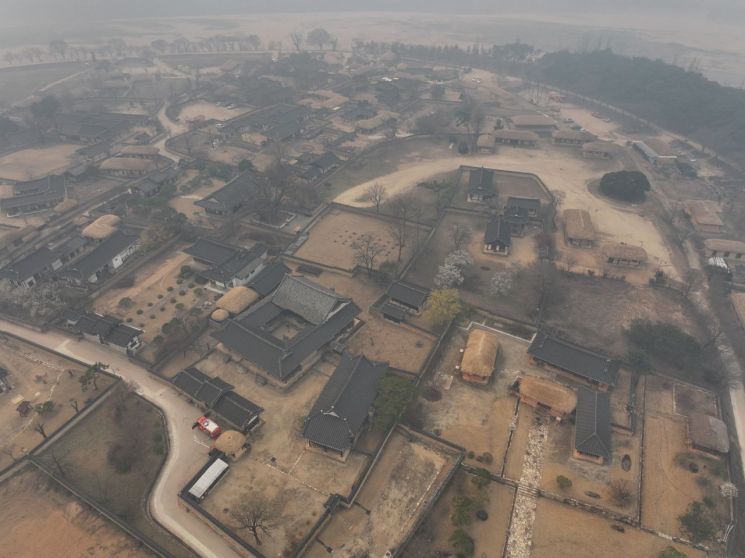
Specific details on how much should be allocated for wildfire response have not yet been disclosed. The government has estimated figures based on internal statistics, but the ruling and opposition parties are still engaged in political disputes over whether to use contingency funds for the response. The exact scale of the damage has not been confirmed yet. In the 2022 wildfires in Uljin, Samcheok, and Gangneung along the East Coast, about 400 billion won was spent on recovery. The damaged area at that time was 20,523 hectares. Although the damage area from the current wildfire has not yet been estimated, it is expected to be around 48,000 hectares, and since it is estimated to be the largest damage ever, the budget required for recovery is expected to be substantial.
The key issue is bipartisan consultation. The ruling and opposition parties differ in opinions regarding the scale of available resources for disaster response. The People Power Party estimates that only 400 billion won of the contingency funds available for wildfire damage can be used, and that the immediately usable disaster recovery funds by each ministry amount to only 200 billion won. On the other hand, the Democratic Party claims that a total of 4.8 trillion won can currently be deployed for wildfire response, combining 2.4 trillion won in contingency funds, 927 billion won in disaster and accident countermeasures by each ministry, and 1.5 trillion won in national treasury debt burden for disaster recovery. The Ministry of Economy and Finance also estimates that the amount available from each ministry's disaster recovery funds is 200 billion won. However, no decision has yet been made on whether to increase contingency funds or expand ministry budgets for wildfire response.
© The Asia Business Daily(www.asiae.co.kr). All rights reserved.
![Clutching a Stolen Dior Bag, Saying "I Hate Being Poor but Real"... The Grotesque Con of a "Human Knockoff" [Slate]](https://cwcontent.asiae.co.kr/asiaresize/183/2026021902243444107_1771435474.jpg)
















