Lee Jaeyong and Kwak Nojung Meet Xi Jinping Together for the First Time
Attending the 'International Business Representatives Press Conference' Linked to the China Development Forum
China's Strategic Approach Toward Korean Memory Companies
Samsung Electronics Chairman Lee Jae-yong and SK Hynix President Kwak No-jung meeting Chinese President Xi Jinping side by side is interpreted as a scene where China sent a strategic 'love call' to Korean memory semiconductor companies. This is seen as a clear reflection of China's desperate interests in securing advanced technology amid the prolonged U.S. semiconductor export restrictions on China.
On the 28th, Samsung Electronics and SK Hynix met President Xi in person at the Great Hall of the People in Beijing. The meeting, held under the name 'International Business Representatives Press Conference,' was an official event linked to the China Development Forum (CDF), where Chairman Lee and President Kwak sat at the same table with President Xi alongside about 30 global major business leaders. This is the first time that the CEOs of Korea's two major memory semiconductor companies have met the top Chinese leader simultaneously in a public setting.
Other companies attending the same event included Germany's BMW and Mercedes-Benz, U.S. Qualcomm and FedEx, Saudi Arabia's state-owned Aramco, British Standard Chartered, AstraZeneca, France's Sanofi, Denmark's Maersk, and Sweden's IKEA. Leaders from the automotive, semiconductor, logistics, energy, and pharmaceutical sectors were prominently included. At last year's event, Korean semiconductor company CEOs did not attend publicly, and President Xi only held private meetings with some U.S. companies. This year's meeting with Korean semiconductor company heads is considered exceptional.
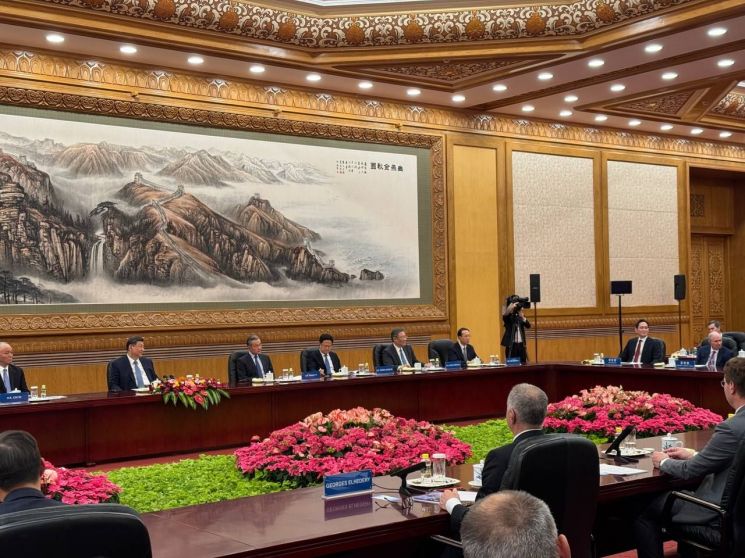 Samsung Electronics Chairman Lee Jae-yong and SK Hynix CEO Kwak No-jung, among others, are attending a meeting with Chinese President Xi Jinping and global company CEOs at the Great Hall of the People in Beijing, China, on the 28th (local time). Photo by Yonhap News.
The scene of Samsung and Hynix facing President Xi directly clearly reveals China's message. Amid intensifying U.S.-China technological hegemony competition and a sharp decline in foreign direct investment, China has identified Korean companies as practical partners to revive its semiconductor industry. For China, which has been hindered in securing high-performance memory due to U.S. semiconductor export controls, restoring cooperation with Korean companies that possess both production bases and technology is urgent.
Samsung Electronics produces NAND flash in Xi'an, China, while SK Hynix manufactures DRAM and NAND flash in Wuxi and Dalian. Both companies face restrictions on importing equipment into their Chinese factories due to U.S. semiconductor equipment export regulations, but currently, they are introducing equipment through Verified End User (VEU) designations. If the U.S. government resumes export controls, production in China could be disrupted, directly impacting China's advanced industries overall.
President Xi stated that day, "China is an ideal and promising investment destination for foreign companies," and promised to "guarantee equal market participation according to the law." He then indirectly criticized the U.S. technology blockade strategy by saying, "Turning off someone else's light does not make my light shine brighter." This is read as a subtle message to Korean semiconductor companies not to leave China.
From the perspective of Korean companies, it is becoming increasingly difficult to balance between the two superpowers, the U.S. and China. They must pursue building semiconductor factories and receiving subsidies in the U.S. while maintaining large-scale production bases in China. This meeting with President Xi is interpreted as confirmation that this dual strategy remains valid.
An industry insider said, "Samsung and Hynix are by no means simple foreign-invested companies in China," adding, "They are essential pillars for maintaining China's semiconductor ecosystem, and President Xi meeting them directly reveals China's desperation."
Another insider said, "Since China remains a core market for Korean semiconductor businesses, this meeting can be seen as a signal to strengthen local partnerships and cooperation," adding, "In the ongoing U.S.-China conflict, it is important for private companies to maintain smooth relations with the Chinese government, which can be viewed as a strategic move to secure business stability and sustainability for Korean semiconductor companies."
© The Asia Business Daily(www.asiae.co.kr). All rights reserved.
![Clutching a Stolen Dior Bag, Saying "I Hate Being Poor but Real"... The Grotesque Con of a "Human Knockoff" [Slate]](https://cwcontent.asiae.co.kr/asiaresize/183/2026021902243444107_1771435474.jpg)















