Anna Choi, Former KMA Spokesperson, Appointed as First Principal
"You cannot just do nothing and only demand alternatives"
"The medical community must be the first to propose measures for coexistence with the public"
"You cannot just do nothing and only demand alternative solutions. The medical community must proactively present alternatives."
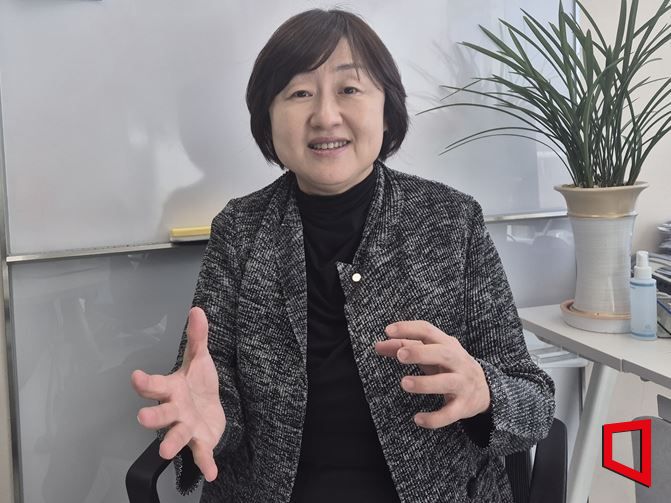
The Korea Medical Policy School, founded mainly by former Korean Medical Association spokesperson Anna Choi, will hold its opening ceremony on the 30th at Korea University College of Medicine in Seongbuk-gu, Seoul.
The school was established to train young doctors, including medical students and residents, as experts in health and medical policy. Principal Anna Choi analyzed that one of the causes of the decades-long repeated conflicts between the medical community and the government is the medical community’s neglect in nurturing talent capable of participating in the medical policy process. Therefore, the goal is to cultivate doctors who have the ability to prepare practical alternatives and negotiate based on a proper understanding of policy and politics, rather than engaging in simple issue-based struggles.
On the 27th, an interview was held with Principal Choi at Korea University College of Medicine in Seongbuk-gu, Seoul, where she shared the background and vision of the Korea Medical Policy School.
- What is the reason for starting the Medical Policy School?
▲ The goal is to have field experts participate in the medical policy decision-making process. Until now, doctors have focused mainly on treating patients and conducting research, showing relatively little interest in policy. Because there are few policy experts within the medical community, people who are not well acquainted with the field have often managed medical policies. Even those interested in becoming policy experts are frustrated because they do not know where to start learning. We want to teach them politics, society, and policy?subjects not covered in existing schools?and also inform them about ways to apply this knowledge.
- Have you failed to persuade the public during past conflicts between the medical community and the government?
▲ Even if a doctor diagnoses that surgery is absolutely necessary, the surgery cannot be performed without the patient’s consent. The same logic applies to the medical system. No matter how right the medical community thinks a direction is, persuading the public is essential. The medical community has the responsibility to seek understanding and communicate with the public, but this has been lacking. One of the largest parts of the curriculum is 'public communication,' and a quarter of the entire course deals with how to communicate with the public. It is unfortunate that doctors have been demonized and that there is a perception that fulfilling doctors’ demands would harm the public. We want to break that frame and be the first to propose measures that allow the medical community and the public to coexist harmoniously.
- What roles do you expect from the school’s graduates?
▲ First, I think it is important for them to enter the medical community’s internal organizations such as district and city medical associations, the Korean Medical Association’s executive body, and the general assembly. If the government and the public regard the Korean Medical Association and the medical community as communication partners who engage in dialogue and propose alternatives, conflicts like those we see now will greatly decrease. Until now, even if doctors had the will and capability, most did not even consider entering society because they had many patients to treat and papers to study, as if it were a custom. Doctors should also enter roles such as members of the National Assembly and their aides, the Ministry of Health and Welfare, and various political and special government positions. It is perfectly fine if they do not take on these roles and become clinical doctors. However, if they meet patients with this vision, they will gradually help resolve the public’s distrust of the medical profession. We expect them to play leadership roles that create waves in their respective positions.
- Why did you create tracks (courses) not only for policy but also for digital healthcare and the bioindustry?
▲ Although the surge in medical school applicants is problematic, it also means that capable students who have worked hard are becoming doctors. It would be a national waste of talent if they only become doctors who simply provide clinical care. Not all doctors need to be for domestic use only. If supported by policy and systems, Korean healthcare could become a pillar of the national industry. For example, currently, patients with hair loss who want hair transplant surgery flock to Turkey. Although the numbers are small, most patients who want conjoined twin separation surgery go to Singapore. The growth of the medical industry is not possible only because doctors have excellent surgical skills in internal and external medicine. Even now, when attending conferences or forums, companies all complain that there are many regulations domestically and that there is no policy support. We need to nurture talent who will prepare policies necessary to lead global healthcare and create K-Medical that benefits the country’s future.
© The Asia Business Daily(www.asiae.co.kr). All rights reserved.
![Clutching a Stolen Dior Bag, Saying "I Hate Being Poor but Real"... The Grotesque Con of a "Human Knockoff" [Slate]](https://cwcontent.asiae.co.kr/asiaresize/183/2026021902243444107_1771435474.jpg)















