Trump Announces 25% Tariff on Cars and Parts
Automakers Face Annual Cost Increase of 161 Trillion Won
Goldman Sachs: "Car Prices Could Rise by Up to 22 Million Won"
GM, Ford, Stellantis Shares Fall
U.S. President Donald Trump announced a 25% tariff on imported cars and parts, raising concerns that vehicle prices in the United States could increase by anywhere from several million won to tens of millions of won. There is growing speculation that this indiscriminate tariff attack on the global automotive industry will lead to soaring production costs and inflation for companies, ultimately resulting in a massive bill for American consumers.
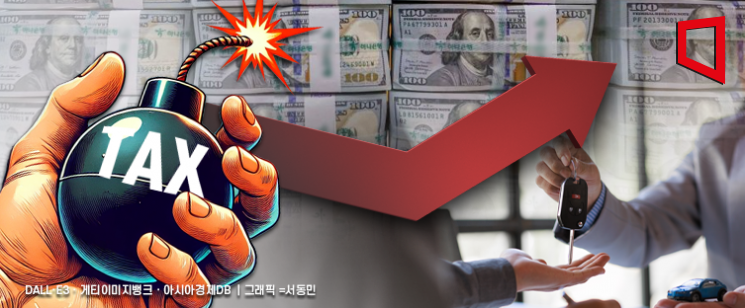
According to a compilation of Wall Street analyses on the 27th (local time), the 25% tariff on cars and parts, which the Trump administration will gradually enforce starting at midnight on April 3, is expected to raise vehicle prices in the U.S. by at least $4,500 (about 6.6 million won) and up to $15,000 (about 22 million won). Major U.S. bank Bank of America (BoA) projected that the tariff increase would raise the price per vehicle by more than $4,500, while investment firms Bernstein and Guggenheim forecast increases of approximately $6,700 and $6,000 to $7,000, respectively. Goldman Sachs predicted vehicle prices could rise from a minimum of $5,000 to as much as $15,000.
The surge in production costs for automakers supports the outlook for higher vehicle prices. Bernstein estimated that the new tariff measures could increase global automakers' costs by up to $110 billion (about 161 trillion won) annually. Since the U.S. imports about 50% of its cars and 60% of its car parts, the impact of the tariffs is expected to be enormous and difficult to gauge. For U.S. automakers General Motors (GM) and Ford, Bernstein estimated that they would adjust their supply chains to increase the use of domestic parts and that even if vehicle prices rise, their pre-tax profits this year could plunge by 30%.
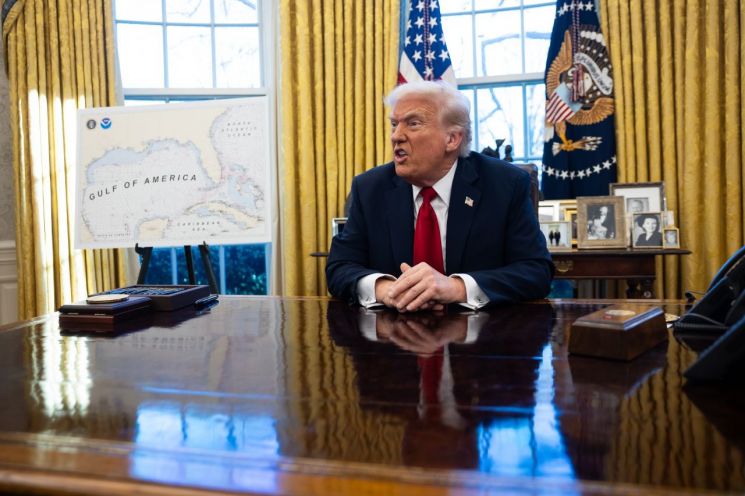
President Trump’s decision the previous day to temporarily exempt parts covered under the United States-Mexico-Canada Agreement (USMCA) from tariffs is seen as a measure to alleviate concerns over sharply rising costs for the automotive industry and higher consumer prices, given the highly integrated North American automotive supply chain. In particular, by imposing a 25% tariff not only on finished vehicles but also on key components such as engines, transmissions, powertrains, and electrical parts, there are growing worries that production costs will rise for vehicles assembled in the U.S. that use foreign-made parts.
John Elkann, chairman of Stellantis, expressed concerns during a call with investors about the "affordable prices of products made in the U.S." and warned that the "uncertainty" caused by the tariff policy could hurt domestic demand. Jessica Caldwell, director at U.S. automotive market research firm Edmunds, also noted that "expectations for rising car prices are reasonable," adding that "this presents an additional challenge to an industry already struggling with ongoing purchasing power concerns."
Market research firm Cox Automotive predicted that at least half of the 20 models currently sold in the U.S. priced under $30,000 (about 44 million won) would be directly hit by the new tariff measures.
Concerns over tariff-driven "carflation" (car + inflation) have also caused used car prices to rise. The used car industry reported that due to supply chain disruptions during the COVID-19 pandemic, there is a shortage of used cars that are 1 to 3 years old, and combined with tariff uncertainties, prices for vehicles 4 to 6 years old are increasing.
Ultimately, given the tightly intertwined global automotive supply chains, there is growing criticism that this tariff hike on cars will have a negative impact across the entire U.S. economy.
Shares of U.S. automakers have plunged following the announcement of the tariff increase. As of 3:32 p.m. Eastern Time on the New York Stock Exchange, General Motors (GM) was down 7.11%. Ford fell 3.44%, and Stellantis declined 0.84%. In contrast, U.S. electric vehicle maker Tesla rose 2.09%. Tesla reportedly produces vehicles sold in the U.S. domestically, thus experiencing relatively less impact from the tariffs.
© The Asia Business Daily(www.asiae.co.kr). All rights reserved.
![Clutching a Stolen Dior Bag, Saying "I Hate Being Poor but Real"... The Grotesque Con of a "Human Knockoff" [Slate]](https://cwcontent.asiae.co.kr/asiaresize/183/2026021902243444107_1771435474.jpg)
















