Regional Economic Revitalization Fund of 64 Billion Won to Be Created
Wide-Area Tourism Belts Including K-Gourmet Belt and East-West Trail to Be Developed
Special Law on Vacant House Maintenance to Be Enacted
Youth Housing to Expand from 5 to 35 Locations
To revitalize rural farming and fishing villages facing the threat of extinction due to population decline and aging, the government is shifting its strategy to focus on the economy. Over five years, 180 tasks will be pursued, ranging from tailored support for farmland, fish farms, and settlement funds to expanding youth housing, nurturing food tech talent, and building workation infrastructure. The plan aims to foster new growth foundations such as region-specific industries, startups, tourism, and healing industries.
The Ministry of Agriculture, Food and Rural Affairs announced on the 27th that it held the "Committee for Improving the Quality of Life of Farmers and Fishermen and Rural Development" on the 24th, where the "5th Basic Plan for Improving the Quality of Life of Farmers and Fishermen and Rural Development" containing these details was reviewed and approved.
Since the enactment of the Special Act on Improving the Quality of Life of Farmers and Fishermen and Rural Development in 2004, the government has invested a total of 178 trillion won and implemented four basic plans. However, structural problems such as youth outflow and job shortages remain. In particular, towns and townships with populations under 2,000 increased from 177 in 2000 to 392 in 2023, more than doubling, and 73.5% of administrative villages nationwide do not even have retail stores.
Accordingly, this plan shifts focus from expanding basic infrastructure to fostering region-specific industries and transforming the economic ecosystem by attracting private sector vitality. Over five years, 21 ministries and agencies will jointly implement 3 major strategies, 12 key tasks, and 180 detailed projects.
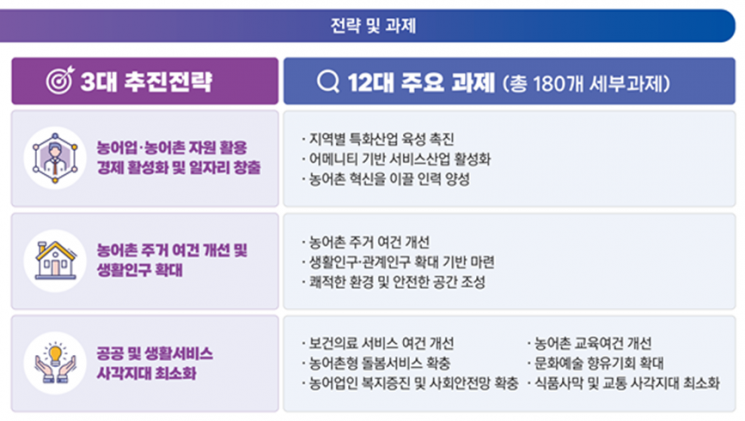
First, location regulations will be improved focusing on industries nurtured by local governments, and a ‘Self-Regulation Innovation Zone’ system will be introduced. Expansion of scale-up programs for rural convergence industries, improvement of ‘regulations under the fingernail,’ and activation of resident-led economic organizations linked with the Rural New Vitality Plus Project will also be promoted.
An agricultural industry innovation belt will be established by providing integrated support for settlement conditions, capacity building, and facilities to anchor companies within the region. The fishing village economy based on the sea will be fostered through the concept of a ‘marine living zone.’ Support for startups in the agri-food and marine fisheries sectors will be provided, along with the establishment of a regional economic revitalization fund to induce private investment, amounting to 64 billion won from 2025 to 2027.
Tourism and healing industries will also be developed as new economic resources for rural farming and fishing villages. This includes a wide-area tourism belt linking K-Gourmet Belt and East-West Trail, tourism of globally important agricultural heritage (K-Heritage), and the creation of marina and complex marine tourism cities. The healing industry utilizing agricultural, forestry, and marine resources will be expanded centered on healing farms (337 locations), forest healing facilities (83 locations), and marine healing centers (5 locations).
Youth inflow is also a key pillar of the economic revitalization strategy. By 2029, 1,000 local creators will be nurtured, food tech contract departments (9 schools) will operate, startup internships (300 people annually) will be provided, and tailored support for settlement funds, fishing vessels, and fish farms will strengthen the startup infrastructure in rural farming and fishing villages.

Rural housing conditions will also be improved. The enactment of a special law on vacant house maintenance is being pursued, and youth housing will be expanded from 5 to 35 locations. Regional vitality towns will increase from 27 to 67 locations, and welfare housing for the elderly will be supplied from 1,000 to 3,000 units annually. Village-level LPG pipeline networks will increase from 390 to 498 locations, and township-level networks will expand to 70 locations.
Living infrastructure such as health, medical care, and transportation will be improved simultaneously. The rural home-visit bus service will expand from 90,000 users this year to 180,000 by 2029, and home medical care centers for long-term care will be expanded to 250 locations. Mobile markets will increase from 9 to 30 districts, and mobile laundry, hairdressing, and beauty services will be strengthened. The rural transportation model will be maintained in 82 counties, and passenger ship fare support for island areas will continue.
Along with the revision of the Quality of Life Special Act, the government will subdivide service standards to the town and township level and introduce public-private consulting in subordinate areas. A private cooperation foundation will also be established through smart rural laboratories and ESG certification systems.
Park Sung-woo, Director of the Rural Policy Bureau, said, "If we do not transform rural farming and fishing villages back into spaces of economy and jobs, we cannot stop the trend of population extinction. We will focus policy capabilities on producing tangible results that local communities can feel within five years."
© The Asia Business Daily(www.asiae.co.kr). All rights reserved.
![Clutching a Stolen Dior Bag, Saying "I Hate Being Poor but Real"... The Grotesque Con of a "Human Knockoff" [Slate]](https://cwcontent.asiae.co.kr/asiaresize/183/2026021902243444107_1771435474.jpg)
















