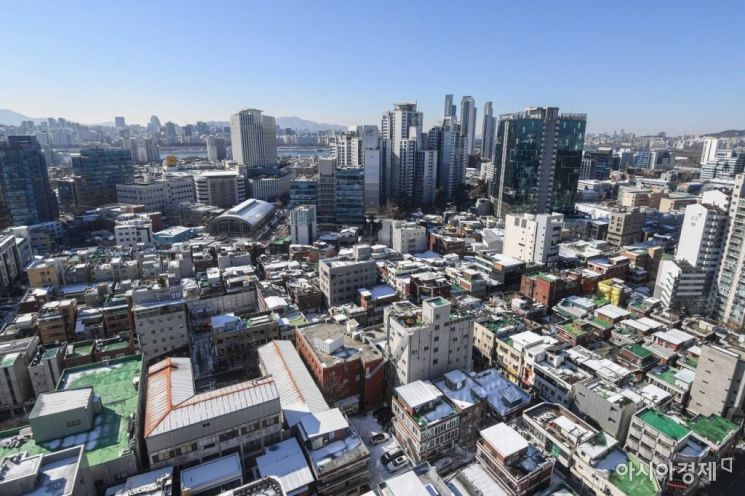
Seoul City is accelerating the development of semi-industrial areas by easing regulations, including increasing the residential floor area ratio (FAR) up to 400%.
On the 27th, the city announced that the "Partial Amendment to the Urban Planning Ordinance," which was primarily proposed by Seoul City Council member Seo Sang-yeol, has been revised, promulgated, and immediately put into effect. In addition, the "District Unit Plan Establishment Standards for the Construction of Multi-family Housing in Semi-industrial Areas," which contains development guidelines, has also been prepared and will be implemented immediately along with the ordinance amendment.
This ordinance amendment establishes an institutional foundation to lead the growth of semi-industrial areas, which were once centers of consumer and manufacturing industries but have become outdated due to excessive regulations.
Last November, the city announced the "Improvement Plan for Semi-industrial Area Systems." Through this, the semi-industrial areas will be restructured into "future advanced industry spaces," and mixed-use development will be further permitted. This ordinance amendment is to fully implement the improvement plan for semi-industrial areas. Currently, semi-industrial areas totaling 19.97㎢ are designated in the southwestern part of Seoul, including Yeongdeungpo, Guro, Geumcheon, Gangseo, Dobong, and Seongdong.
First, when establishing district unit plans for multi-family housing construction within semi-industrial areas, the maximum FAR will be significantly relaxed from the current 250% to 400%. Regulations have been eased to expand housing supply while strengthening public interest by newly adding provisions for public rental housing supply.
The FAR incentive is divided into public facility donations, FAR relaxations under other laws, and public rental housing supply. In the case of public rental housing supply, half of the relaxed FAR must be supplied as public rental housing.
Furthermore, the previously ambiguous target area for establishing district unit plans for multi-family housing construction has been defined as "sites of 3,000㎡ or more." Previously, if there was even one factory in the semi-industrial area, a district unit plan had to be compulsorily established regardless of size. However, if the factory ratio is less than 10%, multi-family housing construction is allowed without establishing a district unit plan.
Improvements have also been made to allow more flexible adjustment of development methods. Previously, mixed industrial-residential development was only possible on sites smaller than 10,000㎡. In the future, the area restriction will be removed so that project entities can freely choose the development method regardless of site size.
Along with the increase in residential FAR, the FAR for mixed industrial-residential buildings has also been adjusted upward according to the ratio of industrial facility retention. To resolve fairness issues where the same FAR was applied regardless of the industrial facility retention ratio in zones with less than 30% factory ratio, the zones have been subdivided.
Accordingly, the allowable FAR by industrial facility ratio (from 10% to over 50%) has been raised by a minimum of 15 percentage points to a maximum of 30 percentage points.
Additionally, for public semi-housing such as public rental housing and rental dormitories directly implemented by the public sector, a FAR of 400% will be applied. For existing housing purchased by public housing operators as acquisition rental housing, a basic FAR of 300% will be applied, but it can be relaxed up to 400% if additionally supplied as public rental housing.
Jo Nam-jun, head of Seoul City's Urban Space Headquarters, stated, "With this ordinance amendment and the revision of district unit plan establishment standards, a foundation has been laid for the full-scale promotion of semi-industrial area development. We will continue to provide ongoing support so that the previously stagnant semi-industrial areas can play a central role in urban development."
© The Asia Business Daily(www.asiae.co.kr). All rights reserved.
![Clutching a Stolen Dior Bag, Saying "I Hate Being Poor but Real"... The Grotesque Con of a "Human Knockoff" [Slate]](https://cwcontent.asiae.co.kr/asiaresize/183/2026021902243444107_1771435474.jpg)















