The Australian dollar is expected to turn stronger, supported by U.S. President Donald Trump's weak dollar stance and China's economic stimulus measures.
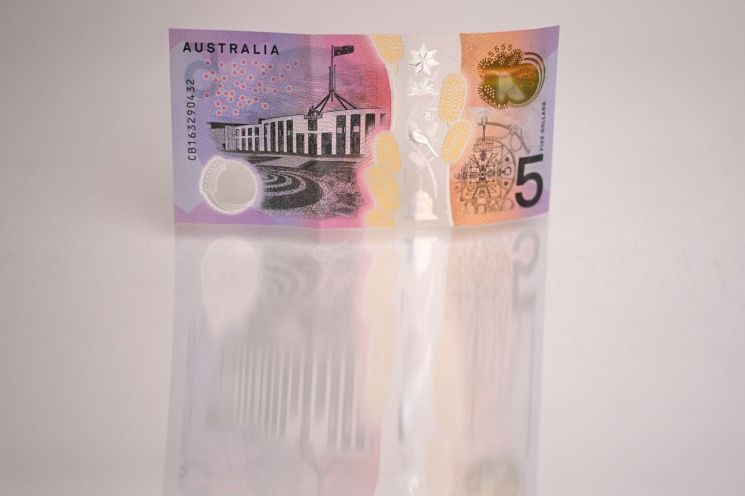
According to Bloomberg News on the 23rd (local time), Bank of America and others forecast that the Australian dollar could strengthen until December this year.
On the 22nd in the foreign exchange market, the Australian dollar closed at 0.63 U.S. dollars per 1 Australian dollar. Although this is 21% lower than the 2021 peak, it has risen 3% compared to last month's low, attempting a rebound. The market expects that as President Trump intensifies the trade war and the U.S. economy shakes, the U.S. dollar will weaken, leading to a stronger Australian dollar. Andrew Ticehurst, chief strategist at Nomura Holdings, said, "In the second quarter of this year, the Australian dollar will strengthen supported by a weak U.S. dollar," adding, "The Australian dollar is currently trading at historically low levels compared to commodity prices and interest rates."
Richard Pranulovich, head of currency strategy at Australia's major bank Westpac, also said, "A major 'regime shift' for the U.S. dollar is approaching," and "This opens the door for the Australian dollar to enter a sustained period of strength."
The Reserve Bank of Australia (RBA) is cautious about cutting interest rates until confirming that inflation is under control, and China, Australia's largest trading partner, is boosting domestic consumption in response to U.S. tariffs, which also influences the Australian dollar's strength. Oliver Levingston, strategist at Bank of America, said, "First, a gradual recovery of the Australian dollar will come from the weak U.S. dollar, followed by the effects of China's economic stimulus," adding, "There is also a possibility that the benchmark interest rate will rise further to defend against inflation. This will support the Australian dollar's bottom in the medium term."
However, volatility may arise ahead of the retaliatory tariffs announced by President Trump next month. Westpac analyzed that risk asset liquidation to avoid tariff risks could cause the Australian dollar to temporarily weaken.
Bloomberg News reported, "Australia tried but failed to be exempted from steel and aluminum tariffs, and there are concerns that major exports could be affected by the U.S. reciprocal tariff measures."
© The Asia Business Daily(www.asiae.co.kr). All rights reserved.
![Clutching a Stolen Dior Bag, Saying "I Hate Being Poor but Real"... The Grotesque Con of a "Human Knockoff" [Slate]](https://cwcontent.asiae.co.kr/asiaresize/183/2026021902243444107_1771435474.jpg)















