Lee Jun-seok Holds Press Conference to Criticize Ruling and Opposition Parties' Pension Reform
Pension Reform Agreement Based on 21st National Assembly Public Deliberation, Not a Hasty Deal
Kwon Seong-dong: "Plan to Support Structural Reform Discussions in the National Assembly Special Committee"
Lee Jun-seok, a member of the Reform New Party, criticized the national pension reform passed by the National Assembly as a 'collusion.' Lee said, "The behavior of lawmakers, whose average age is close to 60, recklessly dividing the future of children being born now must stop here."
Lee Jun-seok Criticizes Pension Reform Agreed by Ruling and Opposition Parties as 'Collusion'
At a press conference at the National Assembly, Lee criticized the national pension reform plan agreed upon by the ruling and opposition parties, calling it "collusion exploiting future generations without structural reform." He said, "(Paying) 4 percentage points more in insurance premiums and receiving 3 percentage points more in income replacement rate, delaying the pension depletion point by 9 years?putting aside the shortsightedness of these number games?why did you, who benefit the most and bear the least burden, decide this at your discretion?" He pointed out, "Certain generations will pay for about 5 to 6 years more and receive increased pensions, but children who went to daycare, kindergarten, and elementary school today, unaware of anything, will have to bear the increased rates for life for pensions they may or may not receive 50 to 60 years later."
He continued, "If this adjustment only delays the pension depletion point, given the nature of our political sphere, structural reform will not be touched for another 20 years, and politicians will continue to fight leisurely. Then, about 10 years later, there will be another adjustment, and eventually, there might be a declaration of pension bankruptcy, saying there is no money left to pay the people," he warned.
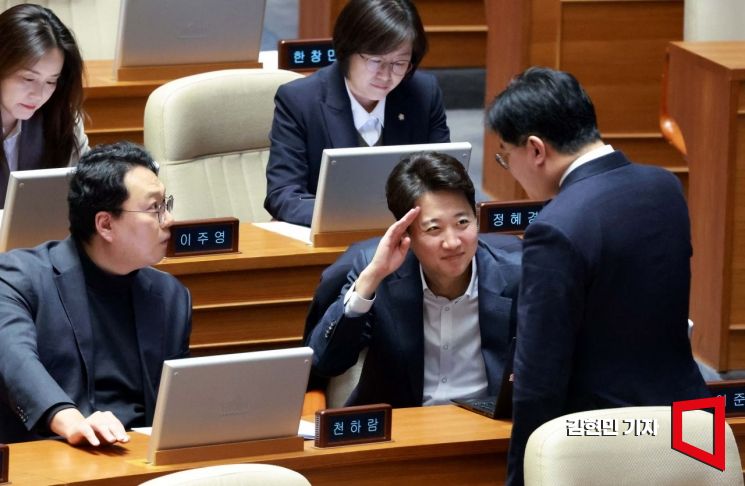 Lee Jun-seok, a member of the Reform New Party, is greeting lawmakers and officials at the National Assembly plenary session on the 26th, where the proposal for the appointment of Ma Eun-hyuk, Jeong Gye-seon, and Jo Han-chang as Constitutional Court justices is being presented. Photo by Kim Hyun-min
Regarding future responses, Lee said, "I will make every effort to ensure that the structural reform I have consistently proposed becomes fundamental," adding, "The introduction of an automatic pension adjustment mechanism, the separation plan for new and old pensions proposed by KDI, and various institutional devices to strengthen generational equity should be introduced."
Seemingly aware that criticism of pension reform might be perceived as generational division or hatred, Lee said, "The forces that truly divide generations and exploit and exclude certain generations are the members of the People Power Party and the Democratic Party who hastily voted in favor of the National Pension Amendment Bill at the National Assembly yesterday."
Pension Reform After 18 Years Promoted Through Public Deliberation
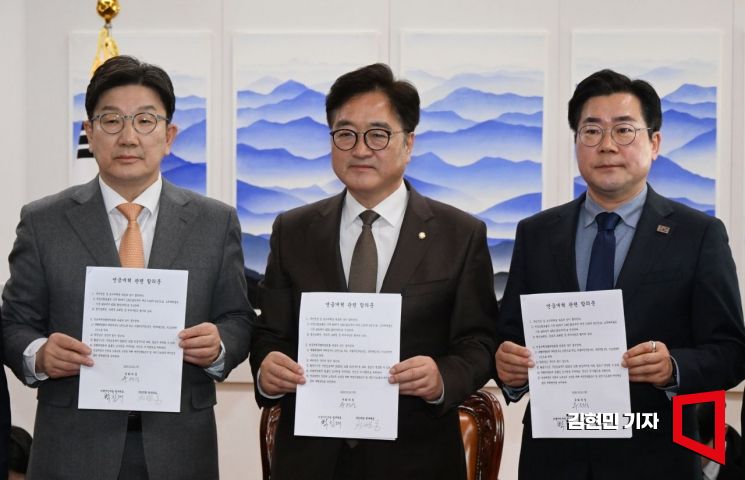 Woo Won-shik, Speaker of the National Assembly, Kwon Seong-dong, Floor Leader of the People Power Party (left), and Park Chan-dae, Floor Leader of the Democratic Party of Korea (right), are announcing the agreement on the National Pension reform plan in the Speaker's office of the National Assembly on March 20, 2025. Photo by Kim Hyun-min
However, the reform is evaluated as historically significant. Although pension discussions have been ongoing, past governments and political circles avoided pension reform for 18 years due to political burdens. Notably, the insurance premium rate was raised for the first time in 27 years.
This pension reform is highly regarded as it was agreed upon between ruling and opposition parties amid the serious situation of President Yoon Suk-yeol's impeachment. Moreover, the passed reform plan of 'pay more, receive more' was discussed based on public deliberation by the 21st National Assembly's Pension Special Committee and continued through negotiations between the 21st and 22nd National Assemblies.
Previously, the 21st National Assembly's Pension Reform Special Committee gathered public opinion through a national public deliberation method. The deliberation involved ordinary citizens learning about pensions and related topics, engaging in deliberative discussions, and then conducting a survey. The result showed that 56.0% of the citizen panel agreed with the '13% insurance premium rate and 50% income replacement rate' plan. However, even after the public deliberation, political negotiations were difficult due to concerns about pension depletion, leading to an adjustment of the income replacement rate increase to 3 percentage points to strengthen fiscal stability.
The government analyzed that the pension depletion point would be extended from 2056 to 2071 with this reform. It also evaluated, "This reform has enhanced the sustainability of the system and is expected to significantly reduce the burden on future generations." Additionally, the National Pension Act amendment passed by the National Assembly includes provisions that clarify the previously criticized ambiguous payment guarantee regulations.
Regarding criticisms of insufficient restructuring, the ruling and opposition parties agreed to discuss fiscal soundness measures, including an 'automatic stabilization mechanism' depending on economic conditions, and a multi-layered income security system covering basic pensions, retirement pensions, and private pensions at the Pension Reform Special Committee.
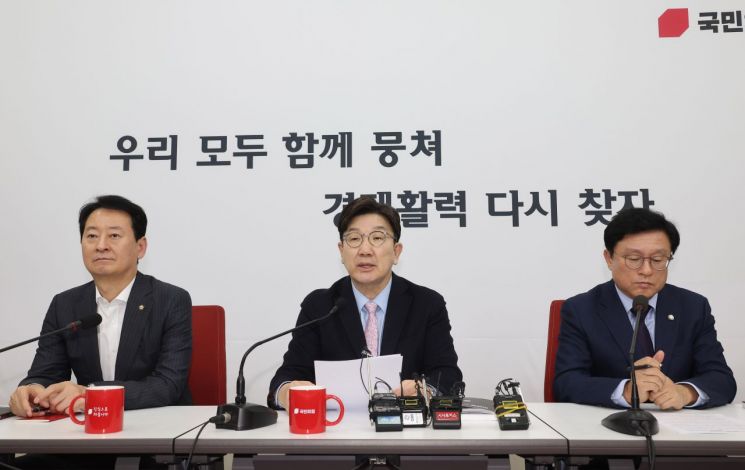
Kwon Seong-dong, floor leader of the People Power Party, explained at a press briefing, "If we were afraid of criticism and blame from the younger generation, we would have taken a stance like Park Soo-young, a People Power Party lawmaker who resigned as chair of the party's pension special committee. But we believed that if it is the right path for the people and the finances can be extended by 8 or 9 years, we must make a decision despite criticism and blame." He added, "I think the insufficient parts should be supplemented through the National Assembly's Pension Special Committee," and said, "We plan to assign young lawmakers who opposed pension reform to the special committee so that their fighting spirit and persuasiveness can reflect the claims of the younger generation, and we will lead and support this effort." He concluded, "All responsibility lies with me," and "I will bear it all."
© The Asia Business Daily(www.asiae.co.kr). All rights reserved.
![Clutching a Stolen Dior Bag, Saying "I Hate Being Poor but Real"... The Grotesque Con of a "Human Knockoff" [Slate]](https://cwcontent.asiae.co.kr/asiaresize/183/2026021902243444107_1771435474.jpg)

















