A highly efficient eco-friendly microorganism capable of removing persistent pollutants from synthetic dyes and waste plastics has been developed.
On the 21st, the Advanced Radiation Research Institute at the Korea Atomic Energy Research Institute announced that Dr. Jeong Jong-hyun's research team, in collaboration with Incheon National University and the Korea Institute of Science and Technology, developed a strain that can environmentally remove persistent pollutants using radiation.
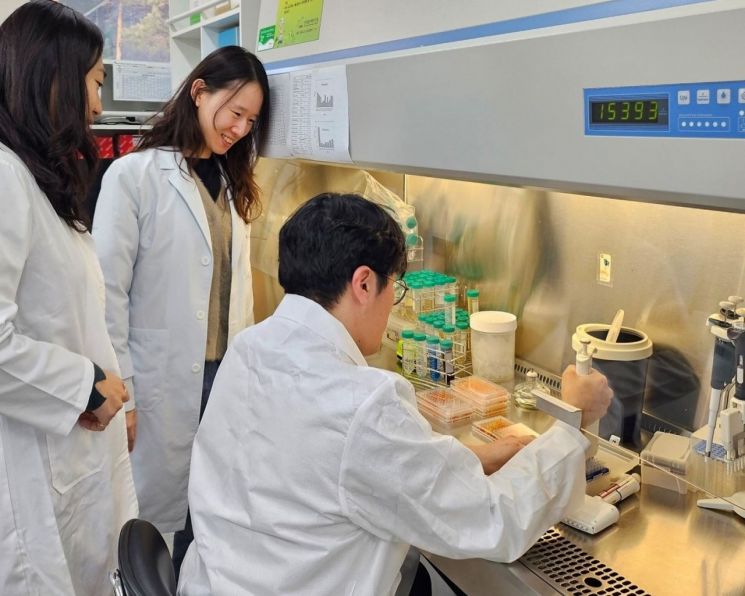 Dr. Jeong Jonghyun's research team is verifying the performance of a high-performance recalcitrant pollutant-degrading strain developed using radiation. Provided by Korea Atomic Energy Research Institute. Dr. Jeong Jonghyun's research team is verifying the performance of a high-performance recalcitrant pollutant-degrading strain developed using radiation. Photo by Korea Atomic Energy Research Institute.
The research team previously noted that laccase activity increases with higher copper ion concentrations. Instead of directly modifying this enzyme as before, they enhanced the copper ion tolerance of the laccase-containing strain (MBLB0692) by creating an environment where laccase can be activated through copper ions.
For laccase activity, copper ions must be introduced, but typical strains experience toxicity and growth difficulties when copper ion levels increase. Therefore, enhancing copper ion tolerance in strains requires modification of dozens of genes present in the strain.
Focusing on the fact that radiation can mutate multiple genes simultaneously, the research team designed a technique to increase copper ion tolerance by irradiating strains in a gamma-ray irradiation facility. Through experiments, they developed a strain capable of growing even in copper ion concentrations of 10mM (10 millimolar), a level at which most microorganisms cannot survive.
A millimolar is a concentration unit indicating how much of a specific substance is contained in 1 liter of solution; for copper ions, 10mM corresponds to about 600mg.
Through this series of processes, the new strain developed by the research team showed laccase activity 2.6 times higher than the existing strain.
Additionally, genetic analysis confirmed that genes related to laccase production, copper absorption, and excretion were activated in this strain. In actual synthetic dye decomposition experiments using this strain, most dyes were decomposed faster and more effectively than before.
Based on this new strain, the research team plans to further develop strains that can decompose waste plastics and produce useful functional materials such as recyclable plastics, thereby advancing resource circulation technology.
A strain is a concept used to classify microorganisms based on their characteristics, similar to how animals are categorized by their roles. For example, just as dogs are classified by breed into detection dogs, sled dogs, guard dogs, etc., microorganisms can be classified according to their purposes such as disease treatment, fermentation, and environmental purification.
Based on this, research and industrial fields utilize strains tailored to specific purposes to improve efficiency.
Jeong Byung-yeop, director of the Advanced Radiation Research Institute, said, “Microorganism-based eco-friendly technology is a technology that can be used in various industries in the future,” adding, “The technology developed by the research team will provide a sustainable solution to environmentally treat persistent harmful substances.”
© The Asia Business Daily(www.asiae.co.kr). All rights reserved.
![Clutching a Stolen Dior Bag, Saying "I Hate Being Poor but Real"... The Grotesque Con of a "Human Knockoff" [Slate]](https://cwcontent.asiae.co.kr/asiaresize/183/2026021902243444107_1771435474.jpg)















