Korea Pharmaceutical and Bio-Pharma Manufacturers Association Holds First Innovation Forum
Aims to Develop Blockbuster New Drugs through National Projects
Emphasizes Need for Structural Reform and Talent Supply in Pharmaceutical Bio Industry
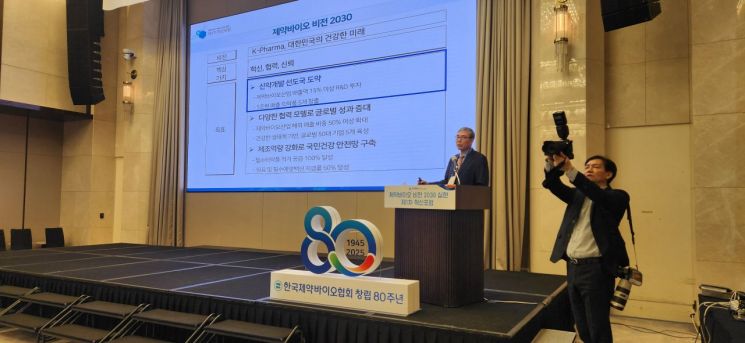 Lee Gwansoon, Chair of the Future Vision Committee of the Pharmaceutical and Bio Association, is delivering the keynote speech at the '1st Innovation Forum' held on the 21st at Chosun Palace in Gangnam-gu, Seoul. Photo by Jeong Donghoon
A proposal has been made that a state-led project is necessary to develop global blockbuster new drugs (new drugs with annual sales exceeding 1 trillion KRW).
On the 21st, the Korea Pharmaceutical and Bio-Pharma Manufacturers Association held the '1st Innovation Forum' under the theme 'How to Achieve the Leap to a Leading Country in New Drug Development?' at Chosun Palace in Gangnam-gu, Seoul. The association launched the Innovation Forum this year with the purpose of deriving strategies and execution tasks necessary to achieve the 'Pharmaceutical Bio Vision 2030 ('K-Pharma, Korea's Healthy Future').' The Innovation Forum is scheduled to be held sequentially in three sessions focusing on ▲leap to a leading country in new drug development ▲increase in global achievements ▲strengthening manufacturing capabilities.
In the keynote speech, Lee Gwan-soon, chairman of the Future Vision Committee of the Pharmaceutical Bio Association, emphasized, "To establish a new drug development ecosystem, a permanent organization centered on the National Bio Committee must be established to set and execute the new drug development agenda." He added, "Through this, blockbuster-level new drug development projects should be secured and turned into projects that can deploy all national resources."
Chairman Lee diagnosed that Korea is stagnant in terms of global pharmaceutical market share. According to IQVIA, a market research specialist, Korea's pharmaceutical bio industry's global sales ranking was 13th (market share 2.9%) in 2016, remained 13th (3.1%) in 2021, and is expected to maintain 13th place (estimated 3.3%) in 2026. Regarding the current status of domestic new drug development R&D, he pointed out, "The quantitative gap in new modality (treatment method) pipelines has narrowed, but investment amounts are still low." He noted, "As of 2023, the top domestic investor invested 412.4 billion KRW, whereas the top overseas R&D investor invested about 17 trillion KRW, and the investment ratio relative to sales is 11.2% domestically and 18.2% overseas."
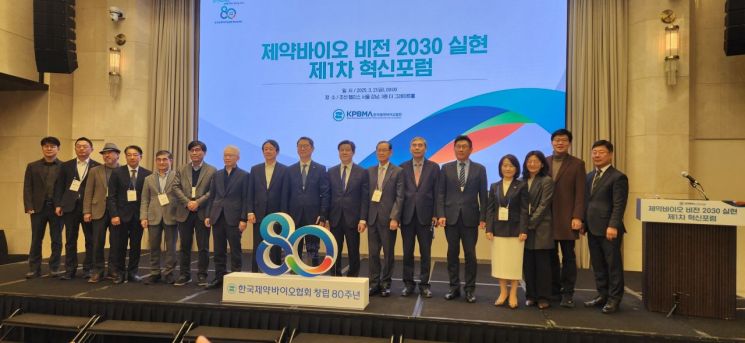 On the 21st, attendees are taking a commemorative photo at the Pharmaceutical Bio Association's 'Innovation Forum' held at Chosun Palace in Gangnam-gu, Seoul. Photo by Jeong Dong-hoon
He also pointed out a serious mismatch between supply and demand for specialized personnel in the pharmaceutical bio sector. From 2023 to 2027, due to the development of convergence technologies, there will be a new demand for 110,000 personnel in the bio-health field, but only 35,000 personnel are expected to enter the bio-health industry, indicating a severe shortage of manpower.
Chairman Lee viewed the urgent need for structural reform in the pharmaceutical bio industry. He said, "To strengthen the new drug sector, the industry structure must shift from a generic (synthetic drug copy) focused pharmaceutical industry to one that strengthens the new drug sector." He added, "Benchmarking recent cases of structural reform in China's pharmaceutical bio industry is necessary." Since 2011, China has selected the pharmaceutical bio industry as a core industry group in its economic development plans. It has drastically reduced corporate tax for pharmaceutical bio companies by 40% and shortened the IND (Investigational New Drug) review period from over a year to 60 days, significantly shortening drug review times. China's pharmaceutical bio industry has shown remarkable growth with an average annual growth rate of 9.5% and ranks second globally in new drug development pipelines.
The forum began with an opening address by Association Chairman Noh Yeon-hong, followed by the keynote speech by Lee Gwan-soon, chairman of the Future Vision Committee, and a presentation by Pyo Jun-hee, deputy director of the Association's AI New Drug Convergence Research Institute, titled 'Change the Game of New Drug Development with AI: The Core of Strengthening Competitiveness.'
Additionally, Lee Byung-geon, chairman of GI Innovation, served as the moderator for a panel discussion featuring Kim Seok-kwan, senior researcher at the Science and Technology Policy Institute (collaborative ecosystem), Kim Young-joo, president of Chong Kun Dang (recognition of innovation value), Lee Young-mi, vice president of Yuhan Corporation (technological innovation), and Jung Eun-young, director of the Health Industry Policy Bureau at the Ministry of Health and Welfare (government role).
Noh Yeon-hong, chairman of the Korea Pharmaceutical and Bio-Pharma Manufacturers Association, stated, "This forum marks the first step toward realizing Pharmaceutical Bio Vision 2030," and added, "In the rapidly changing global environment, our country will leap to become a leading nation in new drug development and seek ways for continuous growth and development of the pharmaceutical bio industry."
© The Asia Business Daily(www.asiae.co.kr). All rights reserved.
![Clutching a Stolen Dior Bag, Saying "I Hate Being Poor but Real"... The Grotesque Con of a "Human Knockoff" [Slate]](https://cwcontent.asiae.co.kr/asiaresize/183/2026021902243444107_1771435474.jpg)
















