On March 13, an on-site inspection was conducted at Shin Young Securities, the securities firm that acquired CP, as well as at Korea Credit Rating and Korea Investors Service, to verify suspicions and facts related to Homeplus's filing for rehabilitation. The key issues in the Financial Supervisory Service's investigation are whether MBK and the securities firms were aware in advance that the credit rating would be downgraded when selling promissory notes and bonds, and whether they had planned the rehabilitation filing in advance. On February 28, Korea Credit Rating downgraded Homeplus's commercial paper and short-term bond credit ratings from A3 to A3-. The credit rating agencies first notified the planned credit rating downgrade on February 25, and Homeplus requested a reconsideration the following day, February 26. On the same day they were notified of the planned downgrade, February 25, Homeplus issued ABSTB. As Homeplus underwent corporate rehabilitation procedures, the ABSTB, whose principal and interest payments were suspended, amounts to about 400 billion KRW. Homeplus stated that “the ABSTB issuance was approved and contracted on the 24th, so there is no problem,” but Shin Young Securities, which sold the ABSTB, threatened criminal charges, claiming that Homeplus offloaded bad debts.
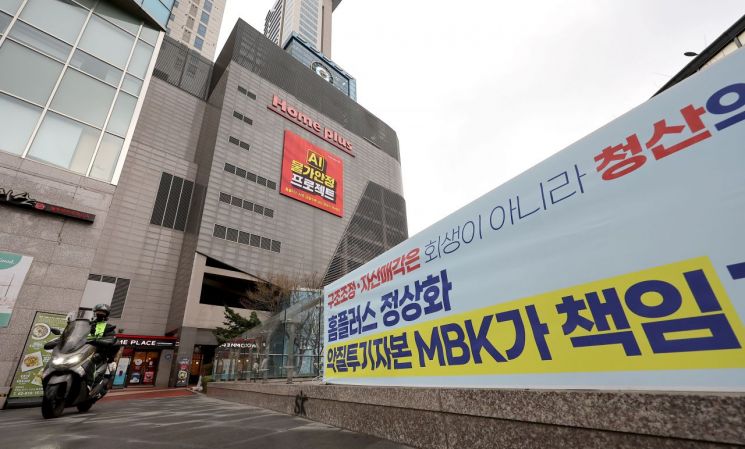
There is also a possibility that the Financial Supervisory Service's investigation will expand into a special audit covering the time of Homeplus's acquisition in 2015. At that time, MBK acquired Homeplus under the name MBK Partners No. 3 Private Equity Fund.
National Tax Service Initiates Special Tax Audit
MBK is also under the National Tax Service's tax audit radar. The Seoul Regional Tax Office Investigation Division 4 has launched a special tax audit on MBK. Investigation Division 4 of the Seoul Regional Tax Office is known as the “reaper of the business world.” Many leading domestic companies have not escaped the scrutiny of Division 4, and MBK has now been caught in its net. The National Tax Service is reportedly investigating various transactions conducted by MBK, including mergers and acquisitions and sales, and is examining the overall flow of funds.
Authorities such as the National Tax Service and the Financial Supervisory Service reportedly maintained restraint in their investigations of MBK until the management dispute with Korea Zinc was resolved. However, as the Homeplus incident is expected to cause damage to small business owners and individual investors, the mood has shifted to “not being able to leave it as is.” A lawyer from a major law firm said, “The investigative agencies were planning to address everything at once after the management dispute was settled, but the Homeplus incident made that impossible,” adding, “There are ongoing criticisms that national wealth is effectively being drained by foreign private equity funds, so the scope of investigations is likely to widen.”
Kim Byung-joo’s History of 42 Billion KRW Tax Recovery for Offshore Tax Evasion
MBK Chairman Kim Byung-joo has a history of being subject to a tax audit for offshore tax evasion on income amounting to about 100 billion KRW and having 42 billion KRW recovered. On December 8, 2020, the civic group Financial Monitoring Center accused MBK of earning profits in the 2 trillion KRW range through the sale of Orange Life (formerly ING Life) but claimed that Chairman Kim did not pay any personal income tax, filing a complaint with the Seoul Central District Prosecutors' Office. The suspicion was that Chairman Kim, as a U.S. citizen, did not properly pay taxes on profits made from acquiring and selling companies. The National Tax Service conducted a two-year tax audit on MBK in 2020. It is known that the audit concluded with a recovery of 42 billion KRW excluding taxes paid by Chairman Kim in the U.S.
“MBK Not Clearly Visible as a Party in Lawsuits”
Despite numerous legal disputes, a notable point is that MBK is not a party in lawsuits or application cases. The management dispute with Korea Zinc also stems from shares held by Young Poong, so MBK is not included as a party in the case, which proceeds only under Young Poong's name. According to Legal News's investigation, there is not a single case registered with the Supreme Court where MBK appears as a party. A lawyer from a major law firm said, “MBK mainly focuses on acquisitions and sales, so it rarely goes to litigation,” adding, “There probably were no such legal disputes before the Korea Zinc management dispute.” Another lawyer said, “MBK seems to use funds created when entering or exiting investments and forms alliances with other investors, employing a strategy of hiding itself as a party and putting others forward.”
By Hyunkyung Lim and Suhyun Han, Legal News Reporters
※This article is based on content supplied by Law Times.
© The Asia Business Daily(www.asiae.co.kr). All rights reserved.
![Clutching a Stolen Dior Bag, Saying "I Hate Being Poor but Real"... The Grotesque Con of a "Human Knockoff" [Slate]](https://cwcontent.asiae.co.kr/asiaresize/183/2026021902243444107_1771435474.jpg)















