Sleep tech company A-Sleep (CEO Dongheon Lee) has published the "2025 Korea Sleep Report," which captures the state of sleep in South Korea. This report was prepared based on vast sleep data collected using A-Sleep's AI sleep measurement technology over one year, from January 1, 2024, to December 31, 2024, covering 246,934 individuals (a cumulative total of 2,988,519 days and 16,078,711 hours).
A-Sleep releases this report annually on "World Sleep Day," which falls on the second Friday of March, aiming to analyze the characteristics and issues of South Koreans' sleep patterns and contribute to sleep improvement.
According to the A-Sleep Sleep Report, the average sleep duration of Koreans was found to be 5 hours and 59 minutes per day. This is more than one hour shorter than the recommended sleep duration (7 to 9 hours) by the Korean Sleep Society.
Although people spend about 7 hours on average in bed, they actually sleep less than 6 hours. Sleep efficiency (the ratio of time asleep to time spent lying down) was also 85% on average, falling short of the ideal 90%. Fortunately, the time taken to fall asleep (average 18 minutes) was within the normal range (under 20 minutes).
Looking at sleep stages, the proportions were 9.22% awake time, 20.43% REM sleep (Rapid Eye Movement sleep: a sleep stage with active brain activity, mainly when dreaming occurs), 54.99% light sleep, and 15.34% deep sleep, all generally within normal ranges. This suggests that while many Koreans have a normal sleep structure, they suffer from chronic sleep deprivation due to insufficient absolute sleep time.
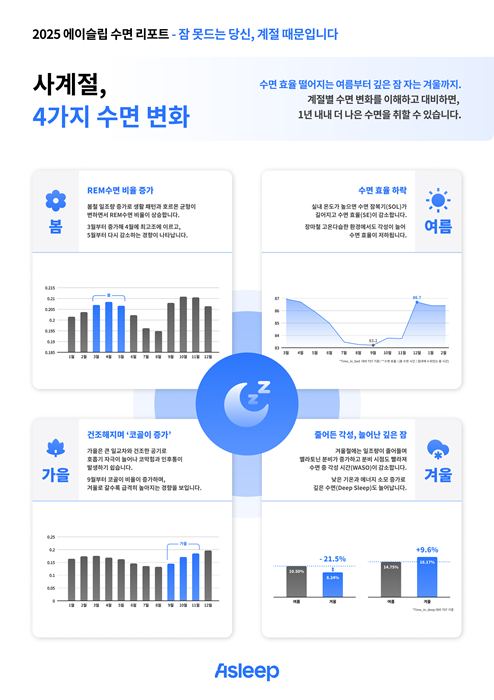
Seasonal changes in sleep are also interesting. According to A-Sleep's analysis, REM sleep proportion surges in spring, while sleep efficiency decreases in summer. From autumn onwards, sleep environments improve, and deep sleep tends to increase in winter.
In spring, daily fluctuations in temperature and sunlight cause abrupt changes in lifestyle patterns. This alters the levels of hormones and neurotransmitters such as serotonin, melatonin, and cortisol, which affect REM sleep.
During the hot summer, sleep quality noticeably deteriorates. When temperatures peak (average 33℃) in August, tropical nights where the heat does not subside and the humid environment during the monsoon season make it difficult to fall asleep, lengthening sleep latency (time to fall asleep) and increasing frequent awakenings (WASO) during the night.
In early autumn, as the heat subsides, sleep environments improve significantly. Especially in October and November, stress caused by tropical nights disappears, and sleep efficiency begins to rise. However, caution is needed during the autumn transition period as temperature differences between day and night widen and the air becomes rapidly dry. Respiratory irritation can increase snoring accordingly.
An increasing trend in snoring was observed starting in October. The snoring rate rose sharply to 17.25% in October from 14.55% in September. Since snoring is closely related to sleep apnea, respiratory care and apnea screening are particularly important.
In winter, the proportion of deep sleep increased by 9.6%. The process of body temperature dropping when falling asleep induces "deep sleep." The time awake during the night (sleep interruptions) was 32 minutes and 28 seconds, a 21.6% decrease compared to summer. With an increase in deep sleep stages, the number of awakenings decreased, improving sleep efficiency and overall rest and recovery effects.
Sleep has a profound impact on both physical and mental health. Chronic sleep deprivation increases the risk of various diseases such as hypertension, diabetes, obesity, and dementia beyond simple fatigue, and can negatively affect mental health conditions like depression and anxiety.
Based on insights gained from analyzing vast sleep data, A-Sleep provides personalized sleep improvement solutions optimized for each user. A-Sleep's AI sleep measurement technology automatically measures sleep status through a phone or microphone without special sensors or wearable devices. Unlike subjective feelings about sleep or one-time tests, it allows accurate daily monitoring of sleep status. A-Sleep's proprietary solutions include the sleep management app "Sleep Routine," the sleep apnea screening and prescription medical device "AppNoTrack," and are also integrated into various products such as SK Telecom's AI voice assistant "A.Dot," Samsung Life's health management app "The Health," Kyungdong Navien's "Deep Sleep Mat," as well as smart beds and tablets.
CEO Dongheon Lee of A-Sleep stated, "Our goal is for everyone to easily and accurately check their sleep data and find ways to improve it themselves." He added, "We published this report to raise awareness of how sleep changes with the seasons, and we will continue to strive to help more people recognize the importance of sleep and develop healthy sleep habits through diverse sleep insights and issues every year."
The "2025 Korea Sleep Report" is structured with various infographics to make it easy for anyone to understand. The full content is available on A-Sleep's official website.
© The Asia Business Daily(www.asiae.co.kr). All rights reserved.
![Clutching a Stolen Dior Bag, Saying "I Hate Being Poor but Real"... The Grotesque Con of a "Human Knockoff" [Slate]](https://cwcontent.asiae.co.kr/asiaresize/183/2026021902243444107_1771435474.jpg)

















