Seoul Apartment Sale Price Index Rises from 0.14% to 0.20%
Songpa (0.72%), Gangnam (0.69%), Seocho (0.62%)
Mayongseong Also Sees Greater Increase Than Previous Week
Gyeonggi-do Turns Stable, Gwacheon Up 0.71%
The apartment price increase in the three Gangnam districts of Seoul recorded the largest rise since 2018. Seoul apartment prices have also been rising for six consecutive weeks, with the rate of increase growing.
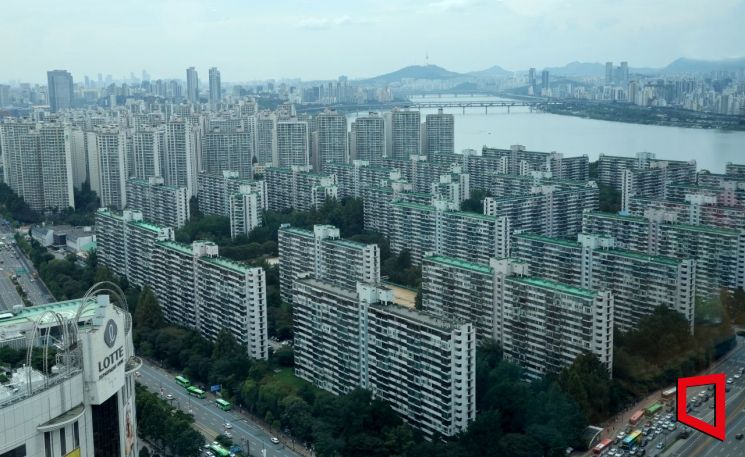
According to the "Weekly Apartment Price Trend Nationwide for the Second Week of March (as of the 10th)" released by the Korea Real Estate Board on the 13th, apartment sale prices in Seoul rose by 0.20% compared to the previous week. This is a larger increase than last week's 0.14%. Seoul apartment prices were △0.02% in the first and second weeks of February △0.06% in the third week of February △0.11% in the fourth week of February △0.14% in the first week of March.
After the lifting of the land transaction permission zone, the sale prices in the three Gangnam districts surged, driving the overall price increase in Seoul. In particular, Songpa-gu saw a sharp rise in prices mainly in Sincheon-dong and Jamsil-dong, increasing by 0.72% compared to the previous week. This is the largest rate of change in 7 years and 1 month since the first week of February 2018 (0.76% increase).
Gangnam-gu rose by 0.69% compared to the previous week, with prices increasing mainly in major complexes in Apgujeong and Yeoksam-dong. This is the highest increase since the fourth week of January 2018 (0.93%). Seocho-gu recorded a 0.62% increase, mainly due to significant price rises in redevelopment complexes in Banpo and Jamwon-dong, marking the largest increase since the fifth week of January 2018 (0.69%). The sale price index change rate for the southeastern region, including the three Gangnam districts and Gangdong-gu (0.15%), was 0.58%, the highest since the first week of September 2018 (0.66%).
Not only in the Gangnam area but also in Mayongseong (Mapo, Yongsan, and Seongdong-gu), the sale price index increase rate grew compared to the previous week. Seongdong-gu (0.29%) expanded its increase from 0.08% in the first week of March, Yongsan-gu rose from 0.10% to 0.23%, and Mapo-gu increased from 0.11% to 0.21%. Nodogang (Nowon, Dobong, and Gangbuk-gu), which had declined last week, either stabilized (0.00%) or turned to an increase. Gwangjin-gu expanded its increase from 0.11% to 0.12%, and Seodaemun-gu from 0.04% to 0.07% compared to the previous week.
The Real Estate Board stated, "While buying hesitation continues in less preferred complexes such as non-subway areas and older buildings, demand is concentrated mainly in preferred complexes such as redevelopment areas, and rising contracts are being signed, sustaining the overall rise in Seoul."
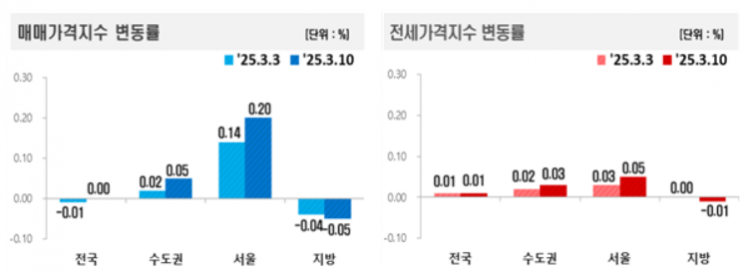 Real Estate Transaction Price Index and Jeonse Price Index Change Rates Nationwide for the Second Week of March. Provided by Korea Real Estate Board.
Gyeonggi-do recorded a decline last week (-0.04%) but switched to stable (0.00%) in the first week of March. In particular, Gwacheon rose by 0.71%, recording the highest increase rate in Gyeonggi-do, with the increase rate expanding from 0.51% the previous week. Suji-gu in Yongin also rose by 0.17%. Gwangmyeong-si (-0.14%) declined mainly in Cheolsan and Gwangmyeong-dong due to increased supply.
Incheon continued its decline, falling by 0.05% compared to the previous week. Yeonsu-gu, where Songdo is located, saw a large drop (-0.12%). The five major metropolitan cities (-0.07%) and eight provinces (-0.03%) all declined. Nationwide apartment sale prices turned stable from last week's (-0.01%), while the provinces (-0.05%) deepened their decline, showing a temperature difference with Seoul. Sejong (-0.14%), Daegu (-0.10%), and Busan (-0.08%) had large declines.
The nationwide weekly apartment jeonse (lease) price in the second week of March rose by 0.01%, maintaining the previous week's increase. Seoul rose by 0.05%, up 0.02 percentage points from the previous week, and Gyeonggi (0.02%) and Incheon (0.01%) also increased. The jeonse price change rate in the metropolitan area was 0.03%. In Seoul, Songpa-gu (0.13%), Yeongdeungpo-gu (0.11%), and Gangdong-gu (0.11%) had large increases, while Dongdaemun-gu (-0.06%) and Seongbuk-gu (-0.02%) declined.
The Real Estate Board explained, "In Seoul, rental inquiries are steady and rising contracts are being signed in preferred complexes with good residential conditions such as subway station areas and school districts, sustaining the overall rise in Seoul."
The five major metropolitan cities and eight provinces remained stable, while Sejong fell by 0.09%. Ulsan (0.07%), Gangwon (0.07%), Chungbuk (0.07%), and Busan (0.03%) rose.
© The Asia Business Daily(www.asiae.co.kr). All rights reserved.
![Clutching a Stolen Dior Bag, Saying "I Hate Being Poor but Real"... The Grotesque Con of a "Human Knockoff" [Slate]](https://cwcontent.asiae.co.kr/asiaresize/183/2026021902243444107_1771435474.jpg)
















