Production Value Up 15.1% Year-on-Year, Totaling 2.1106 Trillion Won
Busan City to Support Resource Enhancement, Habitat Restoration, and Aquaculture Infrastructure
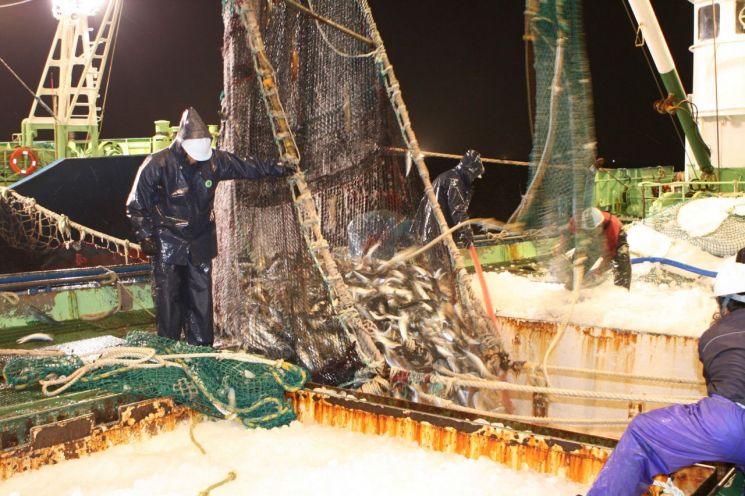
The sea where 'Busan' casts its nets is abundant. While coastal fisheries have declined, offshore fisheries and marine aquaculture have increased, resulting in a rise in both total fishery production and value.
The Busan Metropolitan Government (Mayor Park Hyungjoon) announced on the 13th that last year, the total fishery production in Busan reached 728,000 tons, a 5.6% increase from the previous year, and the production value rose by 15.1% to 2.1106 trillion won.
According to Busan city, offshore fisheries recorded 479,398 tons and marine aquaculture production reached 43,397 tons, increasing by 16.7% and 12.9% respectively compared to the previous year. Coastal fisheries produced 204,564 tons and inland fisheries 1,451 tons, which were decreases of 14.4% and 39.3% respectively from the previous year.
Offshore fishery production was 479,000 tons, up 16.7% from the previous year's 411,000 tons and 9.2% higher than the recent five-year average of 439,000 tons.
For skipjack tuna, a representative offshore fish species, production increased by 23.5% year-on-year due to the expansion of fishing grounds in the Pacific Ocean and an increase in the number of fishing operations. On the other hand, due to the concentration of fishing efforts on skipjack tuna by shipping companies, production of yellowfin tuna and bigeye tuna decreased by 6.6% and 11.3% respectively compared to the previous year.
Among seaweed aquaculture (99.6% as of 2024), Gim production increased by 0.3% from the previous year, while miyeok and dashima increased by 17.7% and 35.8% respectively due to favorable growing conditions.
This year's aquaculture production is expected to be similar to last year's. For seaweed aquaculture such as Gim and miyeok, stable sea conditions are expected to keep yields at last year's level. However, uncertainties such as high water temperatures due to climate change and price fluctuations remain as potential risk factors.
Busan city plans to continue supporting infrastructure such as aquaculture equipment and activation agents to stabilize aquaculture production, and to strengthen competitiveness in the aquaculture industry by developing local aquaculture species suitable for high water temperatures and researching smart aquaculture technologies to better respond to changes in the aquaculture environment.
The decline in coastal fishery production is attributed to changes in resources due to worsening weather and high water temperatures, poor fishing conditions, and reluctance to go fishing due to continued high oil prices.
As the impact of high water temperatures expands, production of coastal fish species such as mackerel (93,542 tons), horse mackerel (21,635 tons), and anchovy (14,762 tons) has decreased. In contrast, production of Spanish mackerel (13,064 tons) and sardine (5,934 tons) increased by 9.3% and 213.5% respectively year-on-year.
Inland fisheries saw a 39.3% decrease in production to 1,451 tons in 2024, compared to 2,390 tons the previous year, and an 18.4% decrease compared to the recent five-year average of 1,777 tons, due to both lower production and falling unit prices.
Production by major inland species was: apple snail 1,092 tons, crucian carp 87 tons, carp 66 tons, bluegill 61 tons, and snakehead 53 tons. Most species saw a decrease in production compared to the previous year, but apple snail, which is produced through inland aquaculture, dropped by 43.4% due to decreased demand, while snakehead increased by 8.2%.
Shim Sungtae, Director of Busan's Maritime, Agriculture and Fisheries Bureau, said, "Last year, offshore and marine aquaculture production increased, but coastal and inland fishery production decreased due to climate change such as high water temperatures and resource fluctuations," adding, "To ensure a stable supply of seafood, we will strengthen the foundation for resource enhancement and habitat restoration and actively support infrastructure for stable aquaculture production."
© The Asia Business Daily(www.asiae.co.kr). All rights reserved.
![Clutching a Stolen Dior Bag, Saying "I Hate Being Poor but Real"... The Grotesque Con of a "Human Knockoff" [Slate]](https://cwcontent.asiae.co.kr/asiaresize/183/2026021902243444107_1771435474.jpg)















