Baedal Minjok to Apply 6.8% Takeout Fee from Next Month
300 Billion KRW Investment to Boost Takeout Orders
Attention on Whether Coupang Eats Will Maintain Free Takeout Fees After This Month
Baedal Minjok has announced that it will start charging normal fees for takeout orders from next month to promote takeout order activation, signaling that competition among delivery platforms is expected to expand to takeout orders as well. Coupang Eats will maintain its free takeout fee policy until the end of this month, but its future operation plans have not been finalized. Industry insiders believe that since the leading company has decided to grow 'takeout' through large-scale investments, a response may be necessary. Yogiyo is also actively promoting takeout orders, so a 'takeout battle' comparable to delivery is expected to unfold in the future.

According to Woowa Brothers on the 13th, Baemin will apply a 6.8% brokerage fee for takeout orders to partner stores starting from the 14th of next month. Takeout orders are a service where customers place orders through the app just like delivery, but customers pick up the food directly from the store. The advantage for customers and restaurants is that there is no delivery fee, but from the platform's perspective, operational and development costs have continuously occurred just like delivery brokerage. Baemin explained that although it has maintained a free policy until now, growth has been slow because an investment structure for activation was not established.
Last July, Baemin announced its plan to charge takeout fees, deciding not to charge existing partners until March this year and offering a 50% discount to new partners. With these benefits ending, normal fees will be charged one month later. Baemin's 6.8% takeout fee is lower than Yogiyo's 7.7%, which already charges fees for takeout. However, the fact that Coupang Eats, rapidly catching up as the second-largest player in the market, currently offers free takeout fees is a burden. Coupang Eats maintains a free takeout order fee policy until the 31st of this month as part of the Fair Trade Commission's voluntary regulation. However, since the voluntary regulation is currently under negotiation, it is uncertain whether this will continue.
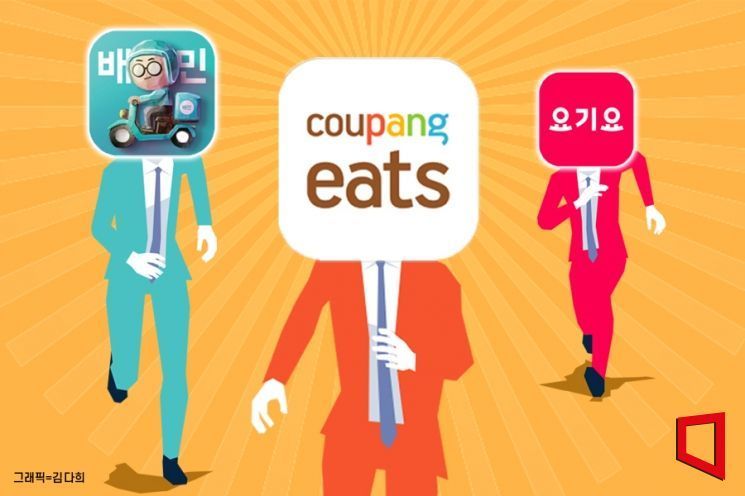
Baemin's strategy is to activate takeout, which is known to account for less than 10% of total orders, to attract new users who do not overlap with delivery users, thereby seeking new growth. This is why it is investing 30 billion KRW in marketing promotions and revamping its application to make takeout orders easier. Overseas, DoorDash, the number one delivery app in the U.S., reported last year that takeout orders from the same store increased by 9% compared to the previous year, and 59% of users used the store for the first time through takeout. DoorDash charges a 6% takeout fee. Uber Eats also explained that from the restaurant's perspective, takeout offers an opportunity to acquire new customers at a lower cost than delivery.
As of last month, with more than 22 million users actively promoting takeout orders, Baemin's competitors are expected to respond strategically. Baemin plans to offer various discount benefits to encourage customers to pick up food directly from nearby restaurants. If this happens, takeout orders will concentrate on Baemin, and from the store owners' perspective, even if they pay fees, an increase in orders without delivery fees can ultimately improve profitability. An industry insider said, "Although partner stores may initially voice opposition to fee charges, it can be proven in the long term that profit margin improvement and consumer benefits are greater," adding, "If fees remain free, other apps will also consider that securing takeout customers through reinvestment is difficult."
© The Asia Business Daily(www.asiae.co.kr). All rights reserved.
![Clutching a Stolen Dior Bag, Saying "I Hate Being Poor but Real"... The Grotesque Con of a "Human Knockoff" [Slate]](https://cwcontent.asiae.co.kr/asiaresize/183/2026021902243444107_1771435474.jpg)
















