Promotion of 'Gwangju-Style Public Healthcare Policy Transformation'
Citizen Briefing... Announcement of 'Citizen-Centered Public Healthcare'
Shift in Perception from 'Institution to Function and Role' through Public-Private Cooperation
A New Chapter in Essential, Critical, and Emergency Care with 'Integrated Care + Medical Services'
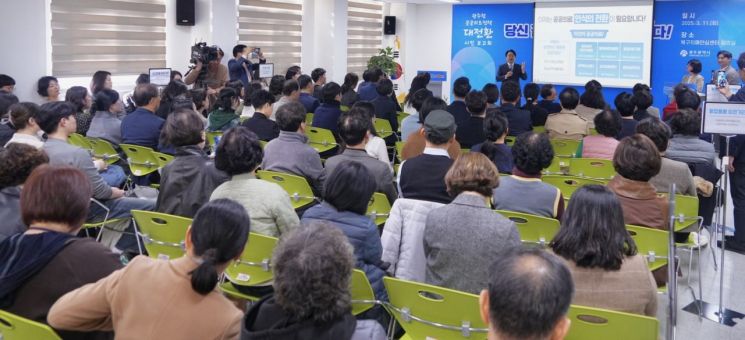 Kang Kijeong, mayor of Gwangju, is presenting medical policies at the 'Gwangju-type Public Healthcare Policy Paradigm Shift Citizens' Report Meeting' held at Buk-gu Dementia Safety Center on the afternoon of the 11th. Provided by Gwangju City
Gwangju City is promoting a major transformation in public healthcare to ensure that all citizens can live healthy lives where they reside and receive timely treatment. By integrating medical care into the Gwangju-daum Integrated Care model and reorganizing existing medical resources, the city aims to strengthen essential, critical, and emergency medical services based on function and role, opening a new chapter in 'citizen-centered Gwangju-style public healthcare.'
On the afternoon of the 11th, Gwangju Mayor Kang Gi-jung announced this 'citizen-centered public healthcare policy' at the 'Gwangju-style Public Healthcare Policy Transformation Citizen Briefing - Health Comes to You' held at the Buk-gu Dementia Relief Center in Gwangju.
Mayor Kang emphasized, "Now, public healthcare needs to shift from an institution-centered approach to a function- and role-centered one. It is important to determine how to incorporate public value into healthcare through public-private cooperation, as seen with the Public Nighttime Children's Hospital. We must closely fill the gaps in areas such as pediatrics, childbirth, and other essential, critical, and emergency medical services where infrastructure is lacking due to social issues."
The main points of the 'Gwangju-style Public Healthcare Policy Transformation' include: ▲expanding 'medical care' in integrated care, ▲operating 'Integrated Health Centers' by reorganizing public health centers, ▲expanding essential and critical infrastructure, ▲establishing a one-stop emergency medical platform, and ▲promoting the establishment of a Gwangju Medical Center focused on emergency and cardiovascular care.
The city will expand 'medical services' within the 'Gwangju-daum Integrated Care,' which first introduced 'universal care' in Korea to enable healthy aging in one's own home. Starting this year, the city will implement a 'three-piece set of medical care services.' This includes newly established ▲home-visit nursing and ▲home-visit oral health education services provided by nurses and dental hygienists, as well as expanded ▲customized home-visit exercise services by physical and occupational therapists.
To reflect diverse and complex medical needs, the city will completely reorganize public health center functions from a provider-centered to a citizen-centered approach. This year, the city will reorganize staff and purchase equipment in the first half, with plans to open three Integrated Health Centers per district in phases. These centers will gradually expand to all autonomous districts.
The city will also work to expand 'essential and critical infrastructure' so that everyone can receive timely treatment. As part of this, a Mental Recovery Support Center will be established to help heal trauma from social disasters such as the Jeju Air passenger plane accident, and a comprehensive disaster psychological support platform will be built. A new Regional Mental Health Emergency Medical Center will also be designated to respond to severe mental illness cases.
To ensure there are no delays in providing essential medical care during the golden hour, Chonnam National University Hospital and Gwangju Christian Hospital will be designated and operated as 'responsible medical institutions.' These institutions will provide high-quality essential care in areas such as emergency, trauma, cardiovascular, mental health, and infectious diseases, and establish cooperative networks for integrated care.
The city will also move away from a centrally led emergency medical system to establish a 'Gwangju-style emergency medical platform' tailored to local needs. By sharing detailed emergency room information and data in real-time via PC and mobile, the city will significantly improve patient transfer and referral systems so that all emergency rooms in the region function as one hospital.
The city is preparing to establish a Gwangju Medical Center focused on essential and critical care in the Gwangseo area (Gwangsan-gu and Seo-gu). Previously, the medical center focused on serving as a safety net for vulnerable groups and responding to infectious disease crises, but it will now expand its role to fill essential medical gaps that cannot be addressed by the private sector. The plan is to establish a Gwangju Medical Center that serves as a public healthcare control tower, focusing on essential services such as emergency cardiovascular care.
Mayor Kang stated, "Gwangju has already begun transforming public healthcare with initiatives such as the nation's first Public Nighttime Children's Hospital. Through Gwangju-style public healthcare, we will protect citizens' health by ensuring that anyone, anywhere, at any time of need, can access medical services more closely, reliably, and confidently."
© The Asia Business Daily(www.asiae.co.kr). All rights reserved.
![Clutching a Stolen Dior Bag, Saying "I Hate Being Poor but Real"... The Grotesque Con of a "Human Knockoff" [Slate]](https://cwcontent.asiae.co.kr/asiaresize/183/2026021902243444107_1771435474.jpg)















